
27 January 2023
The Opportunity of Forestry
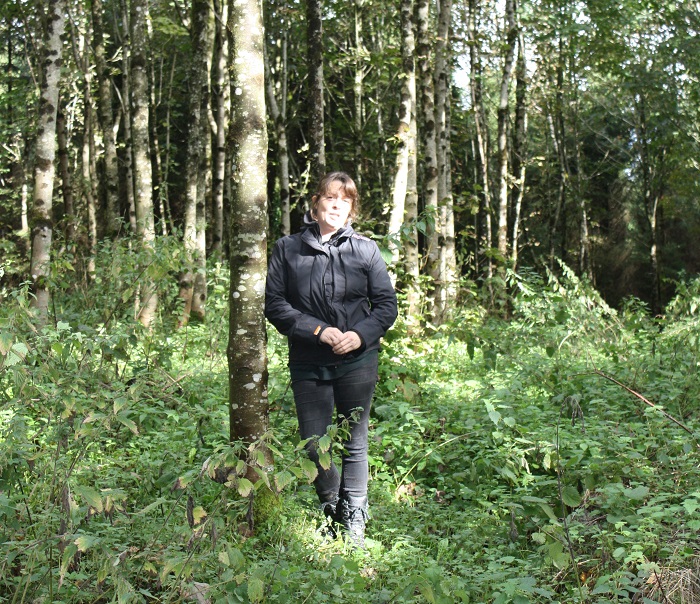
Dermot Leavy, his late wife Florian and their four daughters were previously dairy farmers located on the outskirts of Kinnegad, Co. Westmeath.
They also had an out farm, a few miles away, which was primarily for cattle fattening along with some tillage on the better ground. In the early 2000’s, Dermot and Florian started to review their farming enterprise, as their daughters focus was on completing their education and developing their careers, which took them way form the farm activities.
In 2001, Dermot and Florian planted 18.8 hectares of the more marginal land on the out farm and set the rest of that farm. The dominant species planted was Norway spruce on 12 hectares (ha). On the mineral soil, a mix of broadleaves was planted including four ha of sycamore, 1.5 ha of ash and 1.3 ha of a mix of broadleaf species including birch and beech. As well as providing a future timber supply, the site was planted to enhance the environment, the landscape and to create an attractive recreational amenity. The front of the planted area was adjacent to an archaeological site.
In 2005, the Leavy family availed of an opportunity to retire from farming and leased the home farm as well. This allowed Dermot more time to manage his crop and spent a lot of time shaping his broadleaf trees, which has certainly benefited the crops overall quality. Sadly in 2014, Florian became ill and passed away.
Olive
Olive, one of the four daughters, who had completed a PhD in immunology in Trinity College, and subsequently worked as a scientific editor with Springer Nature in London for 11 years. In November 2016, Olive decided to return home to help her dad. Her initial plan was start a local business outside the farm. Her plans changed when in early 2017, Dermot brought Olive to see the forest; this was the first time she had ever set foot in it since its establishment. Even though the forest was somewhat overgrown and access was poor due to the archaeological area on the front of the site, Olive was mesmerised with its beauty and potential. Both Olive and her Dad started to open up the site and improve the accessibility of the forest.
Olive wanted to know more about forestry in order to manage the developing trees and attended some Teagasc events. Olive got to know the Westmeath Farm Forestry Group, a representative group of forest owners that formed in 2010 with the help of Teagasc. She became an active member as she felt she was meeting like-minded growers and benefiting from each event and or meeting that she attended. In 2017, Olive completed a 5-day chainsaw course along with five other Westmeath Group members. She received a 5-year felling licence in 2017. With the confidence of completing the chainsaw course, this allowed her to commence felling trees within the forest, initially to help with access.
One of the challenges associated with the forest was external access; – its location was 500m away from the public road with accessible only through an agricultural field, which was currently set. A forest road was applied for in 2017 and approved in 2019. The Forest Road grant allowed 470m but Olive applied for an extra 130 metres to allow some internal access into the forest, which she made her own provision. She was fortunate to have some suitable gravel material in the field adjoining the site, which greatly facilitated some of the road building. She took an active role in coordinating the road building process, and learned a lot from the experience.
Continuous Forest Cover
Olive also got interested in Continuous Cover Forestry (CCF) from both the members of the Westmeath Forestry group and attending Pro-Silva events. She decided to thin the forest under CCF principles, for four main reasons
- Financial – CCF can provide regular income rather than one big cash injection
- Environment – CCF facilitates retention and enhancement of diversity
- Legacy – CCF provides an close to nature forest and an attractive legacy
- Resilience – CCF management can facilitate more diverse forests in terms of both species and structure and therefore provide greater resilience
Olive applied for the DAFM Woodland Improvement Scheme – Continuous Cover Forestry element and received approval in 2020. She took an active interest in both the marking of the trees for removal and monitoring the harvesting as it took place on site. All felling was carried out by a harvesting machine which operated by CCF trained driver.
The conifer thinning produced mainly pulp and some pallet wood material. The thinning of the Norway spruce provided an average return of €650 / hectare.
Firewood Business
When Olive got her chainsaw licence qualification, she started to sell as felled timber as firewood, and realised that there was a local market. The harvester also felled the broadleaves during the thinning operation. She sold a third of it to the harvesting contractor, but she retained the rest as fuelwood for her firewood business. She has built up a significant customer base that takes about 100 cubic metres a year. This is as much as Olive can physically prepare and supply. She ensures a good quality, dry firewood product of less than 22 percent moisture – confirming her stated desire to be “quite picky” which helps retain her valuable customer base.
Ash Dieback
The ash unfortunately developed Ash Dieback Disease like many crops in the country at this stage. During the first thinning, Olive hoped to have about 100 hurley butts, but this was reduced to 32 due to Ash Dieback and associated stain which was found on the rest of the stems. She has applied for the Reconstitution and Underplant scheme and is awaiting approval. The ash once removed will supply her firewood business for a season or two. Olive intends to replace the ash with a Native Woodland mix, namely oak, birch and a number of other compatible native species. As the ash was mainly at the entrance to the site, she wants her new woodland to look well after planting. Olive also intend to maintain the young crop herself as the overall ash plot is small and will encourage natural regeneration of suitable native species .
Forest Owners groups – local and national
In 2017, Olive joined the Westmeath Farm Forestry Committee. She picked up a lot of advice and found the group to be a great sounding board. She cannot overstate the value of the Westmeath Group and its members for getting her involved in forestry. She became national secretary of the Irish Forest Owners (IFO) – an umbrella group set up in late 2020 to support most of the existing Forest Owners groups –and their national co-ordinator since last June. She has also taken on a part time administrator role with Pro Silva Ireland.
No Regrets
Olive has had no regrets about returning home. Forestry has given her a new lease of life. She feels all forest owners should recognise the importance of Forestry Producers Groups. She cannot overstate their importance of encouraging and inspiring forest owners of their central role they play in the forest industry. Olive has loved the interaction with the various foresters and contractors. She feels that is important that forest owners have ‘regular conversations’ with both their forester and contractor when on site, allowing time for it helps ensure a good job.
The Teagasc Forestry Department issues an article on a Forestry topic every Friday here on Teagasc Daily Subscribe to: Forestry e-News Keep up-to-date with the Teagasc Forestry Department or follow them on Social Media