
The practices leading to quality milk on the Ryan family farm
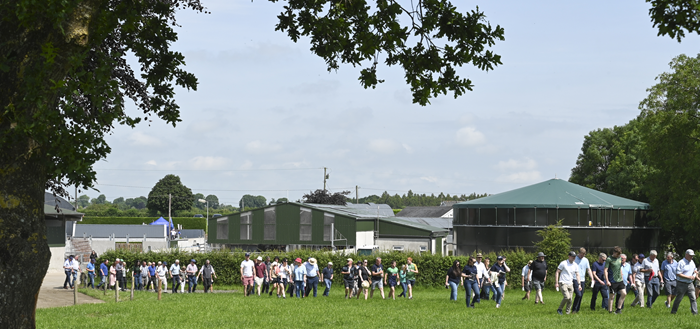
The NDC & Kerrygold Quality Milk Awards are an important acknowledgment of excellence in dairying. Earlier this week, an event jointly hosted by Centenary Thurles Cooperative, the National Dairy Council, Ornua and Teagasc, celebrated the success of the Ryan family, who farm in Moyne, Thurles, Co. Tipperary and were the 2025 National Winners of the NDC and Kerrygold Quality Milk Awards.
The Ryan’s have a tradition of high milk quality having previously won the Centenary Thurles Milk Quality award in 2017 and finishing as runners-up in the NDC competition in 2018. They consistently deliver by running a streamlined, efficient operation focusing on the doing the basics well every day.
Following their nomination for the 2025 NDC and Kerrygold Quality Milk Awards, the Ryan family excelled through a comprehensive judging process that evaluated a range of the most important aspects of modern dairy farming.
The Ryan family milk approximately 150 cows on a 56 hectare milking platform at Lisheen, near the village of Moyne, outside Thurles, Co. Tipperary, where they are the fourth and fifth generation of Ryans farming.
The overall farm area consists of 80.88ha in 3 blocks. The Ryans operate a spring calving system with a high emphasise on six-week calving rate to maximise the milk produced from grass. In 2025, the Ryans sold 548 kgs milk solids to Centenary Coop at 4.4% fat and 3.66% protein.
Milk quality on the Ryan Farm
Maintaining high standards is par for the course on the Ryan farm. Annual average SCC is almost always <100,000. The 5-year average for the farm is 88,000.
Management of milk quality is important for maximising milk price as high SCC has many impacts. High SCC leads to higher treatment costs, involuntary culling and milk loss associated with both milk being discarded during treatment and through its impact on the udder tissue which reduces milk output.
Milk quality management also reduces antibiotic usage during lactation. The high standards of animal health and welfare practiced on this farm are important for the sustainability of both the farm and the Irish dairy industry.
Table 1: Ryan Farm Milk Supply Profile 2022-2026 YTD
| Year | Litres supplied | Average cow numbers | Fat (%) | Protein (%) | Milk solids (kg/cow) | SCC | TBC | THD |
| 2022 | 922,636 | 139 | 4.34 | 3.7 | 550 | 102 | 10 | 147 |
| 2023 | 926,250 | 149 | 4.42 | 3.64 | 517 | 99 | 9 | 225 |
| 2024 | 936,883 | 149 | 4.42 | 3.66 | 523 | 71 | 9 | 249 |
| 2025 | 995,991 | 151 | 4.40 | 3.66 | 548 | 91 | 9 | 151 |
| 2026 (Jan-May) | 379,792 | 158 | 4.32 | 3.54 | 195 | 68 | 7 | 199 |
Table 1 above shows the consistency of performance of the Ryan herd.
Table 2 highlights the excellent milk quality standards on the farm throughout 2025.
Table 2: 2025 Milk Supply details for the Ryan Farm
| Month | Litres | Fat | Protein | SCC | TBC | THD |
| January | 0 | 0 | 0 | 0 | 0 | |
| February | 29,852 | 4.41 | 3.56 | 107 | 21 | 200 |
| March | 99,773 | 4.24 | 3.30 | 64 | 21 | 100 |
| April | 133,712 | 3.96 | 3.47 | 66 | 7 | 100 |
| May | 135,461 | 4.02 | 3.49 | 87 | 7 | 100 |
| June | 120,742 | 4.06 | 3.56 | 98 | 5 | 200 |
| July | 115,380 | 4.22 | 3.61 | 94 | 7 | 300 |
| August | 111,826 | 4.37 | 3.7 | 91 | 4 | 200 |
| September | 92,307 | 4.89 | 3.92 | 99 | 7 | 100 |
| October | 78,774 | 5.17 | 4.21 | 104 | 6 | 100 |
| November | 62,461 | 5.38 | 4.1 | 126 | 12 | 100 |
| December | 15,703 | 5.84 | 4.31 | 125 | 10 | 200 |
| Average | 82,999 | 4.40 | 3.66 | 91 | 9 | 151 |
Facilities
- 20-unit Pearson milking parlour built in 2018.
- Fitted with ACRs to prevent over milking and associated teat end damage.
- Automatic teat sprayer for pre and post spraying
Milking procedure
- Gloves worn by all milkers.
- Cows are pre-sprayed and dry wiped with paper towel.
- Strip 1/4s.
- Post-milking teat disinfection using automatic teat sprayer.
Machine maintenance and washing
- Autowash programme uses 280 litres of water for each rinse.
- Hot wash daily AM.
- Cold wash daily PM.
- Descale Wash every second day.
- Liners changed every 2000 milkings.
- Annual milking machine service ahead of calving.
Managing mastitis
- Stripping identifies the cow as well as the Smaxtec boluses.
- Treated based on veterinary recommendations.
- Leg bands to identify cows.
- Dip cluster following milking of mastitic cow or cows with high SCC identified.
Drying off
- Selective Dry Cow Therapy (SDCT) used on approximately 30% of the herd in recent years.
- Selection criteria for cows eligible for SDCT are cows milk recorded below 50,000 SCC, and no clinical case during the year and will CMT some cows also.
Other practices that contribute to milk quality on the farm
- Tails clipped 3-4 times per year or as necessary.
- Roadways maintained to ensure clean surfaces which reduces environmental contamination of udders and teats.
- Excellent cubicle hygiene. Cubicles are cleaned and limed twice daily during housing for 2 weeks post-drying off and 2 weeks pre-calving. The cubicles are limed once a day for remainder of dry period.
- Top quality transition diet.
- Heifers are trained to cubicles and parlour.
The above first appeared in the proceedings from the Milk Quality Farm Walk on the Ryan Family Farm and was adapted for use on Teagasc Daily.