
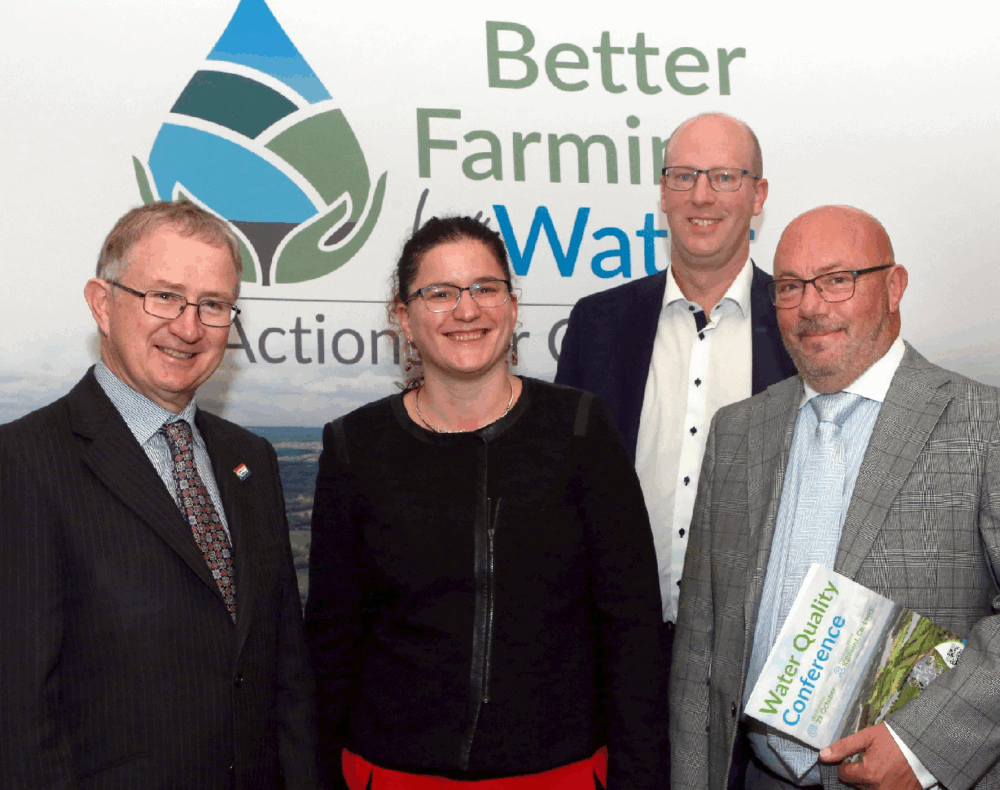
Ireland’s sixth Nitrates Action Programme is due to come into effect in January 2026. At the Teagasc Water Quality Conference held on October 29, Ted Massey, Head of Water Quality and Air Division at the Department of Agriculture, Food and the Marine provided an update on the programme that will run from 2026-2029.
Ireland’s Nitrates Action Programme (NAP) gives effect to the requirements of the Nitrates Directive. Its purpose is to promote best practice from an agricultural perspective and to achieve the Directive’s objectives which are to reduce and prevent pollution of waters from agricultural nutrients.
Farmers will be aware that a number of major changes were introduced as part of Ireland’s fifth NAP, the sixth NAP has proposed a smaller number of new impactful measures. These changes, as discussed by Ted Massey at the Water Quality Conference, consist of both proposed regulatory measures (table 1) and non-regulatory proposed measures (table 2).
Table 1: Proposed sixth NAP Regulatory Measures
| Proposed measure | Aim |
| Dairy farmers to declare their milking platform | To ensure improved nutrient distribution on fragmented intensive livestock farms |
| Increased slurry and soiled water storage capacity requirements on dairy farms arising from Teagasc research | To improve on-farm nutrient storage and management. |
| Adjusted chemical N & P silage production allowance for farms operating at or below 85 kg organic N/ha | To match N&P application with crop requirements and to reduce the risk of surplus nutrients remaining or declines in soil fertility. |
| Prohibit application of sewage sludge to arable land in the autumn in targeted areas except for land sown to high N uptake crops | To match the timing of nutrient application with crop demands and reduce the risk of nutrient loss. |
| Expansion of DAFM’s organic nutrient movement database to include all organic manures applied to agricultural land, regardless of source | To encourage best practice in terms of nutrient use and reduce the risk of over-application. |
| Continued and increased focus on compliance and enforcement through the National Agricultural Inspection Programme | Increased compliance enforcement and promotion leading to better on-farm practice and understanding. |
| For derogation farmers a farm-gate nutrient balance calculated using the DAFM supported Ag Nav tool, which is an online sustainability platform developed by Teagasc, ICBF and Bord Bia | To aid better decision making for on-farm nutrient management and enable farmers to identify and prevent excessive surplus nutrients being applied and/or retained within the farm. |
| Review and streamline the GAP Regulations | Ensure clarity of requirements. |
Non-regulatory measures, Ted Massey outlined, such as knowledge transfer, awareness raising efforts and incentivisation can also play a significant role in the protection of water quality from an agricultural perspective.
Table 2: Proposed sixth NAP non-regulatory measures
| Proposed measure | Aim |
| Expansion of the Agricultural Sustainability Support and Advisory Programme (ASSAP). | To enable targeted free on-farm advice to more farmers. |
| Continuation of the Farming for Water European Innovation Partnership (EIP) to the end of 2029. | To incentive farmers to adopt targeted measures, beyond regulatory requirements, specific to their own farm situation. |
| Knowledge transfer and awareness raising for both farmers and farm advisers through Teagasc’s Better Farming for Water campaign as well as mandatory and voluntary training programmes. |
To improve awareness regarding water quality issues and knowledge base amongst farmers and advisors so communications are aligned, and correct approaches are taken. |
| Research on Mehlich soil analysis to better quantify plant available nutrients. | To enhance the quantification of Irish soil and plant available nutrients which will allow for more appropriate nutrient application rates and reduce the risk of nutrient loss. |
| Research on cover crop establishment. | To optimise timing and establishment methods for cover crops to mitigate nitrogen loss, sediment and run-off from arable land. |
| Continuation of Teagasc’s Agricultural Catchment’s Programme post-2027 | To ensure ongoing improvements in best available science and understanding of factors impacting water quality from an agricultural perspective. |
At the conference, Ted Massey explained that the proposed NAP aims to achieve the optimum balance between regulation and nonregulatory measures to improve water quality. Finalisation of the Sixth NAP is subject to public consultation regarding the proposed NAP and the overall environmental assessments that will underpin the proposed programme.