
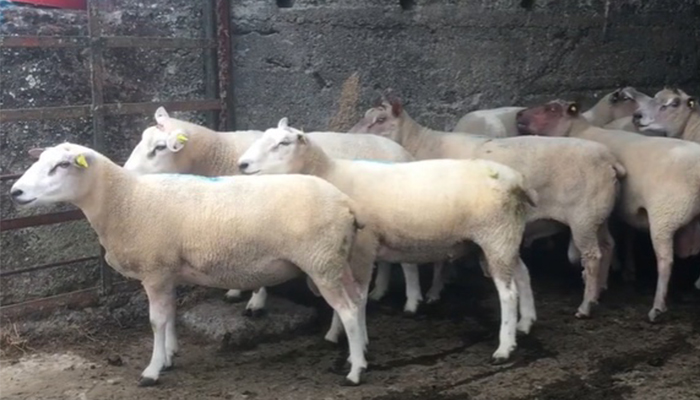
Dr Tim Keady, Teagasc, Athenry Research Centre, Co. Galway, writes on the ram effect and its role in allowing for a compact lambing season.
There are many reasons, including improved labour efficiency, that producers may wish to compact the lambing season. This requires synchronising the flock during mating by using either progestagen-impregnated sponges or the ‘ram effect’. The latter is a natural way of synchronising the onset of the breeding season in a flock of ewes.
The ‘ram effect’ can be used to induce ewes (ewe lambs or adult ewes) to start cycling provided they are sufficiently close to the time of normal onset of their breeding season. In practice, the ram effect can be employed to ensure that all ewes in the flock are at the stage of exhibiting overt oestrus during the first 17 days of the joining period.
The ‘ram effect’ is due to the impact of pheromones released by sexually mature rams on ewes that have not yet entered their breeding season. For the ‘ram effect’ to work, the ewes should have not been in contact (either sight or smell) with rams for the previous month. When such ewes are exposed to rams, the ram’s pheromones cause hormonal changes in the ewe that precipitate the onset of ovarian cyclicity.
Implementing the ‘ram effect’
The ‘ram effect’ is illustrated in Table 1. When introduced on day one, an apron can be used on the ram to prevent mating any ewe that is already cycling and happens to be on heat at the time.
Upon introduction of rams, most ewes that have not entered their breeding season will have a ‘silent heat’ within 36 hours and a proportion will have a second silent heat after 6 days. These ‘silent heats’ are not detected by rams. The rams should be removed after 24 to 36 hours.
Ewes will cycle (i.e., be detected by the rams as on heat) at approximately 17 days after the last ‘silent heat’. Consequently, there are two peak dates for the number of ewes showing heat, namely 18 and 23 days after exposure to the rams. Consequently, fertile rams should be introduced to the flock 14 days after the rams used to induce the ‘ram effect’ were introduced; the peak mating times will be 4 and 9 days later. The reason the rams are introduced at day 14 is to allow for any short cycles and to pick up any individuals that were already cyclic at the time of ram introduction.
Table 1: Time table for use of the ‘ram effect’
| Day | Action |
| 1 | Introduce aproned rams |
| 3 | Remove aproned rams |
| 14 | Introduce fertile rams |
| 18 | 1st peak in matings |
| 23 | 2nd peak in matings |
At Athenry, the ‘ram effect’ was used on the ewe lamb flock – the onset of the breeding season is much later than for adult ewes. During the joining period, 98% of ewe lambs were mated/raddled). Of the ewes that lambed, 78% lambed within the first 21 days, 90% had lambed by day 26. This clearly illustrates that the ‘ram effect’ synchronised lambing.
When using the ‘ram effect’ to synchronise the mating season it is essential to have:
- An adequate number of rams for mating (1 ram per about 20-30 ewes).
- Adequate facilities at lambing- especially lambing pens (1 pen per 6 ewes)
- Sufficient labour- to cope with the flock during the lambing season.
More from Teagasc Daily: What to consider if mating ewe lambs