
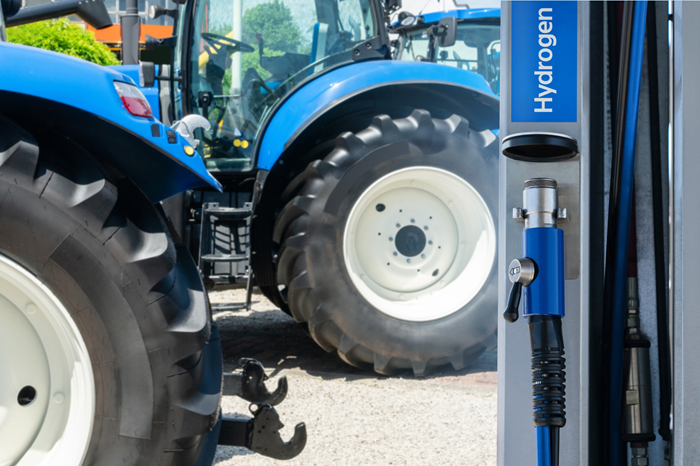
Hydrogen could offer Irish farmers a way to reduce carbon emissions, avoid fossil fuel price volatility and make better use of Ireland’s rich renewable resources, Energy and Rural Development Specialist at Teagasc, Barry Caslin tells us more.
Farmers often ask: ‘Where are we with hydrogen as a fuel for tractors?’. It’s a fair question given the growing interest in cleaner and more sustainable energy sources.
For many years, diesel has been the trusted fuel for tractors and other farm machinery. But with rising fuel costs, concerns over energy security and increasing pressure to adopt greener practices, alternatives are being actively explored. Hydrogen stands out as a particularly promising option – a clean fuel that could revolutionise how farms generate power and open new income streams.
While the technology to run tractors and vehicles on hydrogen already exists, the key challenge lies in sourcing the fuel reliably. Hydrogen is produced from three main sources: fossil fuels (grey hydrogen), fossil fuels combined with carbon capture (blue hydrogen), and renewable energy (green hydrogen). Grey and blue hydrogen produce significant carbon emissions, whereas green hydrogen is much cleaner but currently expensive and less readily available, with higher costs that farmers would ultimately face.
Storage challenges and advances
Storing hydrogen presents its own difficulties. Conventional metal tanks can allow hydrogen to escape, causing logistical and safety issues. However, new developments in materials science offer solutions. Graphene, a single layer of carbon atoms, is 200 times stronger than steel and impermeable even to hydrogen. Containers made from graphene represent a significant breakthrough, bringing hydrogen storage closer to being practical and affordable for use in agriculture and transport.
Why not batteries? The limits for farmers
While electric vehicles are becoming common, battery technology is not yet suitable for heavy farm machinery. Tractors and harvesters demand high power, and current batteries require heavy, rare materials and strong electrical infrastructure – all challenges in rural Ireland. Limited grid capacity and inadequate charging infrastructure mean battery-powered machines are not yet viable on a large scale for farming.
Hydrogen: Portable, flexible and green
Hydrogen can be produced on-site by splitting water into hydrogen and oxygen using renewable electricity from solar, wind or hydropower – resources that Ireland has in abundance. This allows farms to generate their own fuel, reducing dependence on diesel and the national grid.
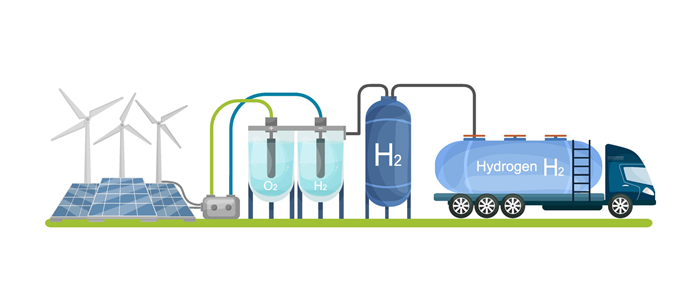
Green hydrogen production. Image source: iStock
Hydrogen is lightweight and has a much higher energy density than petrol or diesel. While hydrogen is a gas requiring larger storage tanks than liquid fuels, it delivers significantly more energy per kilogram. For comparison, petrol and diesel have energy densities around 45 MJ/kg, whereas pressurised hydrogen offers about 120 MJ/kg – nearly three times more.
Hydrogen can power engines through direct combustion, similar to diesel, or through fuel cells, where hydrogen reacts electrochemically with oxygen to produce electricity, with water vapour as the only emission. Fuel cells offer quiet, efficient operation and are increasingly used in vehicles.
Legal and industry developments
A major milestone was reached in the UK in April 2025 when hydrogen-powered agricultural and construction vehicles were legally permitted on public roads. This was largely driven by companies like JCB, which has invested heavily in hydrogen combustion engines. This regulatory change opens the door for wider practical use of hydrogen machinery.
Several engine manufacturers are racing to develop hydrogen-compatible engines that match the size, power and performance of diesel units. Kubota, for example, has a 3.8-litre spark ignition engine producing up to 114hp with the same footprint as its diesel counterpart. Deutz is set to begin mass production of its six-cylinder 295hp TCG 7.8 H2 engine later this year, noted for its quiet operation and carbon-neutral credentials. JCB Power Systems has produced over 75 units of its four-cylinder AB448 H2 engine, offering diesel-equivalent power and torque, currently undergoing extensive vehicle testing.
In France, Massey Ferguson is targeting 2026 to unveil a hydrogen-powered tractor prototype. Supported by €4.4 million in government funding, the project focuses on overcoming hydrogen storage challenges by developing high-pressure tanks tailored for farm machinery. This promises safer, more efficient fuel storage and smoother integration with existing tractor designs, reducing costs and complexity.
Perkins Engines, meanwhile, is focused on developing a six-cylinder, 7-litre 200-series to show the potential for 60-335hp hybrid power units using hydrogen gas and an integrated electric motor.
While hydrogen infrastructure in Europe is still developing, countries like South Korea and Japan have already established networks supporting tens of thousands of hydrogen vehicles. Europe remains a hub of cutting-edge research and innovation, with programmes like Horizon Europe funding research for green hydrogen technologies, although commercialisation needs to accelerate. Globally, efforts continue to reduce the cost of green hydrogen, but it remains a work in progress.
Comparing costs: Hydrogen vs. petrol
Hydrogen packs more energy per kilogram than petrol or diesel, but as a gas, it requires larger tanks and specialised handling. In Ireland, petrol costs around 179 cents per litre, with an average vehicle achieving approximately 14 kilometres per litre – about 13 cents per kilometre.
Hydrogen costs vary greatly depending on production. Grey hydrogen, derived from fossil fuels, costs roughly €1 to €2 per kilogram but carries a high carbon footprint. Green hydrogen, produced by electrolysis using renewable energy, is much cleaner but currently costs between €3 and €12 per kilogram.
In the UK, blue hydrogen (natural gas with carbon capture) costs around 300 cent per kilogram, with retail prices fluctuating between 300 and 600 pence. Taking an average of 450 cent per kilogram, hydrogen-powered vehicles like the Toyota Mirai can travel 30 to 55 kilometres per kilogram, which translates to roughly 11 cents per kilometre – close to petrol’s cost.
The expenses of hydrogen fuel largely stem from three areas: the electrolysers needed to produce it, the renewable electricity powering them, and the specialised storage and transport infrastructure. Electrolysers remain costly and are not yet mass-produced. Although renewable energy prices have dropped, electrolysis is energy intensive. Safe storage requires advanced high-pressure tanks, adding to upfront costs.
Electrolysis is an energy-intensive process, requiring around 60 kWh of electricity to produce 1 kilogram of hydrogen. It is therefore most effective when powered by renewable energy sources like solar or wind. While only about 1 litre of water produces over 1,000 litres of hydrogen gas, approximately 9 litres of water are needed to generate 1 kilogram of hydrogen.
However, as technology improves and production scales up, costs are expected to fall. Greater use of hydrogen in sectors like heavy transport and construction will drive economies of scale, making green hydrogen an increasingly competitive fuel.
Looking ahead for Irish farmers
Hydrogen could offer Irish farmers a way to reduce carbon emissions, avoid fossil fuel price volatility and make better use of Ireland’s rich renewable resources. Companies like JCB, Deutz, Kubota and Massey Ferguson are moving hydrogen engines from concept towards reality, supported by evolving legal frameworks. Realising this potential will likely require investment in hydrogen storage, refuelling infrastructure and skills development
Global innovations and powerhouses
Beyond agriculture, Toyota is advancing hydrogen fuel-cell vehicles with models like the Mirai, which offers refuelling times and ranges comparable to petrol cars. The hydrogen-powered Hilux pickup is in prototype stages, signalling the potential for commercial vehicles.
In heavy machinery, South Korea’s Hyundai Doosan Infracore plans to mass-produce hydrogen engines this year, including an 11-litre 402hp engine designed for construction and power generation. These engines operate with lower-purity hydrogen and emit zero carbon dioxide, highlighting hydrogen’s promise as a fossil fuel replacement.
While challenges remain, the growing momentum behind hydrogen technology suggests it could soon become a key part of sustainable farming in Ireland’s future.
More from Teagasc Daily: Diversifying Irish agriculture – navigating new paths to farm resilience
More from Teagasc Daily: Exploring Farm Diversification: Renewable Energy
More from Teagasc Daily: Unlocking Ireland’s rural income potential
More from Teagasc Daily: Harvesting renewable energy with SRESS