
20 March 2025
The role of phosphorus in grass growth
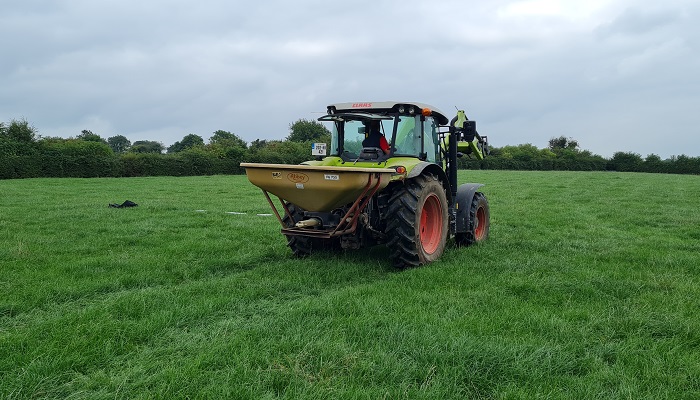
Phosphorus plays a critical role in grass growth, but its management is essential to avoid losses to watercourses. Colm Kelly, Climate Action & Sustainability Advisor at Teagasc Galway/Clare, offers key advice on P’s importance for grassland performance and how to reduce the risk of losses.
Phosphorus (P) plays and important role in grass growth, with deficiency of P leading to poorer root development and a drop in overall grass yields throughout the grazing season.
It is also a pollutant. When it enters watercourses, it can cause water quality problems. Therefore, it is an important nutrient to apply to grassland, but management around its application is crucial to avoid its loss to watercourses.
A trend of lower chemical P sales may indicate under application on some farms. This reduces grassland performance, having a negative effect on our ability to reduce slaughter age, use chemical nitrogen (N) efficiently to meet climate targets and farm profitably.
Phosphorus needed?
Due to the way regulation works, farmers need to demonstrate a need for chemical P. This requires a Nutrient Management Plan that uses stocking rate, meal purchased, soil sample results and, on some farms, soil organic matter maps to calculate allowances.
Peaty soils can only have a maintenance allowance, as they do not hold P. The standard advice is to know how much P fertiliser you can purchase for your allowance. If you buy your chemical P in the form of 18-6-12 for example, your advisor can calculate that you can buy x tonnes and if you stay below this figure, you know you are compliant.
Scenario 1: Jim has a low Phosphorus allowance:
Farms with good or high P soil test results often have small to no allowances for chemical P. In that case, it is good news, P is there in sufficient levels and Jim won’t need to buy more that he won’t get a response from.
There will be P offtakes from Jim’s farm each year from stock, crops or milk he sells, so he should consider testing more regularly – such as every second year – to catch a decline. Typically, 60% of P taken up through grazing can be recycled onto pasture through dung or urine. Once P soil test results start to drop to an index 3, Jim will begin to get maintenance allowances again and can go back in with P to keep the land optimal.
What Jim could focus more on is the P distribution from slurry, in particular. Looking at soil test results, a reading above 8 mg/l is an index 4. On some farms there can be samples reading much higher. These fields typically are easy to access fields that have ended up with surplus P built up over years. More economic responses could be achieved by directing slurry to paddocks with lower indexes or land with high offtakes, such as silage fields.
Scenario 2: Kate has low Phosphorus soil test results:
In this case, Kate is likely not optimising grass growth. If Kate was lowly stocked, perhaps she is growing enough grass for her system and grass utilisation is the ultimate goal.
Kate, however, has a moderate stocking rate and she is feeling the pinch early/late in the year and in silage yields. This is leading to longer housing periods, lower animal performance from grass and more reliance on purchased feed to drive performance.
Kate’s plan is to apply lime where required and then target slurry and chemical P to high offtake fields, such as silage and the best grazing fields with low indexes, avoiding saturated land when high rainfall is likely.
Part of Kate’s farm is in the ACRES scheme and she knows from her advisor if lower P rates apply to the actions chosen for these fields. On low intensity biodiverse pastures, additional nutrients can have a negative outcome for plant diversity. A P build-up option provision applies to intensively stocked grassland farmers with a grassland stocking rate ≥130 kg N/ha prior to manure export. An advisor is required to apply for this additional allowance.
Reduce phosphorus loss?
Most P loss is associated with land that is slow to drain. In heavy rainfall conditions, overland flow occurs where P contained in slurries, fertilisers, soiled water or soil sediment is washed into surface water. Catchments.ie is a website where farmers can view predicted P pollution impact potential (PIP) maps, which predict which areas on your farm may be vulnerable to P loss. Complying with buffer zones and avoiding overland flow risk areas, particularly when heavy rainfall is expected, are practical measures to reduce losses.