
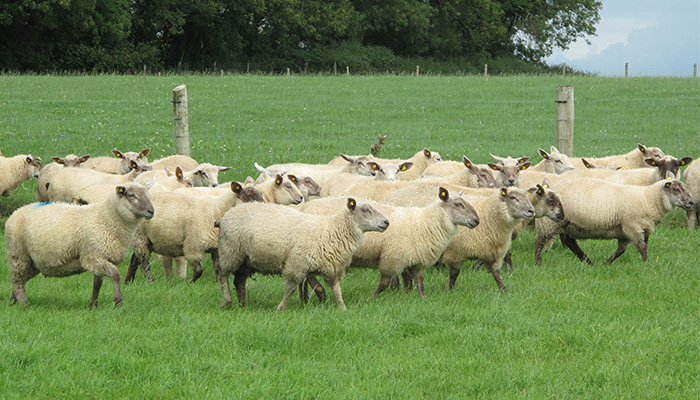
Mid-season lowland lamb enterprises are forecast to experience another positive year in 2026, with margins forecast to rise significantly on the back of high lamb prices and a slight easing of input costs
That’s according to Senior Research Economist at Teagasc, Anne Kinsella who presented a paper co-authored with Kevin Hanrahan, Head of Rural Economy and Development Programme, at the recent Teagasc Outlook 2026 Conference.
Firstly, providing estimates for the 2025 season, Anne Kinsella explained that gross margins on sheep farms are expected to increase by 6% this year, driven by higher output value (+7%) – which helped offset 9% higher direct input spend – and payments under dedicated sheep schemes. Despite higher pasture and forage costs, net margins on the average lowland lamb enterprise are expected to reach €486/ha in 2026 – a climb of 12% on the year previous.
The importance of exports
Anne Kinsella also informed delegates of the importance of export markets to Irish lamb producers; over 80% of Irish sheepmeat was exported in 2024, with France and the UK being the largest respective markets.
“This huge reliance on the export market means understanding the outlook for lamb price developments in Ireland is critical in assessing the prices that Irish sheep farmers are likely to receive for their output,” Anne Kinsella explained.
“Continental EU markets account for the majority of Irish lamb exports and solid fundamentals continue to support the demand for Irish lamb and meat products. France remains our most importance sheepmeat destination, with one-third of all exports destined for the French market, while exports to the UK account for 19%.”
Providing an overview of the EU market in 2025, she added: “The EU market for heavy lamb was characterised by higher prices that persisted right throughout the year and remained at the high level reached in 2024, even well surpassing 2024 prices at some points during the year.
“A supply shortage has been the principle driver of these high prices. EU sheepmeat faces strong global and domestic supply shortages, with EU production continuing to decline in the 2025 year. A substantial reduction in the EU breeding flock over recent years effectively limits the possibility for indigenous production increases in the shorter term.
“With supply shortages driving the current prices, we expect the current prices will continue to be supported by EU demand,” Anne Kinsella added.
These high EU prices, however, have reduced the competitiveness of EU exports on international markets and increased the attractiveness of the EU as an export destination from major global exporters such as New Zealand, Australia and the UK.
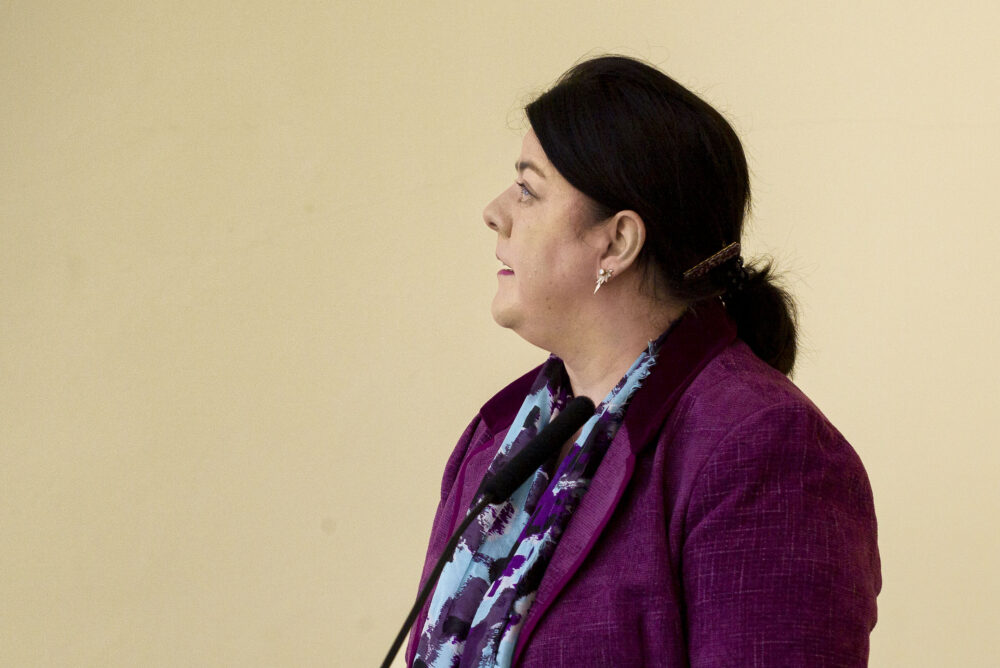
Anne Kinsella presenting at the Teagasc Outlook Conference
Irish supply and outlook
Closer to home, Anne Kinsella explained that sheep throughput in Irish slaughter plants is expected to decline by 20% this year, with lamb throughput at exports plants declining by 19%.
On the back on this reduced supply – both domestically and across the EU – and a 3% forecast reduction in total sheep costs for the 2026 production year, the Teagasc Senior Economist is forecasting increased margins in 2026.
Providing this forecast at the Outlook Conference, Anne Kinsella said: “We expect that lamb prices will remain close to the high levels observed in 2025, with high EU lamb prices forecast to continue due to ongoing supply contraction in the EU.
“Average prices will continue to remain well in excess of the five-year average levels, with prices for Irish sheepmeat forecast to be on average 5% higher than in 2025, and this will result in output value per hectare increasing by 5% relative to the levels estimated in the previous year.”
She continued: “2026 is forecast as another relatively positive year for sheep farmers. With the stable EU market situation, the EU domestic sheep supply is expected to remain tight. The outlook for Irish and EU lamb prices for 2026 is positive and we expect that prices will be up about 5% on average. When movements in all the cost components are taken into consideration, the forecast is that gross margin earned by the average sheep farmer will increase by 10% to €1,092/ha, while net margin will increase to €594/ha – up 22%.
“This positive outlook for Irish lamb prices and the more positive input and overhead cost situation will all lead to a 2026 year that will be on average a positive year for sheep farmers,” Anne Kinsella concluded.