
25 July 2024
Tillage advice: Straw Incorporation Measure and stubble management
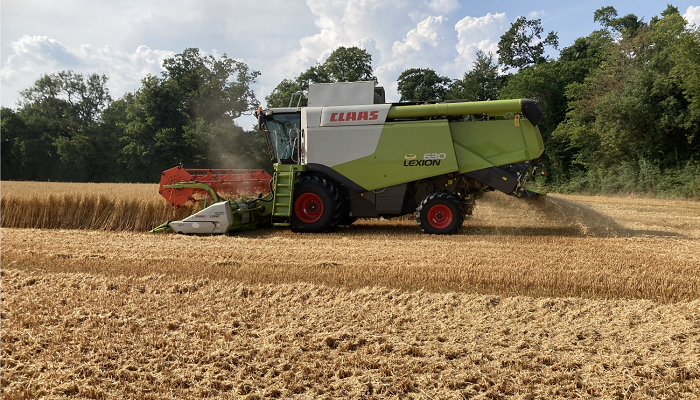
As uncertainty still surrounds the Straw Incorporation Measure (SIM), Crops Specialist at Teagasc, Shay Phelan looks at the economics involved in deciding to chop, the benefits of straw incorporation and stubble cultivation rules farmers need to be aware of.
The decision to bale or chop the straw should always be based on economics of chopping the straw versus the price that can be achieved for baling the straw. While individual deals will be done for the straw, the value of it as an organic manure can be calculated based on the total amount of phosphorus (P) and potassium (K) contained in the straw which is being returned to the soil. The table below estimates the monetary value of straw based on the P and K value.
Table 1: Value of straw chopped and returned to the soil
| Crop type | Crop yield (t/ha) | P (kg/ha) | K (kg/ha) | Value (€/ha*) |
|---|---|---|---|---|
| Spring barley | 7.5 | 3 | 50 | €55 |
| Winter barley | 10.0 | 4 | 51 | €58 |
| Winter wheat | 11.0 | 4.4 | 56 | €64 |
| Winter oats | 9.0 | 3.6 | 87 | €91 |
| OSR | 5.0 | 2.4 | 27 | €32 |
| *Monetary value based on current market nutrient costs for P & K The table above doesn’t include the cost of chopping or incorporation |
||||
Where the plan was to chop late-harvested cereal crops, perhaps a solution would be to chop the headlands regardless and bale the centre of the fields. Straw on the headlands tends to be driven on and so is usually the last to be dry enough to bale; chopping the headlands in late-harvested cereal crops makes sense regardless of any scheme.
Additional benefits
Where straw is chopped, there are also the other benefits that are more difficult to calculate. Such benefits include the biological and physical improvements to the soil, especially where straw incorporation has been done over a number of years. Soil compaction could be a real issue in September harvested fields with heavy balers, loading shovels, bale trailers and possibly even trucks moving in all directions across the fields.
One common comment that many growers will often say when they chop straw is that it helps to get fields cleared quicker. This also helps to reduce costs significantly at a very busy time of the year. Not having to bale straw and remove it will also allow the grower to get other work completed, such as drilling autumn crops or stubble cultivation, on time. This may prove to be as important given how the weather in October and November over the last two years impacted winter cereal crops.
Stubble management
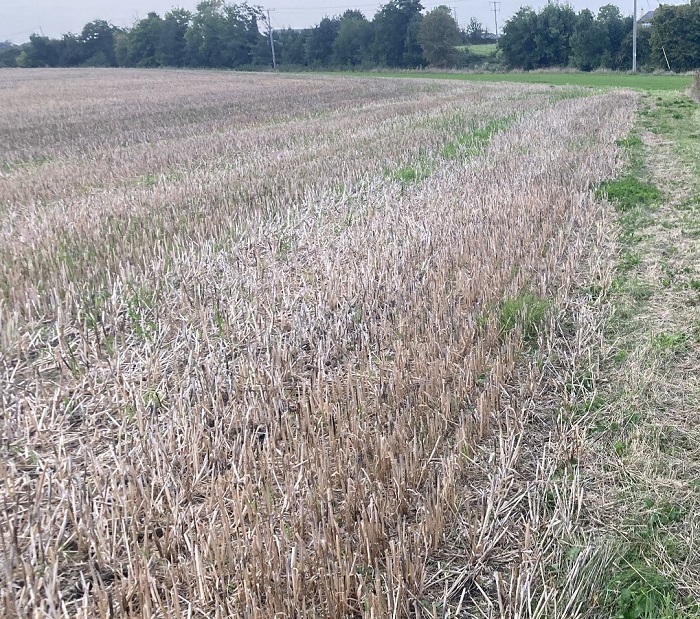
Regardless of the SIM or not, the rules regarding stubble management are still in place. Growers must cultivate stubbles within 10 days of harvest or straw being removed, however between 20% and 25% of the total cereal area must be left idle for ground nesting birds.
Figure 1: 20-25% of stubbles must be left untouched
The stubble cultivation rules are only applicable in the following counties: Carlow; Cork; Dublin, Kildare, Kilkenny, Laois, Louth, Meath, Offaly, Tipperary, Waterford, Westmeath, Wexford and Wicklow.
If you have weeds where light is needed to break dormancy, you can apply to leave stubbles untouched for a period of time; however this must be verified by an agronomist.
Late-harvested crops are exempt from stubble cultivation, these include: potatoes; maize; beet or cereal or bean crops harvested after September 15.
Where catch crops are being sown and grazed, the lie back rules and margin around field boundaries are still in place. The 30% lie back area must be adjacent to the field where the catch crop is going to be grazed and the animals must have access all the time. Don’t forget that a 3 metre margin must also be left around the external boundary but this doesn’t qualify as the lie back.
Also read: Sharp decline in tillage incomes in 2023
Also read: Rat’s tail fescue – an emerging threat