
21 December 2023
Tillage advice: The importance of soil sampling
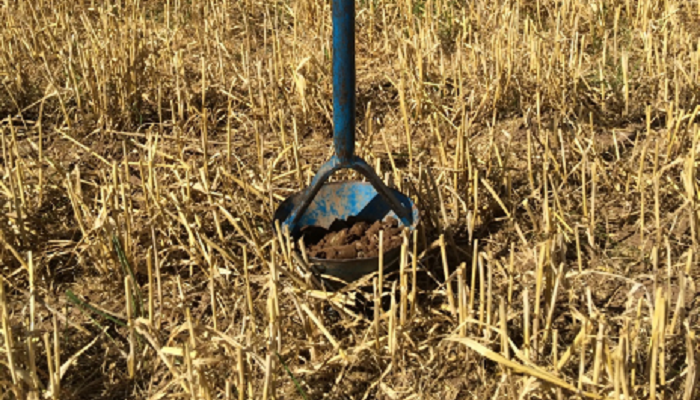
Ciaran Collins, Teagasc Crops Specialist, tells us why an up-to-date soil test report is important, while highlighting legislation changes which make soil sampling mandatory and essential when fertiliser planning for the year ahead.
A former colleague once said: ‘trying to grow a crop without an up-to-date soil test report is like trying to drive a car with no lights in the dark’; you simply do not know where you are going. Having an up-to-date soil test report is essential regardless of the legislative requirements.
Optimising soil health is crucial to crop performance. Major elements like phosphorus (P) and potassium (K) are essential for crop growth and when they are at sub-optimal levels, crop yields will suffer.
Additionally, it is crucial to maintain the soil pH at the ideal level for the specific crop to optimise the effectiveness of nitrogen (N), phosphorus and potassium fertilisers. None of this is possible without up-to-date soil test reports.
Fertiliser is the single biggest cost in the production of any crop, therefore any savings that can be made when essential soil elements are in oversupply will make a significant difference to the bottom line.
As part of Conditionality, soil sampling is mandatory. All arable land must have valid soil samples. Where soil samples are not taken, then Index 4 for P (no P allocation) will be assumed until soil tests are taken. Soil samples are valid for a period of four years, and they must not represent an area greater than 5 hectares and be tested by an accredited laboratory.
Soil test results are central to nutrient management planning and in the calculation of the total fertiliser requirements for the farm. The National Fertiliser Database is now in place, so it is vital to know your limits before fertiliser is purchased for 2024.
In addition to major elements, it is important to test tillage fields for micronutrients. Once crop symptoms appear, treatment with micronutrients may be too late to avoid crop yield losses for that year. Key micronutrients to test for in cereals include: copper (Cu); manganese (Mn); and zinc (Zn). Boron (B) is important for farmers growing oilseed rape and beet.
The results of a soil analysis are only as good as the sample on which it is based. Advice on soil sampling technique is available here.
Grower feedback wanted on winter crop plantings
Following a challenging autumn and early winter period on tillage farms, Teagasc has launched a survey to help identify the areas planted this autumn and to shed light on farmers’ cropping plans for next spring.
With wet conditions persisting from mid-September through to late-November, plantings have been hindered in all areas. This loss of winter crop area looks to be compounded by a lack of seed for spring cereals, which may lead to unsown land on many farms in 2024.
To establish an accurate picture of the areas planted nationally thus far, Teagasc is asking for as many tillage farmers as possible to participate in the survey. The survey aims to assess how much planting has been completed this autumn and to identify if tillage farmers plan to sow winter cereals in January and February.
We would like to get your feedback to create a national picture of winter plantings this year and your intentions for 2024.
To complete the survey via Survey Monkey, click here.