
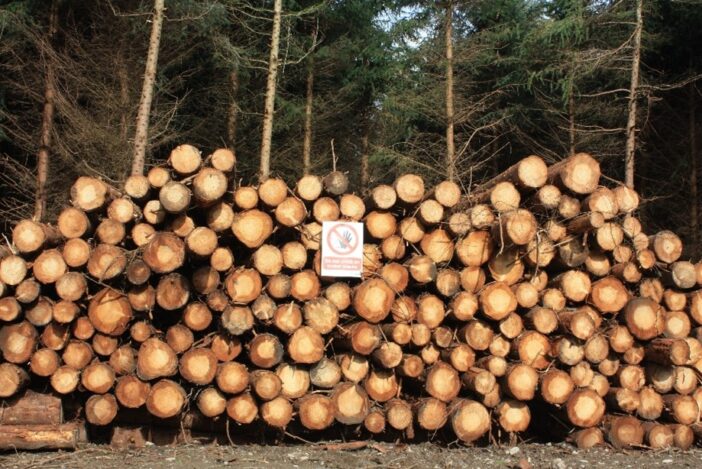
As timber harvesting in forests affected by previous storms continues, it is in every forest owner’s interest to be in control of both the harvesting and sales processes.
In this article, the fifth in a series, Teagasc Forestry Advisors explain the process for measurement of timber in stacks.
When preparing for sale, having accurate estimates of harvested timber quantities is essential information for forest owners. A number of methods can be used:
- Crop inventory carried out by a qualified professional in the forest prior to felling
- It can be calculated by well-calibrated harvesting machines as harvesting takes place
- The timber can be measured in the stacks at roadside (see method described below)
- Weighing of the timber at an agreed weighbridge
Tip! Simply taking photos of timber stacks on particular dates and matching them with volume estimates of the stacks; gives the forest owner an easy way of keeping track of harvested timber on the roadside.
Timber Stack Measurement
Advantages
- It can be done quickly by the forest owner.
- It is useful to know how much timber is leaving the forest.
- It is useful to calculate the volume of different individual stacks, which is important if different timber products are being sold separately from the one harvesting operation.
Disadvantages
- All logs in a stack must be of uniform length and the stack should be built neatly and tidy for easy measurement.
- Frequent monitoring of timber stacks is required to keep track of any partial removal of timber from the stacks.
Definitions
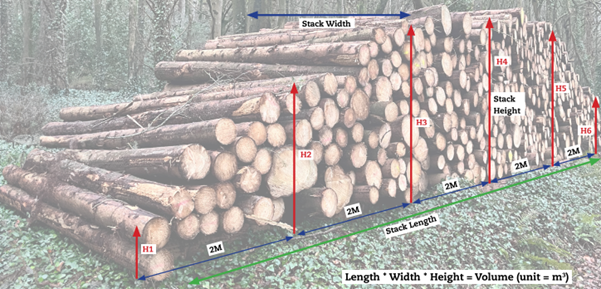
Stack width
The width is the specified length of the timber product in the stack. A number of sample lengths (billets) should be checked to verify the stack width.
You may have a number of different products in your loading area so each product needs to be measured separately.
Stack length
Stack length is the average length of the front and back face of the stack. The stack should be measured from the centre point of the outermost billets at one end of the stack to the centre of the outermost billets at the other end.
Stack height
Stack height is the perpendicular height from the bottom of the stack to the centre of the highest billet at the top of the stack. Average stack height is the average value of a series of height measurements taken along the length of the stack. A minimum of 3-4 measurements should be taken at regular intervals along both faces of the stack or at every two metres.
Measuring a stack
Equipment required
- Measurement tape (30m),
- Measuring stick
- Fixed area grid (quadrant)
- Record sheets
- Stationary
- Scientific
Get Gross Volume of the Stack
Gross stack volume (m3) = the stack width * stack length * average stack height
However, keep in mind that this volume estimate also includes open spaces between the logs. We therefore need to use a conversion factor to convert gross volume to the net volume (volume of timber only).
Calculating the Conversion Factor
There are two options:
Using an area grid (quadrant)
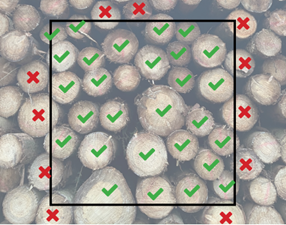
A known area grid (usually 0.7m * 0.7m = 0.49m2) is placed on a face of a stack (represented in blue here). Measure and record the diameter of all billets that are in the grid.
For those only half in the grid, count only every 2nd one.
At least five samples should be taken across the face of the stack at regular intervals. Divide the total surface area of this known sample grid by the surface area of the billets in the sample.
To do so, we use the following formula:
(Sum of ((Diameter)2 * 0.00007854 * no of billets in each diameter class) ) / no. of samples taken / surface area of the quadrant = Conversion Factor.
Using the standard conversion factor
7 is the most commonly used conversion factor in the forest industry.
Apply Conversion Factor to Gross Volume => gross stack volume * conversion factor = Net Stack Volume (m3)
Understanding the market and securing sound contracts are key to maximizing profitability in the timber industry. By aligning with industry best practices and market trends, timber owners in Ireland can help ensure sustainable and profitable forestry operations.
Teagasc forestry advisors are available to provide objective guidance and support to forest owners. For further information, contact your local Teagasc forestry staff and visit the forestry section of the Teagasc website.
View the full series of fact sheets on controlling a conifer harvest here