
Time to correct soil fertility
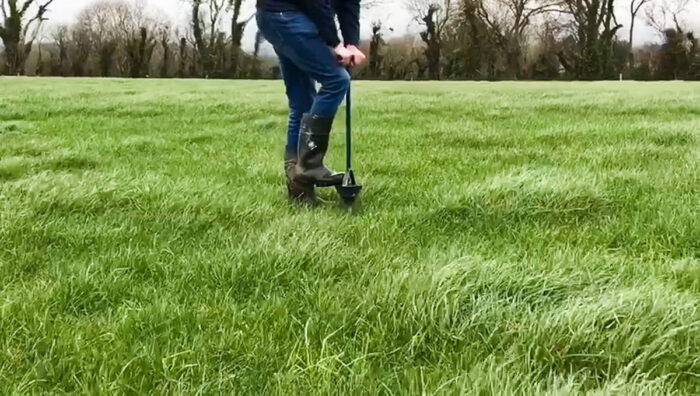
John Enda Flannelly, Drystock Advisor, Teagasc Claremorris, reminds farmers that autumn is an ideal time to assess soil fertility and plan for next year.
Soil sampling is one of the most valuable tools available to farmers, helping to improve grass and crop performance, reduce unnecessary fertiliser costs and ensure nutrient management decisions are based on accurate, up-to-date information.
Soil sampling is an investment that can deliver significant benefits in both the short and long term. There is an opportunity to review individual fields and organise lime and fertiliser applications in advance of the spring. When soil sampling, farmers should ensure enough time has passed since previous fertiliser, manure or lime were applied. Soil sampling should also be avoided in waterlogged conditions to help ensure reliable results.
Get the sampling right
Taking a soil sample correctly is essential to ensure accurate and reliable results. Each field should be sampled separately, with different soil types or areas with a different cropping or management history sampled separately also.
Using a clean soil auger, take approximately 20–25 cores in a W-shaped pattern across the field, at a consistent depth of 10cm. Avoid gateways, headlands, dung patches, waterlogged areas and spots where lime or fertiliser has been recently applied. Ideally, allow at least three months after applying fertiliser or organic manure before sampling, and follow laboratory guidance on the timing of sampling after lime application.
Label each sample clearly with the field name or LPIS number to ensure results can be matched to the correct field. Under nitrate regulations, all soil analysis reports issued since September 14, 2025, must include either the Land Parcel Identification System (LPIS) number or the exact GPS geo-reference of the sampled land.
Understanding the soil results
A soil test provides valuable information on soil pH and nutrient levels, particularly phosphorus (P) and potassium (K). Depending on the analysis requested, other nutrients may also be measured.
Soil pH is especially important because it influences how effectively grass and crops can access nutrients. Where soils are too acidic, plants may struggle to use nutrients efficiently, reducing the response to applied fertiliser. Applying lime where needed can correct soil acidity and improve nutrient availability.
Similarly, identifying low phosphorus or potassium levels allows farmers to address deficiencies and support productive grassland and healthy crop growth. Additionally, soil sampling can also show where nutrient levels are already adequate. This helps farmers avoid unnecessary applications, can save money and ensures fertiliser is targeted where it is most beneficial. With input costs remaining a major consideration, understanding the requirements of each field makes sound financial sense.
Maintaining good soil fertility supports the long-term productivity of the farm. For livestock farmers, better soil fertility can contribute to improved grass growth, helping to maximise the performance of the animals grazed on this grassland.
There are environmental benefits too. Applying nutrients according to soil requirements can reduce unnecessary fertiliser use and help minimise the risk of nutrient losses to waterways. Better nutrient management supports both farm efficiency and environmental sustainability.
The importance of soil samples for schemes
Soil sampling is also an important consideration when preparing nutrient management plans and meeting relevant Department of Agriculture, Food and the Marine schemes and regulatory requirements.
Under Ireland’s nitrate regulations, valid soil test results can be particularly important for determining phosphorus requirements and application allowances on farms subject to specific rules. It is a requirement to have valid soil sample results if your farm is in Nitrates Derogation or in the Agri-Climate Rural Environment Scheme (ACRES).
Farms with a previous year’s grassland stocking rate above 130kgs of organic nitrogen per hectare are required to have soil tests. Without valid soil samples, phosphorus will be assumed to be at Index 4, and no chemical P fertiliser is allowed in this scenario.
Soil test results are valid for a four-year period for relevant nutrient management purposes. If it is over 4 years since you last soil sampled your farm now is a suitable time to get a fresh soil samples taken.
John Enda Flannelly is a Drystock Advisor in Teagasc Claremorris. Find out more about Teagasc Mayo here.