
Time to upgrade your cattle handling facilities?
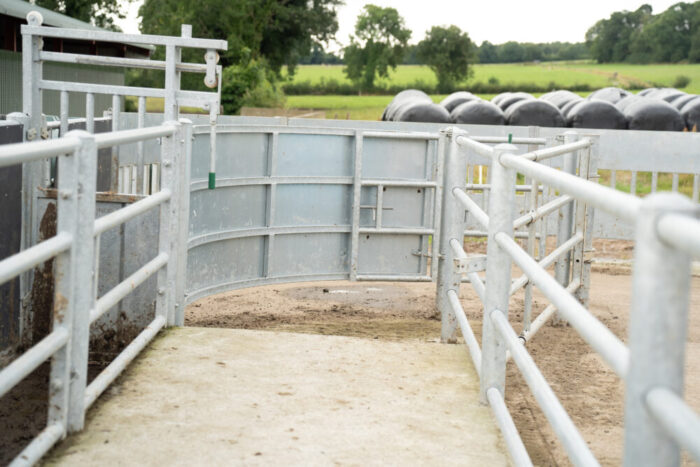
With strong beef prices seen in 2025 and grant support available through TAMS, DairyBeef 500 Advisor, Fergal Maguire writes that now is an ideal time for dairy calf to beef farmers to review their facilities and plan upgrades that will future proof their farms.
With the strong beef prices seen in 2025, many farmers are planning long overdue investments on their farms that will improve efficiency, safety and overall quality of life. While attention often focuses on housing or slurry storage, one critical area that is frequently overlooked on dairy calf to beef farms is handling facilities.
Good handling facilities are critical to the day-to-day management of beef cattle. On calf to beef farms in particular, routine handling is required throughout the animal’s lifetime for tasks such as dosing, vaccination, weighing and handling animals for slaughter. Where facilities are inadequate, farmers are far less likely to carry out these essential tasks regularly, with negative consequences for both animal performance and farm safety.
Inadequate handling facilities can quickly become a bottleneck on farms as cattle numbers increase. Jobs that should be straightforward such as dosing or weighing can become slow and labour intensive. This often leads to tasks being delayed or avoided altogether. Infrequent weighing, for example, means poor thrive or health issues may not be identified early enough to correct them, resulting in reduced lifetime performance.
Although beef animals originating from the dairy herd are often considered relatively quiet, they can still be easily spooked. When this happens in poorly designed or undersized handling systems, the risk of injury to both the operator and the animal increases significantly
DairyBeef 500 demonstration farmer, Irvine Allen is planning to invest in a new fixed handling unit in 2026. While existing facilities on the farm were adequate when cattle numbers were lower, they have become increasingly restrictive as numbers have grown.
“As cattle numbers increased, dosing and weighing started to become a big job,” Irvine explains. “I used to dread dosing older cattle because it had become very slow, the facilities just weren’t big enough for the number of animals.”
In 2025, Irvine applied under the TAMS Farm Safety Capital Investment Scheme for a new handling unit. Under this scheme, fixed handling units are grant aided at up to 60% of the reference cost, making them a far more achievable investment for many farmers. In most cases, planning permission is not required to apply for a handling unit under TAMS, which further simplifies the process.
Irvine has opted for a circular handling system, a design that is becoming increasingly popular.
“I’ve seen circular handling units working well on a number of farms,” he says. “I like the fact that there’s always a gate between you and the cattle when you’re driving them up to the crush.”
What makes a good handling system?
Handling facilities should be designed to suit the size of the herd, the type of stock being handled and how frequently the system will be used. While retrofitting older facilities is possible in a lot of cases, growing herd sizes often justify a complete redesign.
Siting the handling unit
The location of the handling unit is critical. It should be conveniently positioned in relation to farm buildings, roadways and grazing paddocks to minimise animal movement and labour input.
Handling facilities located within or adjacent to existing farm buildings have several advantages:
- Easier management of effluent and slurry
- Reduced rainwater entry
- Easier cleaning and maintenance
Essential components of a handling layout
A satisfactory handling system should include:
- Collecting pen
- Forcing pen
- Race (or chute)
- Crush
- Holding or dispersal pen
Each component plays a specific role in ensuring cattle flow smoothly and safely through the system.
Collecting pen
Where facilities are located independently of housing, the collecting pen should be large enough to accommodate a typical group of cattle on the farm. Where facilities are located in or adjacent to housing, existing pens (for example in a slatted unit) may be used for collecting and holding animals.
Recommended floor space per animal:
- Young cattle: 0.9–1.1 m²/head
- Finishing cattle: 1.4–1.7 m²/head
- Suckler cows with calves: 2.3–2.75 m²/head
Long, narrow pens are preferable to wide, square ones, as cattle are easier to control and move. Recommended pen widths are 4.5–6.0m, depending on herd size, with an entrance of at least 3m to allow easy access.
Forcing pen
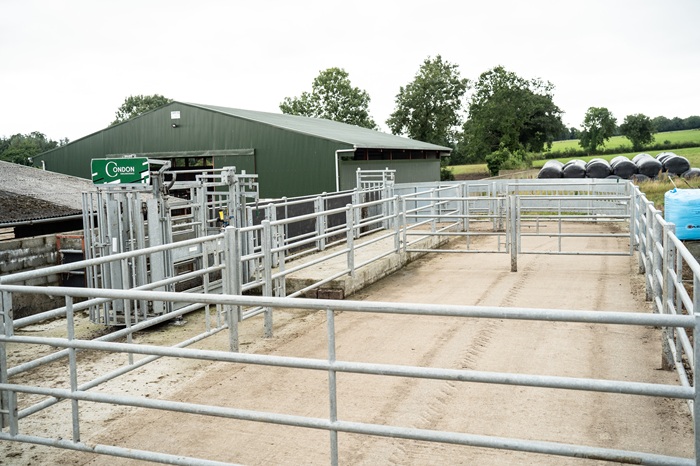
The forcing pen connects the collecting pen to the race and should be funnel shaped, narrowing towards the race entrance. One side of the funnel must be straight, and the angle should not exceed 30°, as wider angles can cause cattle to turn or jam.
The widest point of the forcing pen should be approximately 3–4 m and should hold enough animals to fill the race. Semi-circular forcing pens with incremental latching points offer excellent control and are increasingly common in modern designs.
Race (chute)
The race should allow for safe and efficient movement and restraint of cattle.
Key specifications:
- Length: minimum 3.6 m; ideally over 5 m
- Width:
- Adult cattle: 650–700 mm
- Young stock: approx. 500 mm
- Height: 1.4–1.5 m
- Floor: non-slip concrete
- Structure: smooth surfaces, no protrusions
Provision should also be made for a backing bar to prevent cattle from reversing.
Catwalks and operator safety
A catwalk alongside the race significantly improves operator safety by:
- Reducing the risk of injury
- Improving access and reach
- Preventing cattle feet slipping under rails
Catwalks should be 300–450 mm high and 375–450 mm wide, with at least 1.2 m of working space for the operator.
Dispersal pens and safety passes
Dispersal pens are used to hold cattle after handling and to facilitate sorting and regrouping. Where facilities are close to housing, existing pens may be used.
Safety passes (300–350 mm wide) should be installed wherever people need to move quickly between pens. At least one safety pass should be included in every pen and one every 7.5–8 m along handling passageways. These should not be placed directly in the line of cattle movement.
Designing for animal behaviour
Good handling design should be based on animal behaviour rather than force. Cattle prefer to move in groups, dislike sharp contrasts in flooring, avoid shadows and are sensitive to noise. Adequate lighting, gradual slopes and calm handling all contribute to smoother cattle flow, reduced stress and improved safety.
Final message
Handling facilities are a long-term investment that pay dividends in labour efficiency, safety, animal welfare and performance. With strong beef prices and generous grant support available through TAMS, now is an ideal time for dairy calf to beef farmers to review their facilities and plan upgrades that will future proof their farms.
For more from the Teagasc DairyBeef 500 Campaign, visit here.