
28 March 2025
Timing is everything
“Right place, right time” or a perfectly timed tackle, timing is everything. This is also true for insemination with sexed semen. Getting it right can make a difference. Stuart Childs explains why.
Sexed semen has grown in popularity in recent years and has increased dramatically in the last 2-3 years since the advent of sexed semen labs in the country which has significantly increased the availability of the product.
This trend is expected to increase into the future. Sexed semen technology is constantly evolving and who knows, a time may come where its use will be just as simple as conventional AI is currently. However, for successful use of sexed semen in 2025, timing is important.
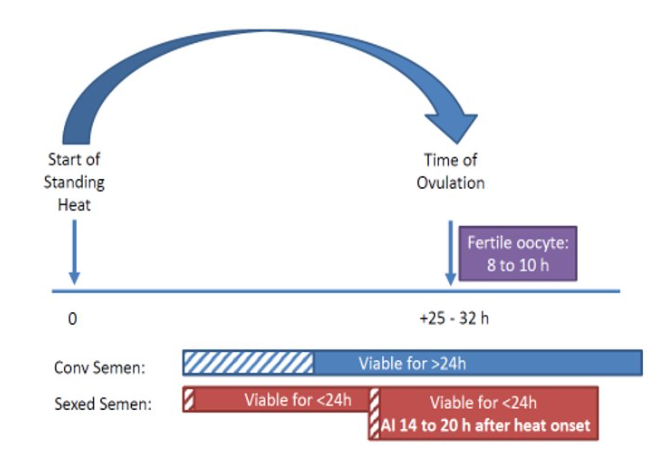
Heat behaviour and timing of AI
The figure above shows a blue and white hatched area in regard to conventional semen straws. This area represents a phase known as the capacitation phase. Capacitation is the process that describes the physiological changes that happen to sperm cells in the female reproductive tract to all the sperm cells to fertilise an egg. The process of sorting semen to make it available as a sexed straw actually starts the process of capacitation in the lab during the sorting process and consequently, sexed semen will not survive as long in the cow or heifer as conventional semen. The solution to this situation is to inseminate later in the heat to ensure the sperm cells are in the tract at the time when the egg is released (ovulation).
This means for successful outcomes with sexed semen, farmers need to follow the table bellow as a guide for the best time (14-20hours after heat onset) to serve the cow or heifer to maximise the chances of conception.
| Onset of heat |
Time of Al | |
|---|---|---|
| 13:00 | 19:00 | 09:00 |
| 16:00 | 22:00 | 12:00 |
| 19:00 | 01:00 | 15:00 |
| 22:00 | 04:00 | 18:00 |
| 01:00 | 07:00 | 21:00 |
Timing of AI for sexed semen relative to onset of heat
Breeding Week 2025
Monday 24th March – Tuesday 1st April
The breeding season on Irish dairy farms has become increasingly concentrated in the late April to June period. The purpose of Breeding Week is to provide timely reminders to farmers on important genetic and technical issues underpinning a successful dairy breeding season.
Details of the events taking place throughout Breeding Week