
12 May 2025
Tips on maintaining performance during the mid-season
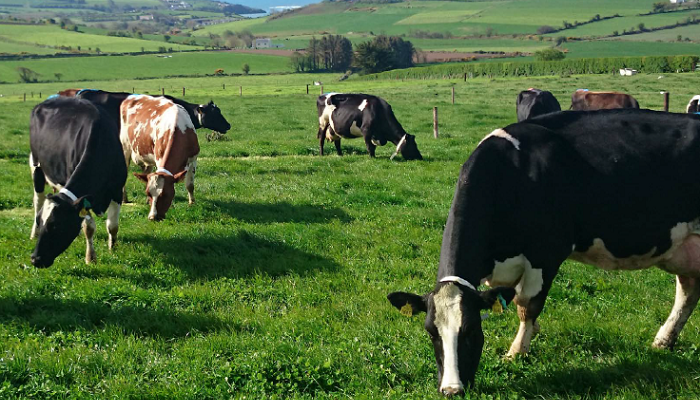
Ruminant Nutrition Specialist at Teagasc, Dr. Aisling Claffey shares key tips for maintaining performance during the mid-season, focusing on grassland management and meal supplementation levels.
Early lactation performance in dairy herds has been bolstered by superb grass utilisation on farm through the first and second rotation. With grass growth now exceeding demand on most farms, maintaining grass quality and appropriate pre-grazing cover is critical to supporting optimal milk production over the coming weeks.
The recent surge in growth gives farmers the opportunity to remove high quality surplus paddocks that can be used to buffer feed during potential periods of low growth or drought in the mid-season, or to reduce demand in late autumn to build cover on the platform for the final rotation, particularly as the dry matter decreases in the sward.
Grazing targets
Herds should be grazing covers of 1,300-1,500 kg DM/ha. It can be beneficial to cut and weigh a few paddocks to ensure you are appropriately estimating cover, particularly at high dry matters of 18-20%.
Grazing heavier covers can impact both on the digestibility of the sward and animal intake (see Table 1), resulting in poorer milk yield and milk protein concentration. Heavier covers tend to have more stem in the base of the sward which acts as a barrier to the cow grazing, resulting in increased residuals (5cm + plus) which will impact on sward quality in subsequent rotations.
Sward digestibility will naturally decline in the coming weeks as the plant ‘heads out’ so it is important that there is capacity in the system to remove surplus material and correct quality to support milk solids yield through the summer months.
Table 1. Impact of pre-grazing cover and concentrate allocation on grass DMI, total DMI, milk yield and response to concentrate
|
Meal kg as fed 0.88kg DM |
Grass DMI kg/cow |
Total DMI kg/cow |
Milk kg/cow |
Response kg milk/ kg conc. |
|---|---|---|---|---|
| Pre-grazing cover of 1,400kg DM/ha | ||||
| 0 | 16.8 | 16.8 | 23.9 | – |
| 2 | 16.2 | 17.9 | 26.2 | 1.15 |
| 4 | 15.6 | 19.1 | 27.8 | 0.80 |
| 6 | 14.9 | 20.2 | 29.0 | 0.60 |
| Pre-grazing cover of 2,000kg DM/ha | ||||
| 0 | 14.8 | 14.8 | 17.1 | – |
| 2 | 14.5 | 16.3 | 19.7 | 1.32 |
| 4 | 14.0 | 17.5 | 21.8 | 1.03 |
| 6 | 13.4 | 18.7 | 23.7 | 0.95 |
Meal feeding rates
Increased growth rates allow us to also address meal feeding rates on farm, to get more grass into the cow. Excess meal feeding will displace grass from the diet, but also impair total diet digestibility as the rumen environment will be less optimal for fibre digestion.
Take this opportunity to reduce meal by 1 kg and observe if this has any impact on cow performance. If grass quality is correct, it will be negligible. It takes approx. 0.6-0.7 kg milk to cover the cost of 1kg concentrate currently, much of this can be replaced with high quality grass. Is it actually paying you to feed meal at your current feed rate?
It is important to note that an additional kg of concentrate does not displace 1 kg of grass from the diet, it is more typically 0.5 kg DM grass displaced at higher feed rate (4-6 kg). Many farms may be under-predicting the intake potential and demand of our herds at peak milk production, particularly where cows are being strip grazed through the summer months.
Grass intake
It is also critical to ensure we are allocating enough grass to cows during the mid-season, and matching our stocking rate accordingly to allow the cow to express herself at grass. To achieve a grass intake of 17 kg DM, we need to allocate a minimum of 18 kg DM to ensure the cow achieves sufficient intake and can graze to at least 4.5 cm. Having appropriate paddock size to allow for 24-36 hour grazings at 1,400 kg DM/ha will also support optimal intakes of pasture and ensure we target the correct covers.
At a stocking rate of 3.5 LU/ha, a farm needs to consistently grow 63 kg DM/day to allocate 18kg of grass. Pushing mid-season stocking rate above this, particularly for long periods, limits our capacity to produce milk from grass, increases our costs of production and dependency on meal feeding and reduces our ability to reseed and correct grass quality via surplus bales.
More from Teagasc Daily: Dealing with surplus grass this May
More from Teagasc Daily: Nitrogen application strategies for grass-white clover swards