
Tracking nitrous oxide in Ireland’s peatland forests
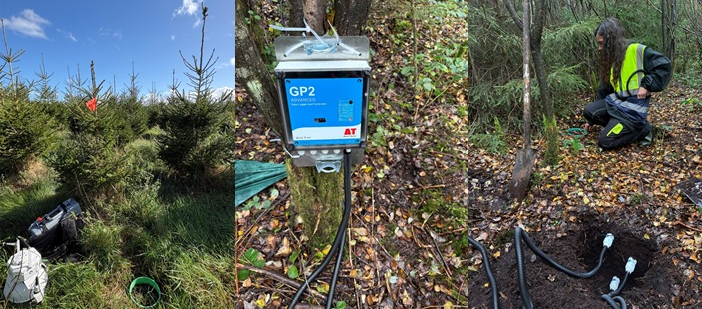
Understanding the climate impact of forests requires attention not only to carbon stored in trees, but also to greenhouse gas exchange between soils and the atmosphere. Nitrous oxide (N₂O), a potent greenhouse gas associated with microbial nitrogen cycling, is an important part of this assessment.
Vasiliki Polychronidou, PhD Student with Teagasc Forestry, Johnstown Castle, Co. Wexford, and Trinity College Dublin, tells us about her work.
The PeatFor project focuses on carbon and nitrogen fluxes in forested peatlands. Led by the University of Limerick, it examines how peat type, drainage level and tree species influence carbon and nitrogen dynamics. PeatFor combines field measurements, remote sensing and modelling to assess forest-climate interactions, providing insights to inform future land-use policies.
PeatFor is investigating N₂O emissions from forested peat soils, focusing on how water-table dynamics, soil properties and forest management influence their magnitude and underlying processes. Based at Teagasc, Johnstown Castle and Trinity College Dublin, this research is supervised by Dr Junliang Zou, Teagasc and Dr Matthew Saunders, Trinity College Dublin. It forms part of PeatFor, a key project funded by the Department of Agriculture, Food and the Marine.
Three fully operational field sites
A field-monitoring network for this research is now fully established and operational at locations in Colgagh, Co. Offaly, Christianstown, Co. Kildare and Cappaghoosh, Co. Galway. Regular N₂O measurements are currently being conducted at all three sites, alongside environmental monitoring.
At Christianstown, nine monitoring locations span mineral, organo-mineral and peat soils, with two permanent gas-sampling collars per location. This provides a comparison across contrasting soil conditions within the same forest. At Colgagh, six locations, also with two collars each, cover three locations in the thinning area and three in the unthinned area. Cappaghoosh contributes eight monitoring locations, each with one collar. Together, these collars provide fixed sampling points for repeated weekly measurements.
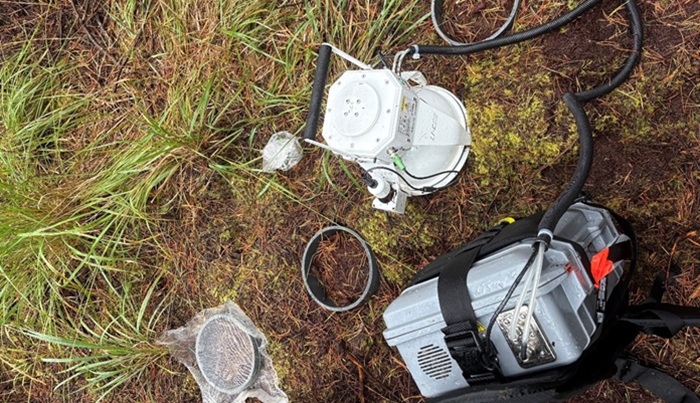
N₂O exchange is measured using a smart LI-COR chamber connected to a gas analyser. Changes in gas concentration during chamber closure are used to calculate the flux: the amount of N₂O exchanged per unit soil area and time.
Why the water table matters
Water-table depth is central to the research because it helps determine the balance between oxygenated and oxygen-limited conditions within the soil profile. When the water table falls, a greater volume of peat can become aerated, potentially increasing organic matter decomposition and nitrogen availability. Oxygenated conditions also support nitrification, the microbial conversion of ammonium to nitrate, which can generate N₂O.
When the water table rises, restricted oxygen availability can favour denitrification, through which nitrate is reduced to gaseous nitrogen compounds. However, wetter conditions do not necessarily produce higher N₂O emissions. Under suitable oxygen-limited conditions, microorganisms can further reduce N₂O to nitrogen gas (N₂), lowering the amount released to the atmosphere. Nitrogen availability and other soil properties influence these responses.
The research therefore examines both water-table depth and its fluctuations, rather than assuming a simple relationship between wetness and emissions.
At Colgagh and Christianstown, automated water-table loggers and soil temperature and moisture sensors provide environmental records between gas-measurement campaigns. At Cappaghoosh, supporting measurements are collected manually during visits. Linking these records with N₂O fluxes will help investigate responses to drying, wetting and seasonal changes.
What the measurements are showing
Initial observations indicate substantial spatial variability, with some locations producing much higher fluxes than others. These localised emission ‘hotspots’ underline the importance of monitoring multiple locations rather than relying on a single measurement to represent an entire forest.
The current priority is to establish whether these patterns persist and how they relate to measured environmental conditions. A longer seasonal record is needed before drawing conclusions about annual emissions or management effects.
Using isotopes to partition N₂O sources
Measuring a flux tells us how much N₂O reaches the atmosphere, but not which processes produced it. The next phase will introduce stable-isotope measurements to help partition N₂O sources, with the aim of estimating the relative contributions of nitrification-related and denitrification-related pathways.
Seasonal isotope sampling is planned to begin in November 2026, once laboratory arrangements are finalised. Proposed analyses include the nitrogen and oxygen isotope composition of N₂O (δ¹⁵N and δ¹⁸O) and, subject to calibration arrangements, nitrogen site preference the difference in isotope composition between the molecule’s two nitrogen positions.
These signatures provide complementary information about N₂O production and its subsequent reduction to N₂. Interpretation must account for overlapping source signatures and changes caused by N₂O consumption, rather than treating an isotope measurement as a unique fingerprint of one process.
Combined with water-table records and supporting soil and vegetation analyses, the isotope component will help explain why similar environmental conditions can produce different net emissions.
From field evidence to forestry understanding
The combined field, environmental and isotope dataset will also support the development and testing of process-based models exploring N₂O responses to changing soil conditions.
For forestry, the longer-term objective is developing a stronger evidence base for assessing greenhouse gas exchange from existing forests on peat soils. By connecting emissions with hydrology and nitrogen-cycling processes, this research will contribute to PeatFor’s wider assessment of peatland forest management for climate and biodiversity.