
Trends in off-farm employment and pensions on Irish farms
Preliminary results of the National Farm Survey 2025 were presented earlier this week. Interesting trends in both farm holder and farm household (farmer and spouse) off-farm employment across farm systems were presented.
Prepared by Emma Dillon, Trevor Donnellan, Brian Moran and John Lennon of the Teagasc Agricultural Economics and Farm Surveys Department, some of the key findings are available to read below:
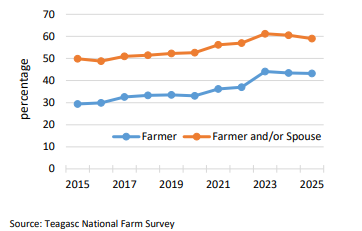
The proportion of farm households where either the farmer or spouse was employed off-farm declined in 2025 to 59%, on average. The proportion of farm holders employed off-farm remained relatively unchanged at 43%.
Figure 1: Off-farm employment (farm and spouse) 2015-2025
Variation by system
The off-farm employment situation differs by system. On average, 54% of tillage farm operators also worked off-farm with a similar proportion on cattle rearing farms (52%) and a slightly lower proportion on cattle other farms at 50%. The comparative figure on sheep farms was 46%.
Although a very low proportion of dairy farmers work off-farm, 58% of dairy farm households have an off-farm employment income i.e. a high proportion of spouses (53%) work off-farm in dairy farm households. The average incidence of household off-farm employment in 2025 (where either the farm holder or spouse was employed off-farm) was 74% on tillage farms, 62% on cattle rearing farms and 57% on both cattle and sheep farms.
The incidence of off-farm employment varies across regions and is a reflection of the dominant type of farming in each region, with some small variation across regions year-on-year.
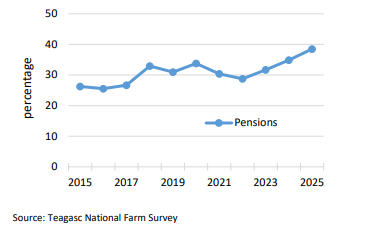
The apparent decline in the proportion of households with an off-farm employment income source is most likely related to the ageing profile of Irish farmers. This is reflected in the associated increase in the proportion of farm households in receipt of pensions (through either the farm holder or spouse) in recent years (Figure 2). In 2025, the data indicates that the proportion of farm households in receipt of pension income was 39%.
Figure 2: Farm households in receipt of pensions 2015-2025
Age of farmers
In 2025, the average age of cattle farmers was 60 years, with the average sheep farmer aged just below this at 59 years. Tillage farmers reported an average age of 56 years with dairy farmers 55 years, in 2025. The higher age profile of drystock farm households is reflected in the relatively larger proportion of those households in receipt of pension income, this was highest on cattle farms in 2025, at about 44% on average. The figure was 38% on sheep farms, 26% on tillage farms and 25% on dairy farms, on average.
To read the full Teagasc National Farm Survey Report 2025, visit here.
Read more: Further growth in farm incomes across all systems in 2025