
Turning a new leaf
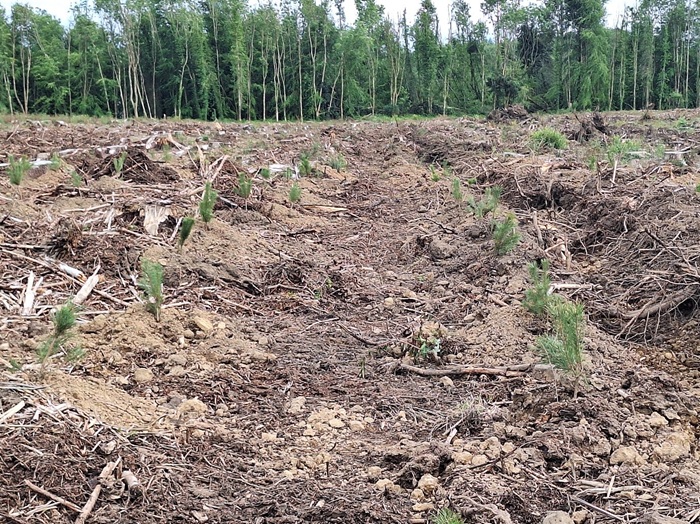
Recent Teagasc Reforestation after Storm Damage events highlighted pathways to re-establishing new forests that are available to forest owners. For one farming family the clearance of their storm damaged forests presents opportunities for new hope and forest renewal. Noel Kennedy tells us more.
Once a forest has been clearfelled, the area must be restocked with a new generation of trees. The aim of this reforestation is to provide an ideal tree planting environment, encourage strong growth of the most suitable tree species and minimise losses or growth delays.
The reforestation stage provides opportunities for the forest owner. Based on previous research studies, replanting sites, particularly those using improved planting stock, can be significantly more productive than the first rotation. Options for diversifying the range of species to improve resilience for the next forest cycle can also be considered.
Replanting with the same tree species such as Sitka spruce is a common choice for many owners with the objective of continuing commercial timber production. However, owners may also wish to consider additional environmental objectives for their new generation of trees where, for example, species diversification with other conifer and broadleaf species can enhance biodiversity while broadening the potential range of timber production.
A forest owner experience
For Pyers O’Conor Nash and his family located near Castlerea, Co Roscommon, who hosted a recent Teagasc Reforestation after Storm Damage demonstration, it signified the turning of a new leaf from the bleak aftermath of storm damage and forward to brighter days and the growth of a new generation of trees and forests.
“We are farming an organic Angus suckler herd,” said Pyers. “We began planting forestry in 1985 increasing over the years to 60 hectares of commercial conifers.”
Storm impact and response
Things changed in January 2025 when storm Éowyn caused severe impacts to trees across their forest at Clonalis, especially to the older and most commercially valuable Sitka and Norway spruce forests.
Pyers knew that despite the shock of this unprecedented event he needed to act quickly and within a few days began to plan for the harvesting and clearance of the damaged areas. Forestry company Western Forestry Co-Op was engaged to harvest and sell the windblown timber into a turbulent market.
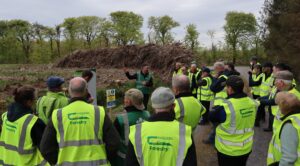
Pyers understood he wasn’t alone and in April 2025 generously hosted a Teagasc led post-storm timber harvesting demonstration bringing his experience to support many similarly impacted forest owners. With extensive coverage of the event by RTE, the scale and impact of forest damage was brought to a national audience.
“We eventually harvested over 7,000 tonnes of timber in Clonalis producing sawlog, pallet, stakes and pulpwood,” said Pyers.
“We weren’t happy about the financial loss from lower timber prices and the opportunity cost of losses from premature harvesting. But we were fortunate to have achieved a reasonable volume of the highest value sawlog timber.”
Looking forward
Pyers is now preparing for the next stage of recovery and renewal, the replanting of a new generation of forests and re-starting the cycle of high-quality commercial timber production.
He said he is heartened by the availability of grant support for the replanting of storm damaged forests but is uncertain about potential maintenance costs to achieve satisfactory forest establishment after four years.
“In the longer term we are also exploring potential alternative income steams to complement timber income, such as carbon and biodiversity credits,” said Pyers. “If and when available, we hope they may encourage the younger O’Conor Nash generations and secure Clonalis’ legacy of beautiful and hard-working forests.”
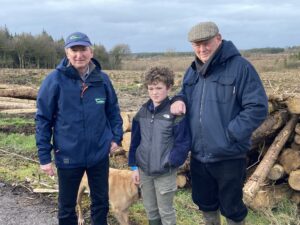
Pyers O’Conor Nash with his grandson Haron and Noel Kennedy, Teagasc Forestry Development Officer, Discussing reforestation plans.
Pathways to re-establishing new forests
Replanting Support Schemes
The Department of Agriculture, Food and the Marine (DAFM) Reconstitution Scheme for Windblow 2026 (RSW) was launched in early February 2026. This provides financial support for private forest owners with forest areas impacted by recent Storms Darragh and Éowyn.
Support may be available to applicants with eligible areas in the form of fixed rate grants of between €3,858 and €6,744 per hectare, according to the Forest Type(s) appropriate for the reconstitution activities. The Department’s scheme document sets out details in terms of RSW qualifying criteria.
The Climate Resilient Reforestation Scheme is a pilot initiative launched by the DAFM in July 2024. It has an annual current annual limit of 525ha, with a maximum 12ha per application. This scheme offers financial support to eligible forest owners who wish to reforest for a different purpose and to build resilience in response to the challenges that climate brings to Irish forests.
Approved applicants can choose from three different elements: Reforestation for Continuous Cover Forestry (CCF), Reforestation for Native Forests and Reforestation for Biodiversity and Water.
A welcome 20% increase in grant rates for this scheme as well as a 20% increase in the forest road grant rate per linear metre was recently announced as part of the suite of enhancements under the DAFM Mid-Term Review of the Forestry Programme.
Forest owners with ash forests affected by ash dieback disease of the following supports:
The Reconstitution Ash Dieback Scheme 2023-2027 provides grant supports for both clearance of the affected ash trees and also for replanting of the forest with appropriate Forest Type options within the Forestry Programme 2023-2027.
The Climate Actions Performance Payment (CAPP) provides additional support €5,000 per hectare for applicants who have already participated in the Reconstitution Ash Dieback Scheme 2023-2027 or who reconstituted under one of the Departments previous reconstitution schemes addressing the impacts of ash dieback.
Consider your options
Reforestation allows forest owners an opportunity to pause and consider their options before choosing the next forest rotation path. The owner’s objectives may have changed from their first crop of trees to reflect the multi-functional nature of forestry.
It is advisable to have an intergenerational discussion on what way the family want to proceed with the forestry enterprise. For further information on reforestation and all aspects of forestry, contact your local Teagasc Forestry Advisor.