
28 October 2023
Using poultry manures on tillage farms – a win-win opportunity
Building stable and healthy relationships between tillage and poultry enterprises will create a win-win for both, John Mahon, Teagasc Signpost Tillage Advisor, told those attending the recent Signpost Programme Poultry event in Monasterboice, Co. Louth.
John explained: “There are opportunities for tillage farmers and poultry producers to come together under working partnerships. Using grain produced on Irish tillage farms in poultry diets and the return of organic manure back to tillage farms is beneficial for environmental sustainability, as the carbon footprint of both enterprises can be reduced.
“The poultry sector can access local sustainable grain; the tillage sector can access organic manures that will reduce costs and save on artificial nitrogen inputs.”
Commenting further, John explained: “Although Irish grain has a lower carbon footprint than most other countries worldwide, there is still scope to improve the greenhouse gases emitted from the Irish tillage sector.
“On Irish tillage farms, about 70% of greenhouse gas emissions are generated from nitrogen inputs. This can be broken down into greenhouse gases associated with the manufacture of nitrogen, nitrate leaching and nitrate losses to air.
“Organic manures can play a valuable role on tillage farms. Not only are they an excellent source of nutrients, they also provide an opportunity to reduce the quantity of artificial nitrogen applied, which is beneficial from a cost-saving and greenhouse gas emissions perspective.”
Considerations for tillage farmers when using poultry manures
For tillage farmers considering importing poultry manure, John said: “Before going out to seek poultry manure, you first need to find a poultry producer and identify is his/her proximity close enough to justify the transfer of manures.
“The time of year in which poultry manures will come available from this supplier must also be considered. If they have poultry manure available during the closed period for application, do you have adequate storage facilities on your farm to hold it until the time is right to spread?”
Once a source of poultry manure has been identified, John directed tillage farmers to consult their agricultural advisor in relation to the regulations that apply to its transport, spreading and incorporation.
“Compliance with the Good Agricultural Practice for the Protection of Waters, commonly referred to as Nitrates Regulations, and the Department of Agriculture, Food and the Marine’s Code of Good Practice for End Users of Poultry Litter, which includes regulations on the transport, storage, spreading and record keeping associated with poultry manures, is critical.”
Assessing the quality of poultry manure that will be provided is also a must, with laboratory testing to identify its nutrient content and dry matter percentage.
“A great deal of variability can exist between poultry manures,” John commented. “This variability stems from the house in which it was produced – either laying hen or broiler houses – and also the diet fed.
“By completing an analysis of the manure, you will be able to develop targeted fertiliser plans based on the manure’s nutrient content. This way, tillage farmers will be able to adjust their fertiliser plans to include poultry manures when establishing such crops as spring barley, with the poultry manure incorporated at establishment.”
Fertiliser savings through poultry manure use
Presenting data from trial work completed by Martin Bourke over 2015 and 2016 on spring barley in Co. Wicklow, John noted that similar yields were achieved when poultry manure was used in conjunction with either CAN or urea-based fertilisers when compared to CAN only applications.
The trial compared incorporation method, with both ploughing and min-till being examined, the use of CAN and urea as a chemical nitrogen source and what effect replacing some of the chemical nitrogen with nitrogen contained within the poultry manure would have on grain yield and grain protein percentage.
In all scenarios presented, crop yields were similar with no significant differences when the total nitrogen load (including both artificial and the nitrogen derived from organic manures) was brought to 150kg N/ha.
Turning to the potential savings made by using poultry manure in conjunction with urea fertiliser as opposed to applications of 10:10:20 and CAN (see programme in table 1 below), John noted that savings of €342/ha could be realised when assumed fertiliser prices of €810/t for urea, €750/t for CAN, €850/t for 10:10:20 and €40/t spread for poultry manure were factored into the equation. These prices were reflective of high fertiliser prices in 2023.
Although fertiliser prices have dropped considerably over the course of this year, John estimates that savings in the region of €150-200/ha are likely with forecasted 2024 fertiliser prices.
Table 1: Fertiliser programme used
| Fertiliser programme | N (kg/ha) | P (kg/ha) | K (kg/ha) |
|---|---|---|---|
| 4.27t/ha poultry manure (68kg N) + 82kg N/ha (urea) | 150 | 42 | 85 |
| 420kg of 10:10:20/ha + 108kg N/ha (CAN) | 150 | 42 | 84 |
| Source: Teagasc trial, M. Bourke, 2016 | |||
In his closing remarks, John noted that poultry manure is a viable alternative to replace crop chemical fertiliser requirements and big cost savings can be achieved if conditions are suitable – this includes the distance from the farm of origin, the storage facilities available and applying the manure to the right crop at the right time.
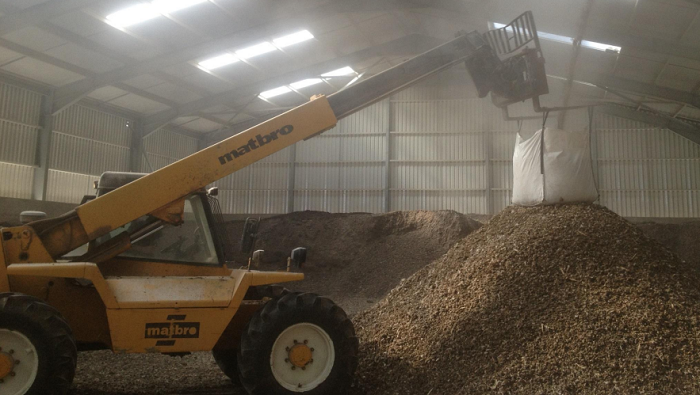
Photo caption: Poultry manure being loaded. Image source: Martin Bourke