
Using the California Mastitis Test (CMT) after calving
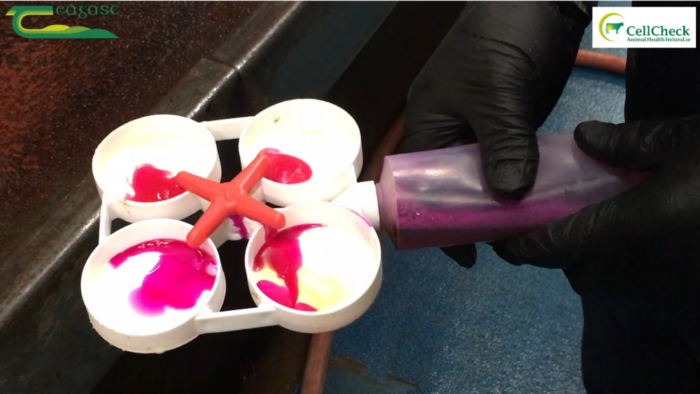
Calving is currently in full swing on most dairy farms, with many tasks needing to be completed each day. One of these important tasks is carrying out the California Mastitis Test (CMT) on freshly calved cows, typically around five days after calving, Padraig O’Connor, Dairy Technician at Teagasc Grange, outlines the process.
The CMT is a simple and effective test used to identify high somatic cell count (SCC) quarters in cows with high SCC or sub-clinical mastitis. These high SCC quarters cannot be detected visually, as there are no visible clots in the milk to the naked eye.
It is recommended that all freshly calved cows are tested before moving from the fresh cow mob into the main herd.
- If the cow tests clear, she can move into the main herd.
- If sub-clinical mastitis is detected in any quarter, the cow should remain in the fresh mob and be treated accordingly.
This practice should continue until milk recording can be completed. Using the CMT test helps reduce the risk of cross-contamination and supports the maintenance of a low bulk tank SCC. While electronic devices are also available to identify high SCC quarters, the CMT remains a simple and cost-effective option.
How to perform the CMT Test
- The test should be completed before milking.
- Discard the first three to four squirts of foremilk from each quarter.
- Squirt milk from each quarter into a separate well on the CMT paddle.
- Tilt the paddle to allow excess milk to pour out until the marker lines in each well are visible. This indicates the correct milk volume.
- Add an equal amount of CMT reagent to each well.
- Gently swirl the paddle for 10 seconds.
- Examine the reaction within 20 seconds.
- The degree of thickening or gelling indicates the level of sub-clinical mastitis in each quarter.
In the below video, Don Crowley discusses explains how the CMT can be used to identify high cell count quarters within high cell count cows:
Scoring the CMT Test
Score 1 – Very Good
- No change in thickness
- SCC < 500,000
Score 2 – Poor
- Grainy appearance when liquid is tilted left or right
- SCC > 500,000 – < 1,500,000
Score 3 – Very Poor
- Obvious thickening or gel formation
- SCC > 2,000,000
Conclusion
The CMT test is a simple and effective method for the early identification of sub-clinical mastitis and high SCC quarters. Following calving, cows should remain in a fresh cow mob until they have been tested and cleared before joining the main herd. Consistent use of the CMT test helps identify high SCC cows early, reduces the risk of mastitis spread and supports overall herd milk quality.