
17 July 2023
Using white clover to reduce nitrogen fertilisation
Reduced nitrogen fertiliser use at farm level will require greater utilisation of white clover in grazing swards in order to maintain herbage production, Brian McCarthy, Deirdre Hennessy and Áine Murray tell us more.
Recent European Union and Irish Government policy changes have placed a greater emphasis on reducing nitrogen (N) fertiliser use at farm level to improve the environmental sustainability of agriculture.
The updated Climate Action Plan, released by the Irish Government in 2022, has set a maximum limit of 300,000t of N fertiliser use for the agricultural sector in Ireland by 2030. To put this into context, in 2021 399,000t were used and a reduced level of 343,193t were used in 2022. This was a 14% reduction from 2021 levels and was largely driven by the huge increase in fertiliser price in 2022.
Clover, both red and white, will play a significant role in offsetting the reduction in N fertiliser use on Irish farms, while helping to maintain adequate grass dry matter (DM) production at farm level. This is achieved through the biological N fixing ability of red and white clover. Red clover is likely to play a significant role in silage swards, where it can reliably produce high yields of high quality silage with little to no N fertiliser application.
White clover inclusion will be the main mechanism to facilitate reductions in N fertiliser use in grazing swards. White clover is the most commonly sown legume species in temperate grassland due to the fact that it grows well in association with grass, can persist within the sward when established and maintained, and is tolerant of grazing.
Biological N fixation
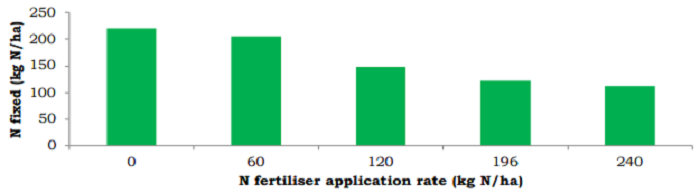
Clover can fix N from the atmosphere and make it available for plant growth. Rhizobia bacteria live in nodules on the roots of clover and fix N making it available for plant growth. Research has shown that between 0 to 220kg N/ha per year can be fixed when clover is included in grass swards (Figure 1).
The rate of N fixation is influenced by N fertiliser supply to the sward and the sward clover content. Generally, an average annual sward clover content of at least 20% is required for sufficient N fixation. In fertilised swards, as N fertiliser application rate increases, N fixation generally declines.
Figure 1: Nitrogen fixation (kg N/ha) on grass clover swards receiving 0, 60, 120, 196 and 240 kg N fertiliser/ha over three years
White clover research
A number of systems research experiments have been undertaken in recent years. These experiments have shown very positive results in terms of reducing N fertiliser application to grass-white clover swards whilst maintaining similar total pasture DM production to grass-only swards receiving higher levels of N fertiliser. Table 1 shows the grass DM production from three systems experiments where grass-clover swards receiving 100 kg less N fertiliser produced on average only 0.4 t DM/ha less than grass-only swards (14.1 vs 14.5 t DM/ha, respectively).
Table 1: Grass DM production and sward clover content from three systems experiments comparing grass-only and grass-clover swards
|
Grass-only (250kg N/ha) |
Grass-clover (150kg N/ha) |
|
|---|---|---|
| Moorepark Experiment (2013-2020) | ||
| Grass production (t DM/ha) | 13.8 | 13.5 |
| Sward white clover content (%) | – | 22 |
| Clonakilty Experiment (2019-2021) | ||
| Grass production (t DM/ha) | 15.2 | 14.6 |
| Sward white clover content (%) | – | 18 |
| Clonakilty Experiment (2022) | ||
| Grass production (t DM/ha) | 14.4 | 14.3 |
| Sward white clover content (%) | – | 14 |
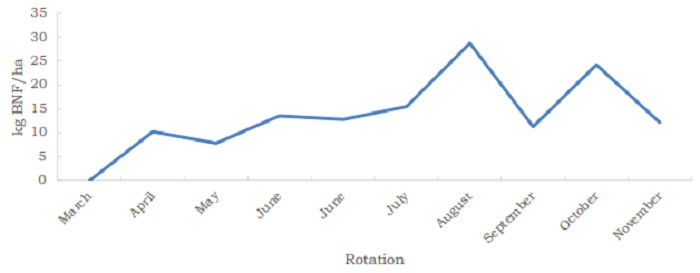
Within the Moorepark experiment in 2021 and the Clonakilty experiment in 2020 and 2021, zero N exclusion plots (5×5m) were included within a subset of the grass-only and grass clover paddocks. These plots were fenced, received zero N fertiliser or slurry, and were not grazed. The plots were mechanically harvested at the same time as the surrounding paddock was grazed by dairy cows, and herbage yield and N content were measured. This allowed the calculation of N yield (which is an indicator of N mineralisation from the soil) and N fixation. On average, the zero N grass-only plots yielded 7.5 t DM/ha and had an N yield of 193 kg/ha, whereas the zero N grass-clover plots yielded 10.3 t DM/ha and had an N yield of 296 kg/ha, indicating N fixation of 104 kg N/ha per year. The pattern of N fixation across the grazing season is illustrated in Figure 2.
Figure 2: Pattern of biological N fixation across the grazing year (average of Moorepark (2021) and Clonakilty (2020-2021)
Conclusions
White clover, by utilising its biological N fixing ability, can offset reductions in N fertiliser use to maintain grass DM production and its use at farm level should be increased significantly in future.
This article first appeared in the Moorepark ’23 Dairy Open Day booklet. For more information on the research work carried out at Teagasc Moorepark, click here.