
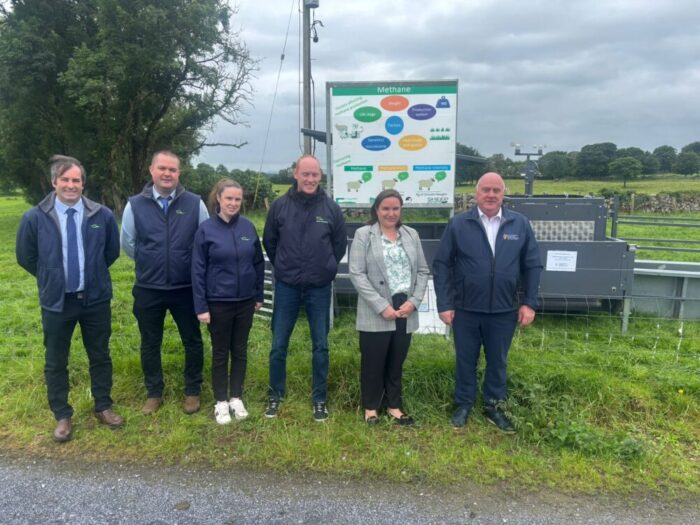
Noel Grealish TD, Minister of State at the Department of Agriculture, Food and the Marine with special responsibility for research, visited Teagasc Athenry, County Galway on Monday, 21 July where he met with Teagasc researchers who provided an overview of various Department of Agriculture, Food and the Marine (DAFM) funded research projects which are ongoing at the Mellows Campus in Athenry, County Galway.
Minister Grealish was provided with an overview of the following research projects:
Modelling Estimates for Agricultural Sustainability Using Real Evidence (MEASURE)
Dr Emma Dillon, Agricultural Economics and Farm Surveys Department, Teagasc
MEASURE aims to enhance Ireland’s capacity to assess and improve the sustainability of its agricultural sector by addressing key data and modelling gaps. It will deliver nationally representative evidence using real farm-level data, integrated from the National Farm Survey and other sources, to support policy development, industry decision-making, and Ireland’s leadership in sustainable food systems. The project will also foster stakeholder knowledge exchange and trial innovative methods of data collection and sharing, culminating in the development of interactive dashboards to visualise farm sustainability across economic, environmental, and social dimensions.
Gender and Generational Factors in Agricultural Resource Management for Sustainability (GENFARMS)
Dr Emma Dillon, Agricultural Economics and Farm Surveys Department, Teagasc
GENFARMS aims to deepen understanding of how gender and generational dynamics influence sustainability and innovation in Irish agriculture. By integrating quantitative and qualitative research methods, the project explores the roles, contributions, and barriers faced by women and younger people in farming. It will generate evidence-based insights to inform policy and promote a more inclusive, equitable, and resilient agricultural sector. The project also emphasises stakeholder engagement and knowledge exchange to ensure that diverse perspectives shape the transition toward sustainable farming practices.
Optimising Biosecurity Risk Communication Pathways for Bovine Tuberculosis
Sharon Sweeney, Teagasc, Rural Economy & Development Programme
ADAPTForRes Research Project
Dr Niall Farrelly and Tom Houlihan, Teagasc Forestry Development Department
The ADAPTForRes Research Project is looking at strategies to increase resilience of Irish forests to impacts of climate change. The research is aimed at pathways which facilitate increased adaptation, mitigation and protection measures have the impact of increasing resilience and reducing the negative effects of climate change on Irish forests.
Strategies include forest genetic options aimed at increasing adaptation, strategies to increase the sustainability of forest sinks to provide GHG emission reductions, and innovative measures to assist the protection of the forest resources from the risk of harmful pests and pathogens. The research is being conducted by Teagasc in collaboration with UCD, University of Limerick, TCD, National Botanic Gardens and AFBI in Northern Ireland. It is funded by the Department of Agriculture, Food and the Marine (DAFM) under grant number 2021RI302 and by the Department of Agriculture, Environment and Rural Affairs (DAERA) in Northern Ireland.
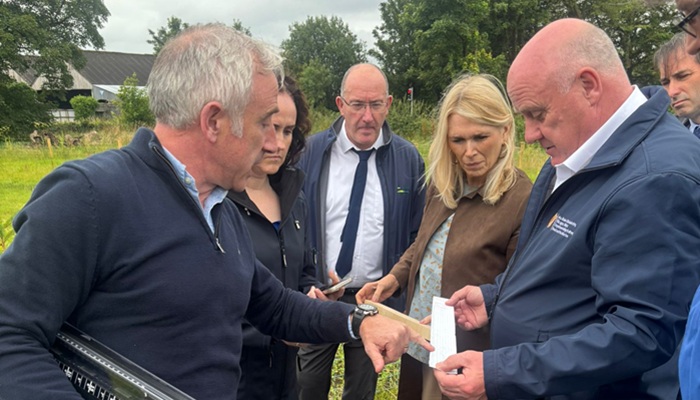
Dr Niall Farrelly ,Teagasc Athenry and Tom Houlihan, Head of Forestry Development Department, Teagasc, update Minister of State Noel Grealish TD and his team on the latest forestry research developments
RumenVentory Research Project
Dr Noirin McHugh, Dr Edel O’Connor and Eoin Dunne, Teagasc Athenry and Professor David Kenny, Teagasc Grange
Currently, methane output from Irish sheep is estimated using the tier one IPCC methodology, which does not use country specific data. The objective of the RumenVentory project is to measure methane output across the production cycle of sheep using the GreenFeed system. The data generated from this project will be used to generate country specific methane emission factors representative of Irish sheep, enabling the agricultural industry to accurately quantify methane output from enteric fermentation.
Methane Predict Research Project
Dr Noirin McHugh, Dr Edel O’Connor and Eoin Dunne, Teagasc Athenry and Professor David Kenny, Teagasc Grange
The Methane-Predict project is a collaborative effort between Ireland and New Zealand to develop scalable low-cost tools for predicting methane emissions in ruminant animals. Central to the project is the identification and validation of biological markers, such as rumen microbial profiles, and fatty acid signatures in milk and meat that correlate with methane output. These biomarkers will be integrated into genomics selection frameworks, enabling the ranking of animals for both productivity and environmental impact. The project supports Ireland’s climate action goals and contributes to global mitigation strategies.
Growing Resilient Organic Farming Systems’ Research Project
Dr Kevin Kilcline, Dr Philip Creighton and Dr Frank Campion, Teagasc Athenry
Growing Resilient Organic Farming Systems – GROFarmS, is a Teagasc organic farming research project being undertaken in conjunction with University College Dublin. The GROFarmS project aims to address the current research gaps in organic farming and demonstrate to farmers technically efficient organic systems of production.
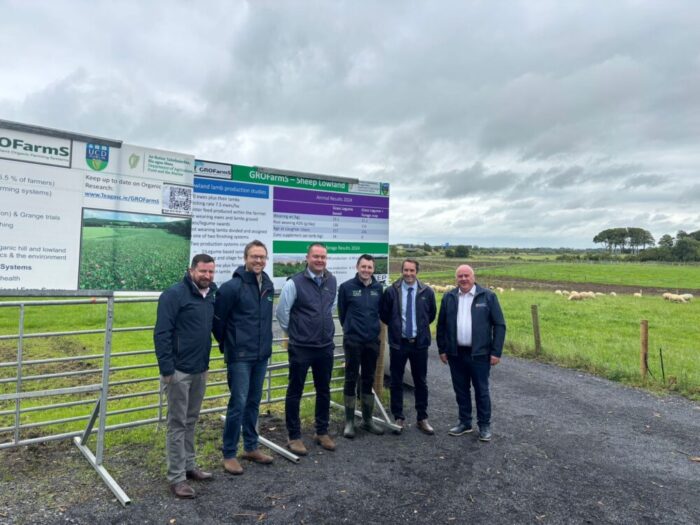
Pictured at Minister Grealish’s recent visit to Teagasc Athenry are from left to right: Dr Karl Walsh, Head of the Research, Bioeconomy and Codex Division at the Department of Agriculture, Food and the Marine; Dr Kevin Kilcline, Dr Philip Creighton, Dr Frank Campion and Professor David Kenny; and Noel Grealish TD, Minister of State at the Department of Agriculture, Food and the Marine with special responsibility for research.
The research will develop evidence on best practice technologies to support profitable and sustainable organic beef and lamb finishing systems.
Dr Kevin Kilcline, Teagasc researcher and GROFarmS project lead said: “The area of organic farming has more than trebled since 2020. There is a pressing need for scientific research on organic farming practices to support evidence based best practice adoption. This project will provide new information on economic and environmental aspects of organic conversion and best practice adoption.”
Research on sustainable organic lamb production is being conducted at the Teagasc Animal & Grassland Research and Innovation Centre in Athenry, led by researchers Dr Philp Creighton and Dr Frank Campion. They will be researching finishing options and management systems for organic hill and lowland lambs and will be conducting the research in collaboration with UCD. This work will take into account effects on animal performance, environmental impact and economic returns.
More from Teagasc Daily: Less meal and earlier finishing with diverse swards
More from Teagasc Daily: Forage crops: An option for finishing hill lambs?
More from Teagasc Daily: Deepening the understanding of hill sheep grazing patterns