
Watch: AI-powered laser weeding in organic vegetables: A first-of-its-kind in Ireland
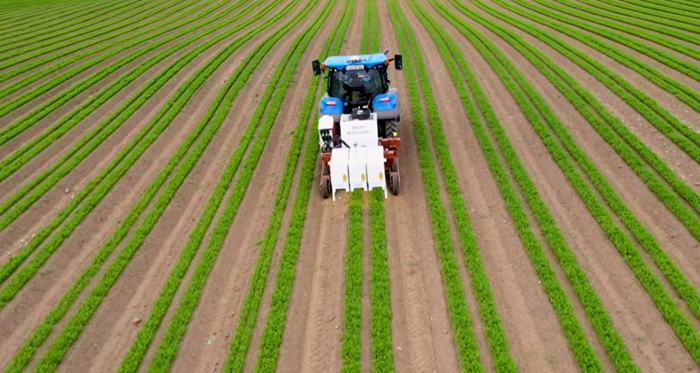
Lasers and artificial intelligence (AI) have long been the stuff of science fiction, but now writes William Deasy, Specialised Vegetable Advisor, some growers are using state-of-the-art commercially available AI-assisted laser weeders for managing weeds in their crops.
Coolnagrower Organic Produce Ltd. laser weeder investment
Philip Draper, Managing Director of Coolnagrower Organic Produce Ltd., is the first grower in Ireland to invest in an AI-powered Carbon Robotics LaserWeeder™ G2.
Philip primarily grows organic carrots, parsnips, beetroot and potatoes and a significant amount of weed management, prior to the LaserWeeder, was done by hand.
“The main reason we were looking at the LaserWeeder was to cut down on manual labour. Manual labour is becoming hard to source and increasingly more expensive,” Philip explained.
And the investment case extends beyond labour costs to weather and climate resilience. Philip added: “Even in a wet season this machine can work, which is very important, especially in Ireland.”
In the below video, William Deasy visits Coolnagrower Organic Produce Ltd. near Birr, Co. Offaly, where grower Philip Draper has become the first farmer in Ireland to invest in a state-of-the-art AI-powered laser weeder:
About the technology, performance and key benefits
The tractor-mounted LaserWeeder passes over crop rows and takes images using high-resolution cameras. AI analyses the images to distinguish weeds from the crop. Then, the lasers shoot the weeds to kill them without damaging the crop or disturbing the soil.
“It’s very important to hit the weeds at the small stage,” explains Philip. “If the weed gets a bit bigger, that means the machine has to go slower.”
The LaserWeeder has required some changes to how Philip typically sows his crops. Sowing is now staggered out to ensure too much is not planted on the same day, otherwise the LaserWeeder would be unable to get through enough acres at the ideal time.
“You have to have your sowings staggered to target the weeds when they’re at the ideal stage, the small stage. It has meant that we’ve had to work long hours when the weed is at the right stage, rather than letting the weeds get too strong. It’s taking us six hours for one acre, and we’ve had to give it three passes. So, on a 24-hour shift we were doing four acres a day.”
The LaserWeeder does not kill every weed but each pass captures weed and crop plant data, which feeds back into the AI model continuously improving detection accuracy, and now Coolnagrower Organic Produce Ltd. only needs a couple of workers to do some follow-up hand weeding whereas before a hand-weeding crew had to be employed.
“The main benefit is we haven’t had to employ a manual weeding crew to come in and do the weeding,” Philip added.
“Another major advantage is the crop is clean now at an earlier stage than I’ve ever had it before. By having this machine, it will allow us now to start bringing our sowings a little bit earlier and to extend the market at that end of the year.”
Support from Department of Agriculture, Food and the Marine Scheme of Investment Aid for the Development of the Commercial Horticulture Sector
Acknowledging support from the Department of Agriculture, Food and the Marine for this significant investment Philip said: “We applied for grant aid with the Department of Agriculture under the commercial horticulture scheme and thankfully we were approved for a grant, which was a huge help and allowed us to make the investment in this technology.”
Investing in the future of the farm
“When you’re making an investment of this level, you’re not just thinking of the next five years down the line, you’re looking at where the business is going to be in the next 20 years’ time. So certainly, this is going to secure the future of the business as well. It’s making the whole thing work more sustainably,” Philip added.
Special thanks to Philip Draper for sharing your expertise and valuable insights for this video and article.