
21 January 2024
Watch: Tips on establishing your ACRES hedge
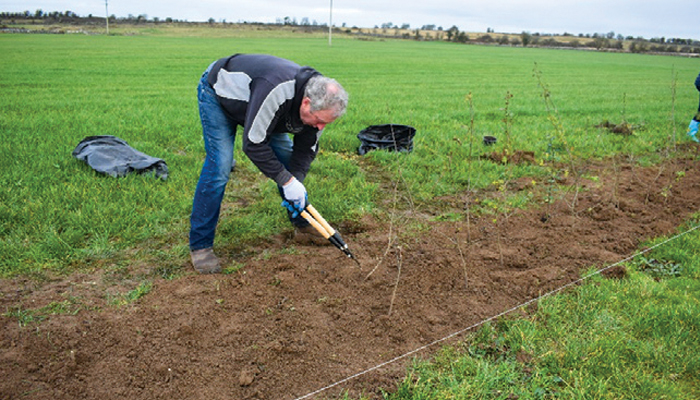
Following a wet winter thus far, the cold spell over recent days has finally allowed farmland to dry, and this may give those who have signed up to ACRES an opportunity to get in and establish their hedging.
Approximately 5,000 farmers will plant 2,000km of new hedges under the Agri-Climate Rural Environment Scheme (ACRES) this winter, adding to Ireland’s extensive network of hedgerows.
When establishing a hedge, farmers must decide if it’s a topped or treeline hedge they wish to establish. Both hedge types are good for biodiversity and both should be present on farms, but management during the establishment years differ.
Topped hedges are those that are maintained to form a traditional hedge with a dense base, while treeline hedges – previously referred to as escaped hedges – are untopped hedges, forming a line of trees or linear woodlands.
Depending on the hedge type desired, the species mix may differ. However, as set out in the terms and conditions of the ACRES scheme, plants must be of Irish origin or provenance and must be purchased from registered producers. The Irish provenance is an important point, as it’s not only a condition of the scheme but such plants are more accustomed to Irish growing conditions. However, due to a shortage in whitethorn whips, some flexibility has been granted to allow non-Irish whitethorns to be sown. This flexibility only applies to whitethorn and all other species must meet the above requirements.
In addition, as part of the ACRES contract, five plants per metre must be planted in a double staggered row, with at least three species – with no one making up more than 70% of the total – planted. That’s about 40cm between the plants and about 40cm between the rows.
Establishing a topped hedge
When establishing a hedge, the first step is identifying suitable species that meet the specifications of your ACRES contract. Topped hedges require species that are tolerant to trimming.
After selecting the suitable species, the next step is turning over the ground with a digger to make it easier for planting. On plant selection and planting, choose two year old bare rooted whips; these are strong and tall and have a better chance of survival compared to one year old whips. Always be careful when planting that you don’t let the whip dry out. Don’t burry the stem when planting, but ensure the roots aren’t exposed. Once in place, firm the soil around the plant with your boot.
Once successfully planted, the next task is identifying and protecting occasional individual plants with a tree guard. These selected trees – approximately one per every 10m – will be allowed grow above the height of the hedge in future years and will prove a valuable asset to biodiversity.
In the below video, Catherine Keena, Countryside Management Specialist at Teagasc, outlines the important steps to take when planting a topped hedge:
On the management of the remainder of the hedge following planting – with the exception of holly and the guarded individual trees – plants should be pruned to about 3cm above the ground. A common mistake that farmers make is failing to prone. Everyone is nervous of pruning at first, but it’s important to create a dense hedge. This cut should be sloping, leaving a sharp point.
Once this has been completed, push a compostable film over the pruned stumps to create a barrier to avoid competition for the newly-sown hedge with weeds or grass. Bark mulch can also be used if available. Also consider whether fencing is required to reduce the damage caused by grazing livestock or rabbits.
Additional pruning will be required for a few years after the hedge has been planted, and this should be done in a targeted manner to help thicken any weak spots within the hedge. The aim, after a few years, is to be able to remove the fence.
Treeline hedge
Some farmers, however, may opt to grow a treeline hedge. The planting procedure for a treeline hedge in ACRES is the same as for a topped hedge, except no hedge plants are pruned but all are allowed grow up into a line of individual trees with full canopies.
Because the plants are not pruned, compostable film is not a practical method of weed control. Other mulches can be considered such a bark mulch or sheep’s wool.
Details on establishing such a hedge are available in the below video: