
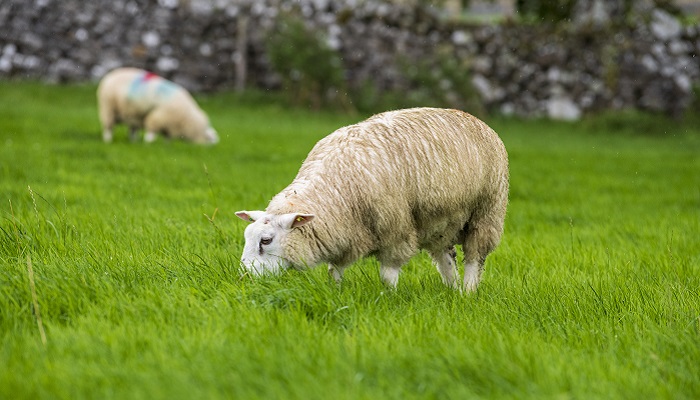
Have you lambs remaining or are in the market for stores, Sheep Specialist at Teagasc, Damian Costello writes on store lamb performance, feeding strategies and marketing options.
The mart trade for store lambs in 2025 has been particularly strong. The demand is in part driven by the record money needed to secure store cattle this year.
Even though store lamb prices have eased slightly in recent weeks, many will be asking themselves the question whether to sell stores now or finish their remaining lambs.
Factors to consider include the number and weight of remaining lambs, estimated time to finish, availability of grass, availability of suitable housing if needed to finish indoors, as well as cash flow/credit situation.
On the purchasing side, farms that run a store lamb finishing enterprise are figuring out what they can afford to pay for stores and still allow for a decent margin on their investment.
The two main factors that determine the profit margin in finishing lambs at this time of year and into the winter are:
- Current price of store lambs versus expected price for lamb carcass when lambs are due to finish
- Cost efficiency of carcass gain during finishing period
Weigh up the options
Whether finishing homebred lambs or buying in lowland or hill lambs to finish, the first important step is to have a plan in place. It is important to take stock of what lambs are on the farm by weighing remaining lambs (or at least a representative proportion) and dividing it up into weight categories i.e. <30kg, 30-35kg, >35kg.
By dividing up the lamb crop like this, it will allow you to accurately assess how much time and feed it is going to take to finish the lambs.
Equally when purchasing lambs, it is important to consider that with lighter lambs versus heavier lambs you will have to adjust the number purchased to allow different residency periods on the farm.
A useful tool to estimate the cost of finishing store lambs on a grassland only farm is the Teagasc Store Lamb calculator. It will also give a good estimate of when lambs will be fit for market. The Teagasc Store Lamb Calculator has recently been updated and is available here, or from your local Teagasc advisor.
Be realistic about performance at grass
It is important to consider the implications that keeping store lambs will have on overall grass demand into the autumn. If we assume grass availability is not an issue, the most economic system involves achieving as much gain as possible from top quality grazed grass followed by a period of meal supplementation – either indoors or at grass to finish lambs. The aim should be to regularly offer lambs fresh grass going in to covers of 1,500 to 2,000kg dry matter per ha (grass height 8 – 10cm).
Several studies have shown a positive impact on performance from moving on lambs when grass height reaches 6cm, thus not forcing lambs to fully graze out swards.
The use of temporary fencing optimises utilisation and allows fresh grass to be offered to lambs every 3 to 4 days. It is also important that any flock health issues such as parasite burden, lameness etc are properly addressed and are not negatively impacting lamb performance at grass.
Table 1: Typical performance of lowland terminal sired lambs on good quality grass
| Time period | ADG (g/day) | Kg gain per week |
| August/September | 160 | 1.1 |
| October/November | 115 | 0.8 |
As outlined in Table 1 with excellent management, there is potential for lambs to gain 1kg per week live weight during this period on a grass only diet. For example, light lambs weighing 25-30kg in August should be approaching 40kg after 12 to 14 weeks of good grass and ready to start the finishing period.
Managing concentrate feed
Aim for high quality ingredients and ensure the feed is specifically intended for intensive finishing of lambs. It should be balanced for minerals and include 0.5% ammonium chloride to help avoid issues with urinary calculi.
Most finishers will look for a good value for money commercial ration in pelleted form. The pelleted feed is less attractive to birds and avoids lambs sorting and selectively leaving behind certain ingredients as can potentially happen with a coarse ration.
There is an opportunity for significant savings per tonne where buying in bulk is an option.
Where lambs are on ad-lib concentrates, it is important that they are gradually build lambs up to ad-lib feeding levels. Increase the amount offered by 200g/day every three days until lambs are ad-lib feeding. It is also important where housed indoors that you ensure that the sheep house is well ventilated and adequately bedded with straw in bedded sheds.
Drafting lambs for slaughter
The aim is to get as close as possible to the maximum carcass weight that meat processors are paying on at the time of slaughter. On the other hand, regular weighing as well as handling for sufficient cover is essential to ensure the target carcass weight is not being exceeded.
This is particularly important where high levels of concentrates are being fed in the finishing period.
In terms of adding value through a carcass price rise, the period February to April has been a good time to slaughter hoggets in recent years. The Ramdan festival in 2026 begins in mid to late February with Easter falling in late March/early April with demand usually high in the preceding weeks.
More from Teagasc Daily: October grass: A delicate balancing act
More from Teagasc Daily: Autumn grassland management for sheep farms