
Well sown is half grown, but measure to make it count
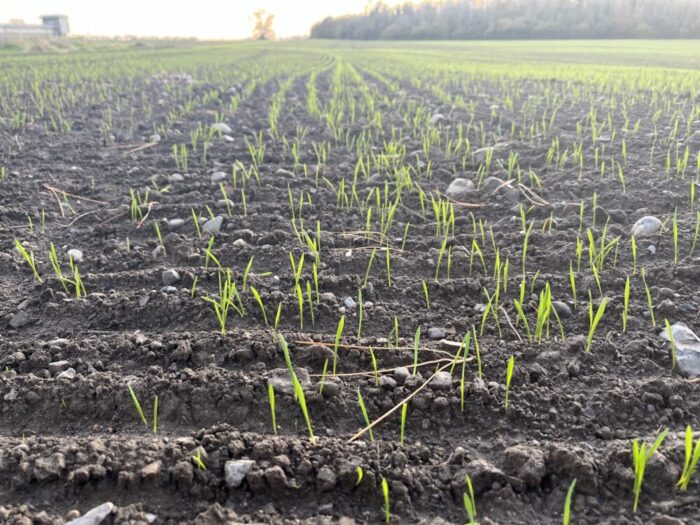
A well-established crop provides the best platform for achieving maximum yields next harvest, Head of Crops Knowledge Transfer, Michael Hennessy discusses the importance of seeding rate, measuring emergence and tracking establishment rates to allow growers make better informed decisions year after year.
The old saying that ‘well sown is half grown’ remains as true today as when it was first coined. Across the country, farmers are working hard to ensure seedbeds are in good condition, and drills are accurately calibrated before planting. A well-established crop, evenly distributed from ditch to ditch, provides the best platform for achieving maximum yields next harvest.
However, crop establishment is often determined by attention to detail. Farmers who consistently achieve high yields year after year rarely point to one major change. Instead, it’s the small adjustments made from field to field that make the difference between an average crop and an excellent one.
In many cases, these differences are not visible from the farm road. Missing 30-40 plants/m² at establishment can affect tiller numbers, crop competitiveness and ultimately yield potential.
Seed rates don’t grow crops. Established plants do.
Start with the right seed rate
A few weeks ago, Shay Phelan highlighted the importance of calculating seed rates using thousand grain weight (TGW) and germination results for individual seed lots. This approach helps growers target the desired number of seeds per square metre and ultimately achieve the optimum plant population.
However, these recommendations should only be viewed as a starting point. Soil type, seedbed conditions, cultivation system and expected winter conditions all influence establishment. Every field has a target plant population, and the seed rate is simply the tool used to achieve it.
Teagasc recommendations provide the baseline, but the most valuable information often comes from your own farm. Measuring establishment over several seasons allows seed rates to be fine-tuned to your soils and farming system rather than relying solely on general recommendations.
Measure what emerges
Knowing the seed rate is useful but knowing how many plants emerge is far more valuable. Ultimately, crops yield from established plants, not seeds sown.
The ideal time to assess plant populations is at the one to two leaf stage. At this point, plants are easy to identify and most seedlings should have emerged.
A simple way to count plants is to use a 0.2m² hoop. A hoop can be made using approximately 159cm of half-inch water pipe joined into a circle. Throw the hoop randomly across the field, count the emerged plants and multiply the figure by five to calculate plants per square metre.
Take several counts across the field to obtain a representative result. Avoid relying on just one or two counts and avoid headlands, tramlines or obviously unusual areas that do not reflect the field as a whole.
If emergence is uneven, investigate why. Was seed placed too deep? Was seedbed consolidation poor? Were conditions too wet or too dry after sowing? Identifying these issues early helps explain differences between fields and can improve future establishment decisions.
Calculate establishment percentage
Once plant counts are completed, compare the actual plant population with the number of seeds originally planted. This gives your establishment percentage.
For example:
- Seeds planted: 350 seeds/m²
- Plants emerged: 300 plants/m²
- Establishment percentage: 86%
This single figure tells you more about your establishment system than any seed rate recommendation ever can. It measures how successfully seed quality, cultivation, drilling and field conditions worked together.
For crops sown in early October, establishment percentages below 80% should prompt questions. Were seedbed conditions poor? Was there soil compaction, cloddy ground or pest damage? Did slugs, leatherjackets, birds or crows contribute to plant losses? Was seed quality as good as expected?
Sowing date should also be considered. A crop drilled in late September may establish at over 90%, while a crop drilled in late October may establish considerably lower because of cooler, wetter conditions. Measuring these differences allows seed rates to be adjusted appropriately rather than applying a one-size-fits-all approach.
Know your system
Cultivation systems can also influence establishment. In wetter seasons, some min-till and non-inversion systems may produce lower emergence levels than plough-based systems. However, the extent of these differences varies considerably depending on soil type, weather conditions and management practices.
If establishment is consistently lower under your chosen system, that is not necessarily a problem. The important thing is to understand the typical establishment percentage on your farm and adjust seed rates accordingly. Measuring and monitoring allows you to quantify these differences rather than relying on assumptions.
Build your own farm database
The real value comes from recording establishment figures year after year. Keep records of plant populations, establishment percentages and field observations such as weather conditions, seedbed quality, cultivation method and pest pressure.
After a number of seasons, these records become one of the most valuable datasets on the farm. They allow you to identify trends, understand risk and make more informed decisions on future seed rates.
The bottom line
Measuring crop establishment takes a little time, but it is one of the highest-value activities a grower can undertake. Seed rate recommendations are only a guide, whereas establishment figures are specific to your farm, your soils and your cultivation system.
By counting plants and recording results each season, growers can steadily refine seed rates and remove much of the guesswork from crop establishment decisions.
Ultimately, it is not the seed rate that matters. What matters is achieving the right number of plants per square metre on your farm. Everything else is simply the process of getting there.