
Wexford farmers get a first-hand preview of BEEF2026 at Teagasc Grange
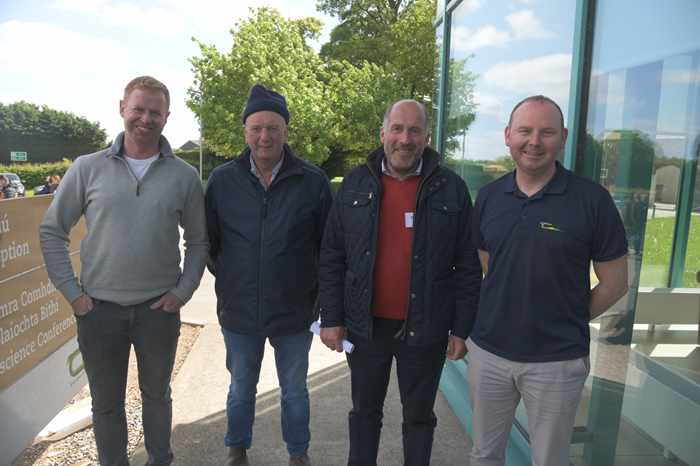
A group of progressive beef farmers recently travelled to Teagasc Grange, Co. Meath, to get a first-hand look at the research, innovation and practical demonstrations that will be on display at the upcoming BEEF2026 Open Day on Wednesday, 1 July.
Representing Wexford on the day were Ken Walsh, Fred Sunderland, and Thomas O’Connor accompanied by their Teagasc Advisor, James Doran. They joined fellow farmers and advisors from Leitrim, Galway and Cork for a comprehensive tour of the research facilities and ongoing projects at Grange.
For many of the visiting farmers, the scale of the operation and the depth of research underway came as a surprise. Throughout the visit, farmers engaged directly with researchers on topics ranging from dairy calf-to-beef systems and suckler breeding to methane reduction and grass-clover systems
Suckler breeding and maternal traits
The visiting farmers had a detailed discussion around the suckler systems in Grange, including both the Derrypatrick herd and the Maternal herd. Researchers outlined how the work on breeding, grass management, age at first calving and finishing performance is directly relevant to commercial farms nationwide.
Thomas O’Connor a suckling to beef farmer highlighted the increasing role of genomics: “Genomics is a big tool showing the breeding of second and third cross cows and how they are performing.”
The role of genomics and specific genes such as myostatin generated significant interest among the group.
James Doran, Teagasc Advisor, commented: “If you look at the myostatin gene work discussed at the National Beef Conference, those breeding decisions are happening here in Grange when bulls are being selected. It’s a massive tool in the farmer’s arsenal.”
Farmers agreed there is huge opportunity to use genomic information more effectively to improve profitability while maintaining carcass performance and functionality.
Dairy beef systems under the spotlight
The farmers visited the new calf-rearing shed, where they examined the building design and calf-rearing system in detail. Key discussions focused on sourcing calves, genetics, feeding rates, concentrate supplementation, weaning management and protocols for transitioning calves to grass, with valuable interaction and in-depth discussion between farmers and researchers.
The importance of genetics and the Commercial Beef Value (CBV) was another recurring theme.
Farmers also emphasised the need for clearer information on the growing number of producer programmes and schemes available to beef farmers.
Suckler farmer, Fred Sunderland commented: “I totally enjoyed the talks, for someone that doesn’t do dairy calves, it gave me an interest in something I would look in to. We have sucklers, time is going to catch up with me. It’s something to look at for an option and open your eyes to consider.”
Clover, grassland and reducing fertiliser use
Grassland management and clover systems were another major focus. Researchers highlighted the increases in performance in grass clover swards, resulting in heavier weaning weights and heavier carcass weight from lower nitrogen inputs being achieved in Teagasc Grange.
They all agreed that understanding the value of clover in terms of silage quality and meal savings is critically important to reduce costs.
The group discussed the importance of practical clover establishment advice in relation to establishment and management: “Research around grass-clover systems is a huge area. Farmers need to know the reseeding costs, how often it needs to be reseeded and how to achieve the performance levels shown,” a farmer said on the day.
Simplicity and infrastructure
A recurring message throughout the visit was the value of simple, practical infrastructure. Many of the farmers remarked that one of the most impressive aspects of Grange was not necessarily expensive technology, but how simple systems were designed to reduce labour and improve efficiency.
“The simplicity stood out,” Ken said. “Having a pen in the middle of a block instead of bringing cattle back to the yard all the time. Proper fencer, proper fencing, proper gates and good handling facilities – they’re simple things but they reduce labour and stress enormously.”
One of the strongest areas of interest during the visit was the ongoing methane research at Grange. Researchers highlighted how genetics, feeding different silage qualities and additives impacted on emissions and age at finish.
Encouraging the next generation
The discussion also turned to the future of the beef sector and the challenge of generational renewal. Many farmers spoke about the importance of maintaining young people’s interest in farming through cattle showing, calf rearing and involvement in farm decisions.
Farmers on the day focused on the fact that rising costs and access to finance is a major concern for young farmers starting out.
Ken added: “I have a son and daughter, and they are very interested in farming and don’t want to do anything else. I’m so lucky to have them so interested in farming, but everything has just gone so expensive, renting land, buying cattle and funding needed starting out’
A day not to miss
As the visit concluded, farmers agreed that events like BEEF2026 are an invaluable opportunity to learn, network and bring home practical ideas.
The farmers also emphasised the need to spread awareness about what is happening at Grange and encourage more people to attend.
“People don’t know what’s here,” one farmer commented. “The scale of it, the quality of the cattle and the amount of research being done. That’s what people want to see.”
This is a free event, open to everyone to attend and Teagasc Grange is easily accessed on the Dublin-Trim R154 road, 20km from Navan and 40km from Kinnegad located at Eircode C15 PW93.
For more insights on BEEF2026, watch the below video:
For more information on BEEF2026 and to plan your trip, visit here.