
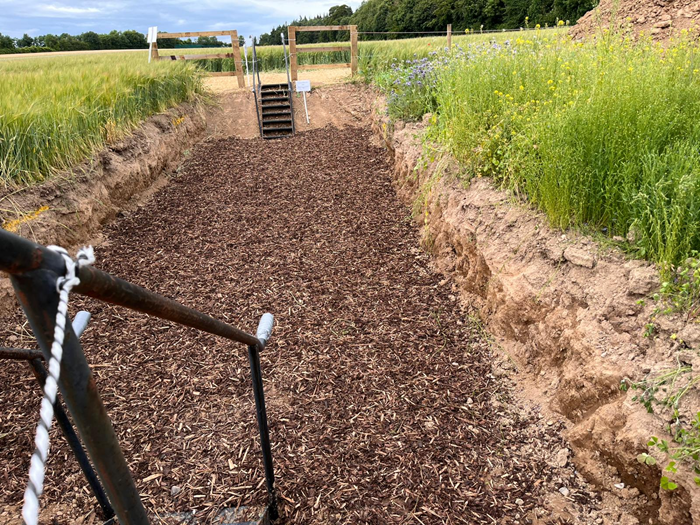
Soil and Plant Nutrition Specialist, Veronica Nyhan revisits the walk-in soil pit demonstration from the Crops and Technology Open Day, revealing the impact of compaction and highlighting solutions to improve soil health.
At the Oak Park Crops and Technology Open Day, held on Wednesday, June 25, visitors had the opportunity to explore our walk-in soil pit.
The pit was located on a Luvisol soil type, locally referred to as ‘difficult’, and positioned on the turning headland of a field parcel, intersecting a tramline near the field entrance. As a result, the cumulative effects of repeated trafficking and tillage on soil structure were clearly visible.
One of the most noticeable features of soil compaction observed was a platy structure. This type of structure, characterised by horizontal, flat, plate-like aggregates, restricts both water infiltration and root growth. While such structures are typically found deeper in the soil profile, at this site they were present near the surface, indicating significant compaction and poor soil health.
A distinct plough pan was also observed at approximately 25cm depth, formed by continuous cultivation at this level. In some areas above the plough pan, the soil appeared quite friable, with small, rounded aggregates and a well-developed root system. However, the presence of the plough pan hindered water drainage and limited plant access to deeper water reserves, thereby reducing the soil’s resilience to extreme weather conditions.
Addressing the issue
Enhancing soil organic matter is one approach to addressing these issues. Increasing organic matter can significantly improve soil structure, which in turn promotes better root growth, drainage, workability, and trafficability. It also boosts the soil’s water-holding capacity – particularly important in lighter soils – while supplying nutrients, enhancing nutrient retention, and supporting soil biology. A richer and more diverse biological community further aids the development of stable soil structure.
Where organic manures are not available, cover crops can play a vital role in mitigating some of the adverse effects of arable farming on soil structure, as demonstrated in the soil pit at Oak Park.
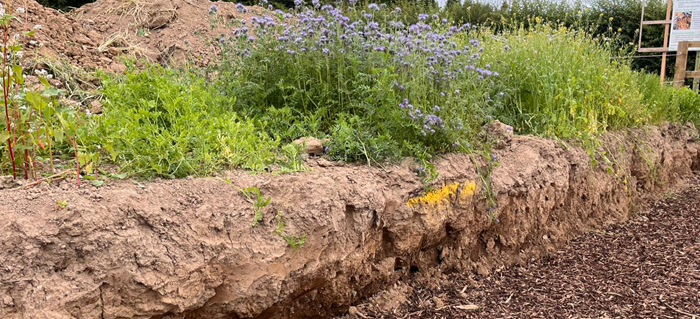
While often promoted for their ability to capture excess nutrients, certain deep-rooted cover crops may also contribute to the remediation of sub-surface compaction in tillage systems. Through the canopy they provide, and their stabilising living root system, cover crops protect the soil from degradation over the winter period, while also providing food for soil macro and micro fauna. The substantial biomass they are capable of producing, both above and below ground, contributes to pool of organic matter once incorporated into the soil the following spring.
However, to maximise their benefits, it is essential to choose the right cover crop species for the intended purpose, ensure it fits within the farm’s rotation plan and sow it at the appropriate time.
Highlights from the Crops and Technology Open Day
Highlights from the Teagasc Crops and Technology Open Day in Oak Park, Carlow are brought to you via this week’s Tillage Edge podcast.
Michael Hennessy chats with Dr. Ewen Mullins about the event and farmer feedback, Veronica Nyhan gives a tour of the soil pit and Jack Jameson discusses his wheat variety trials.
Packed with practical insights and research updates, this episode captures key moments from a busy and engaging event.
Listen in below:
More from Teagasc Daily: Fast-growing faba beans – a runner in shorter growing seasons?
More from Teagasc Daily: Handle pesticides safely
More from Teagasc Daily: Calculating the carbon footprint of your crops