
13 September 2022
White clover as a sustainable alternative to nitrogen
Introducing white clover into perennial ryegrass swards can sustainably increase milk production while maintaining grass production, reducing the need for inorganic nitrogen.
Perennial ryegrass (PRG) grass-based systems are highly efficient and low cost, but are dependent on high levels of nitrogen fertiliser. In recent years, there has been renewed interest in the inclusion of white clover in PRG-based production systems, in order to reduce the environmental impacts and input costs of inorganic nitrogen use.
White clover is a valuable natural resource that can be included into PRG-based systems to increase grass and animal production. It is the predominant legume species incorporated into grass swards in temperate regions and has a lot of agronomical advantages.
White clover possesses the ability to convert atmospheric nitrogen into a plant usable form (i.e. nitrate) to facilitate PRG growth and production. It is also a nutritionally superior feed than PRG alone, as it promotes higher dry matter intakes due to its lower neutral detergent fibre levels. This in turn can lead to higher milk production per cow.
In order to avail of these potential production benefits, it has been suggested that white clover needs to be established within the sward at a minimum rate of 20%. To test this, researchers from Teagasc established an experiment at Clonakilty Agricultural College in Clonakilty, County Cork, from February 2019 to November 2021.
The impact of white clover on grass
The inclusion of white clover in PRG grass-based systems increased milk production. It was also observed that higher milk solids production arose due to higher overall milk production rather than higher milk fat and protein content.
Cows grazing PRG-WC swards had a 6% higher daily milk solids yield, which resulted in a 29kg difference in cumulative lactation milk solids yield. This is a substantial increase in milk solids, particularly at the lower nitrogen input level, that is both critical for the environment and economically important for the farmer – two major issues affecting the industry at present.
As land availability and environmental constraints are two of the main limiting factors affecting increasing production on farms, white clover inclusion into PRG swards is a key grassland strategy that should be incorporated to overcome this challenge. Therefore, it should be promoted that even at the relatively low white clover contents witnessed in this study, white clover can make a positive impact both in terms of grass and milk production.
When the nitrogen inputs were reduced by 100kg/ha and white clover was included in its place, there was a reduction in total grass growth of 0.5 tonnes vs. 1.5 tonnes when nitrogen inputs were reduced by
100 kg/ha on PRG-only swards. Increasing the white clover level in the swards should increase the grass growth further and reduce the gap of total grass grown between the nitrogen treatments. This can also help to insulate farmers from dramatic price fluxes in a volatile market.
These findings should reassure both farmers and industry in promoting the inclusion of white clover in swards, meeting the long-term goal to convert whole farm grazing systems from PRG-only swards to
PRG-WC swards.
The Experiment
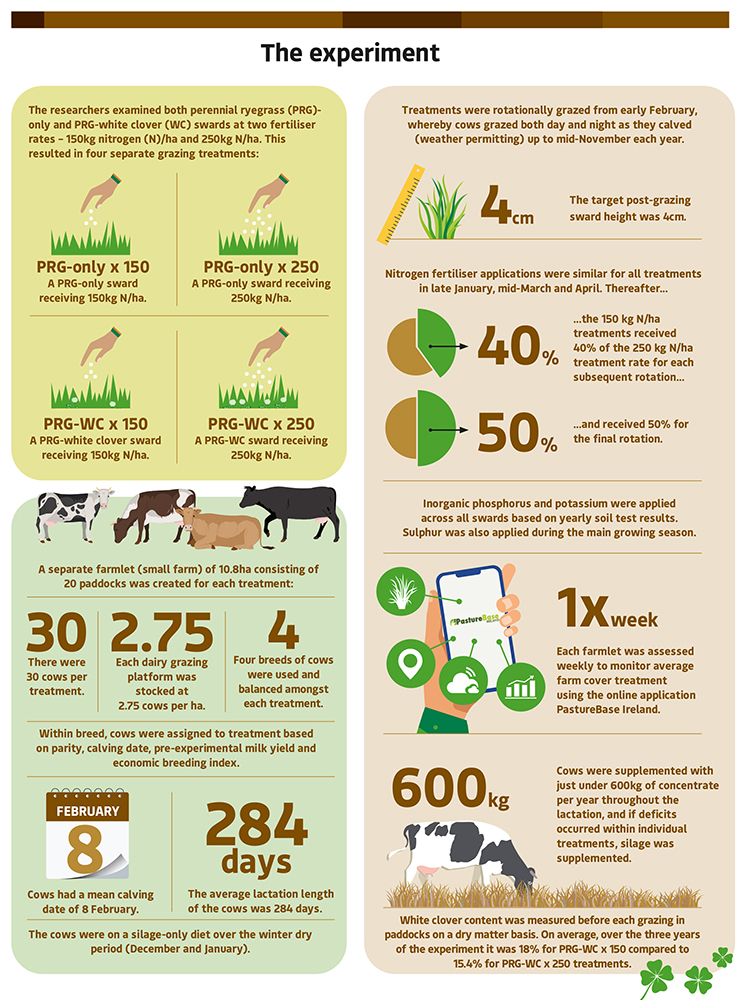
The researchers examined both perennial ryegrass (PRG)only and PRG-white clover (WC) swards at two fertiliser rates – 150kg nitrogen (N)/ha and 250kg N/ha. This resulted in four separate grazing treatments:
PRG-only x 150 A PRG-only sward receiving 150kg N/ha.
PRG-only x 250 A PRG-only sward receiving 250kg N/ha.
PRG-WC x 150 A PRG-white clover sward receiving 150kg N/ha.
PRG-WC x 250 A PRG-WC sward receiving 250kg N/ha.
A separate farmlet (small farm) of 10.8ha consisting of 20 paddocks was created for each treatment.
There were 30 cows per treatment. Each dairy grazing platform was stocked at 2.75 cows per ha. Four breeds of cows were used and balanced amongst each treatment.
Within breed, cows were assigned to treatment based on parity, calving date, pre-experimental milk yield and economic breeding index.
Cows had a mean calving date of 8 February. The average lactation length of the cows was 284 days.
The cows were on a silage-only diet over the winter dry period (December and January).
Treatments were rotationally grazed from early February, whereby cows grazed both day and night as they calved (weather permitting) up to mid-November each year. The target post-grazing sward height was 4cm.
Nitrogen fertiliser applications were similar for all treatments in late January, mid-March and April.
Thereafter the 150 kg N/ha treatments received 40% of the 250 kg N/ha treatment rate for each subsequent rotation, and received 50% for the final rotation. Inorganic phosphorus and potassium were applied across all swards based on yearly soil test results. Sulphur was also applied during the main growing season.
Each farmlet was assessed weekly to monitor average farm cover treatment using the online application PastureBase Ireland. Cows were supplemented with just under 600kg of concentrate per year throughout the lactation, and if deficits occurred within individual treatments, silage was supplemented.
White clover content was measured before each grazing in paddocks on a dry matter basis. On average, over the three years of the experiment it was 18% for PRG-WC x 150 compared to 15.4% for PRG-WC x 250 treatments.
Get more information on the management of white clover swards here
This article featured in the TResearch Autumn 2022 Magazine.
Contributors
Áine Murray, PhD Walsh Scholar
Teagasc Animal & Grassland
Research and Innovation Centre, Moorepark, Co. Cork.
Brian McCarthy, Research Officer
Teagasc Animal & Grassland
Research and Innovation Centre, Moorepark, Co. Cork.
brian.mccarthy@teagasc.ie