Why aren’t more Irish food businesses chasing the organic market?
Joe Kelleher, Teagasc Organic Specialist, reflects on the European Organic Congress in Cork and ponders why more Irish food businesses aren’t chasing it.
One of the more interesting messages to emerge from the session on organic markets at the European Organic Congress in Cork from October 6th to 8th was also one of the simplest: There is an organic market, and it is growing.
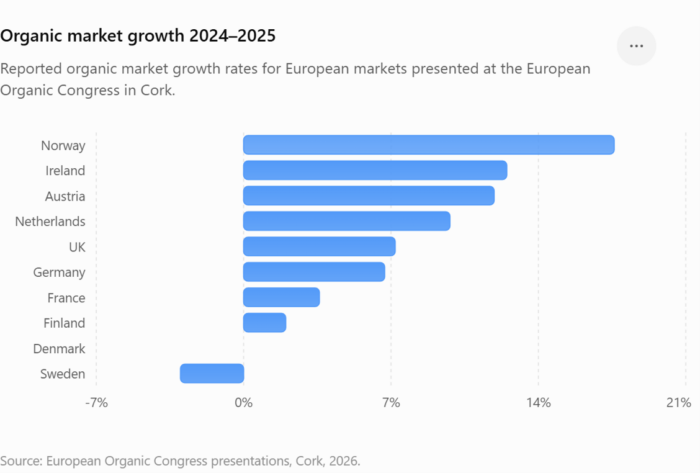
The Irish organic market grew by 12.5% in 2025 compared with 2024. There are now around 6,100 organic farmers and businesses in Ireland, while 67% of Irish shoppers buy organic food and drink. That puts Ireland towards the stronger end of the European markets discussed at the Congress.
The comparison with the US is also interesting. The US organic market grew by 6.8% in 2025, twice the growth rate of the overall US food market. Organic sales reached a record $76.6 billion. Ireland’s 12.5% growth is almost twice the US organic market’s growth rate.
That is significant because it suggests that the Irish organic market is not simply holding its own against a difficult economic backdrop. It is growing at a rate that should make food companies sit up and take notice.
Presentations from a number of European markets showed organic either continuing to grow or returning to growth following the difficult period of inflation and the cost of living crisis. France, for example, was presented as returning to meaningful growth in 2025, while Germany recorded value growth of around 5.7%. Belgium has seen particularly impressive growth over recent years, while the Netherlands was also highlighted for growth ahead of the wider food market.
There was an important theme running through many of these markets – organic is becoming more mainstream. That matters because mainstream markets create opportunities beyond simply selling more of the same products to the same consumers.
The US figures presented by the Organic Trade Association were perhaps the clearest illustration. And it isn’t just one or two categories driving that growth. Organic meat sales in the US grew by 22.5% in 2025, while dairy and eggs grew by 12.8%. Beef was up 44.3%, eggs 22.4% and yoghurt 16.6%.
That is interesting from an Irish food industry perspective because it starts to move the conversation away from organic as simply an environmentally friendly way of farming. It becomes a food manufacturing and product development opportunity.
Ireland has considerable strengths in food production, processing and export. We have established dairy, meat, prepared food and beverage industries, sophisticated retailers and a strong international reputation for the provenance and quality of our food.
Yet one question kept coming back to me during the session: If the market is growing, where are the Irish organic food manufacturers?
There are, of course, Irish businesses producing and processing organic food, and there are obvious challenges. Organic supply chains can be more complicated, raw material availability can be constrained, certification brings additional requirements, and the economics have to stack up for both farmers and processors.
But none of those challenges change the underlying market signal. The Irish organic market grew by 12.5% last year. There are 6,100 organic farmers and businesses. Two-thirds of Irish shoppers are buying organic food and drink.
And internationally, some of the fastest-growing opportunities are appearing in precisely the categories in which Ireland already has significant processing expertise.
Perhaps the bigger question, then, is not whether there is an organic market. There clearly is. The question is whether enough Irish food companies see it as a market worth actively going after.
The European Organic Congress provided plenty of evidence that organic is no longer a marginal proposition. It is a growing market with a widening consumer base and, importantly, one that is demonstrating growth across multiple categories and multiple countries.
For Irish processors and manufacturers, that should at least prompt a serious look at the opportunity. Because if the consumers are already there, the market is growing, and Ireland has many of the capabilities needed to serve it, the obvious question is: Why aren’t more Irish food businesses chasing the organic market?
For more information on the European Organic Congress 2026, visit here.