
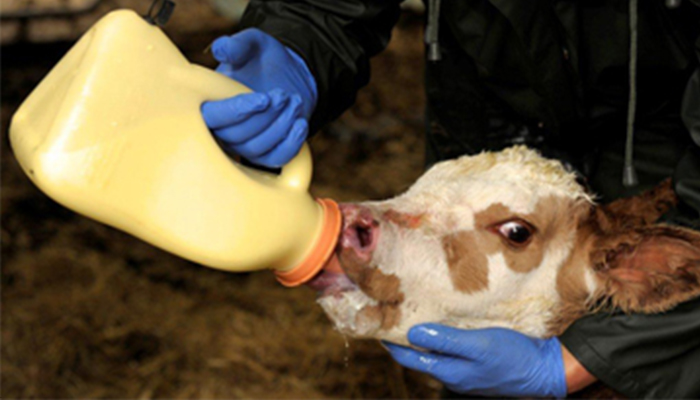
With the calving season fast approaching, Beef Specialist at Teagasc, Catherine Egan looks at the importance of colostrum management when keeping calves healthy this spring.
What is Colostrum?
Colostrum is the first milk produced by a cow after calving, essential for the health and survival of calves. It provides vital nutrients and antibodies, including immunoglobulins (Ig antibodies), energy, growth factors, and increased levels of vitamins and minerals. Colostrum also has a higher fat and protein content than whole milk.
Why is good colostrum so important?
- Passive Immunity: Calves are born lacking active immunity and rely on the antibodies in colostrum to receive passive immunity from their dams. This is transferred through the calf sucking colostrum.
- Disease prevention: The antibodies present in colostrum are essential for protecting the calf from infections and illnesses like scours (diarrhoea), pneumonia and navel infections during the first few weeks of life, before its immune system is fully developed.
What is the 3-2-1 rule of feeding colostrum?
The simple rule of feeding colostrum is as follows;
- Feed from the first milking
- Feed within two hours of birth
- Feed 3 litres of clean, good quality colostrum.
It is important that the calf is observed sucking the mother within the first couple of hours of birth. If the cow has inadequate supply, it is important to make alternate arrangements to supplement the calf.
At birth, the calf’s stomach lining is porous, allowing antibodies to pass through, but it begins closing quickly. Absorption is highest in the first two hours, drops sharply by six hours, and is nearly gone by 24 hours. Additionally, colostrum quality declines as the cow produces more milk, diluting antibodies.
Research has shown that feeding the suckler calf 5% of its birth weight (e.g. ~2 litres of colostrum for a 40 kg calf), within one hour or so of birth, with subsequent suckling of the dam 6 to 8 hours later, ensures adequate passive immunity.
How can I test colostrum quality on my farm?
Colostrum quality can be tested using a Brix Refractometer (see Figure 1). Only colostrum with a brix value greater than 22% should be used in the first feed, equivalent to a concentration of 50mg/ml of antibodies which is the threshold to ensure that calves acquire immunity passively. Consult your vet and advisor in relation to colostrum management practice on your farm. Calves under 14 days old can be blood tested to check for failure of passive transfer. Samples can be tested in the local Department of Agriculture’s Regional Veterinary laboratory.

Figure 1: Testing Colostrum quality
How can I store colostrum?
- Collect colostrum as soon as possible after birth to maximise antibody levels and minimise dilution. Store quality colostrum with a Brix Refractometer reading of above 22% in a fridge within three hours of collection. This prevents bacterial growth and the denaturing of key proteins and antibodies. Fresh colostrum can be stored for up to 48 hours in a fridge. If not used within 48 hours, discard.
- Freeze for longer storage. Colostrum will last for up to one year when frozen. It can be stored in either cartons or zip-lock bags, with the latter facilitating faster defrosting due to the large surface area.
- Colostrum should never be defrosted in boiling water or in the microwave, instead leave to defrost in warm water of 37-38 degrees Celsius;
- Colostrum should always be fed warm, again use warm water to bring it to 37-38 degrees Celsius prior to feeding.
- Hygiene: Use clean, sterilised containers and avoid contamination during collection
- Teagasc Research shows that mature suckler-bred cows produce colostrum with higher IgG levels (134 mg/mL) compared to first calvers (117 mg/mL) and their calves had superior passive immunity (calf serum IgG and total protein). Colostrum IgG concentrations did not differ between suckler beef cow genotypes.
Further information:
View a Teagasc publication on Managing Colostrum here (PDF).
View Animal Health Ireland’s leaflet on Colostrum Management here (PDF)