
21 March 2025
Why LESS gives more
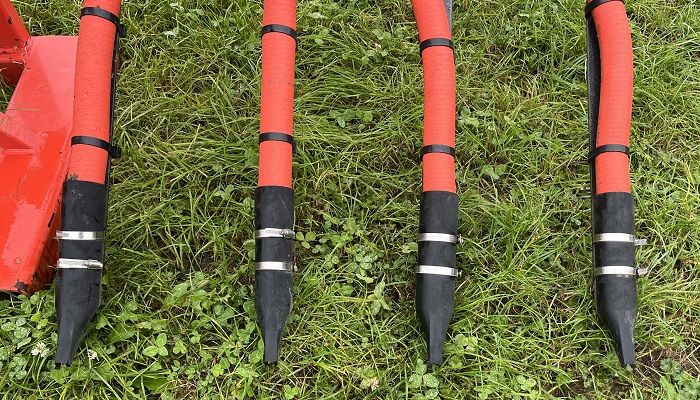
Low emissions slurry spreading (LESS) is a precision technology that reduces nitrogen losses to the air and allows for greater nitrogen use efficiency, Eamonn Dempsey, Advisor in Teagasc Tralee, tells us more.
Low emissions slurry spreading is precision technology which reduces nitrogen losses in the form of ammonia to the environment. With LESS, slurry is applied closer to the plant root. This reduces nutrient losses to the air and increases nutrient use efficiency, leading to better growth and herbage yields.
Types of low emissions slurry spreading include dribble bar, trailing shoe and injection.
- The dribble bar deposits slurry in rows on top of the grass, making it suitable for all ground conditions. It is also the cheapest option available.
- Trailing shoe parts grass to deposit slurry directly onto the soil surface. This system is suitable to use on high grass covers due to low contamination of grass, with a 60% reduction in ammonia emissions compared to splash plate.
- The injection system injects slurry directly into the top soil resulting in 70 -90% reduction in ammonia emissions compared to splash plate.
The importance of slurry testing
While low emissions slurry spreading increases nitrogen recovery, the first step before application is to know the nutrient content of your slurry. The nutrient value of slurry can vary depending on the animal’s diet and the dry matter content. Your slurry can be tested using a slurry hydrometer to give the units per 1,000 gallons of slurry for N, P and K.
You can also take a 2 litre sample of agitated slurry from different tanks on the farm and send to the laboratory to get a good overview of the nutrient value of slurry. The typical value of 1,000 gallons of cattle slurry applied by low emission slurry spreading method is 8 units of N, 5 units of P and 25 units of K.
More farmers required to use LESS
Nitrate Action Programme (NAP) regulations have resulted in a phased introduction of LESS on farms, from January 1st, 2025 it is mandatory for farms stocked above 100 kg/N/Ha to apply slurry through LESS and all pig slurry must continue to be applied with low emission slurry spreading equipment.
Where livestock manure is being applied to arable land, the use of LESS equipment is required unless the livestock manure is incorporated into soil within 24 hours after application.
ACRES participants that choose the LESS action must have a stocking rate of less than 100 kg Nitrogen per hectare and complete an annual declaration for low emission slurry spreading.
Challenges and where to spread
Challenges associated with LESS equipment must also be acknowledged including high investment costs (TAMS), higher horsepower tractors, suitable ground conditions, contractor availability and training.
Decide where on the farm slurry should be applied to maximise P and K, and when is the most efficient time to apply slurry to maximise N recovery. The answer includes a targeted application of slurry in the early growing season, or at silage closing time, based on soil test results.
Recording slurry movements
Farmers exporting slurry or other organic manures need to be aware that new rules in regard to the recording of movements have come into effect since January 1, 2025. Movements must be declared by the exporter within 4 days of the movement taking place, movements made between 1st January and the 30th June 2025 must be verified no later than 14th of July 2025 and movements made between 1st July and the 31st December 2025 must be verified no later than the 14th January 2026. Farmers can notify the DAFM of an organic manure export or verify an import on the DAFM’s recently launched Nutrient Movement App or using the Nitrogen and Phosphorus section of agfood.ie.
This article first appeared in the Kerryman