
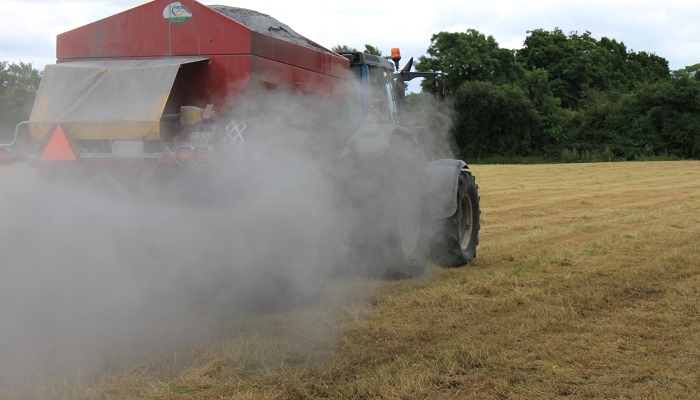
Lime is a lot cheaper per tonne than fertiliser to buy and we need to be spreading it; some key words of wisdom from Lakeland Dairies Signpost farmer, Kieran McDermott who tells us why he’s prioritising lime applications on his farm.
Liming is my big priority this month and, after third cut, I am aiming to apply a maintenance application of 3t/ac of lime. I usually spread 40t of lime per year on average across the whole farm. It is probably one of the easiest jobs on the farm; I order the lime, ask the lime man to come and spread it and all I have to do is open the gap handle.
Our farm is mostly up to date for lime applications. The average pH from the last round of soil samples is 6.2. Ideally, we want every paddock to have a pH of 6.3, but 18% of my land has a pH lower than 6.3.
Every second year, I take soil samples to try and identify and target these low pH areas with the recommended quantities. Taking soil samples regularly is important to me, it not only allows me to track soil fertility, but it allows me to target lime applications where needed.
Why lime?
If the pH of the soil isn’t optimum, we are wasting our money spreading chemical fertiliser; it will be locked up in the soil and won’t be released until the pH is increased. Liming has the ability to increase the soil pH, which in turn releases 70kg/ha/year of nitrogen into the soil, potentially leading to an extra 10-15% more grass grown each year. Since focusing on lime, I have noticed in recent years that I have better nitrogen efficiency and grass growth. Lime is a lot cheaper per tonne than fertiliser to buy and we need to be spreading it.
Cow and grassland performance
Cows are producing 1.6kgs of milk solids at the minute on 3kg of meal. I plan to trim all their tails. This makes milking easier, as you can avoid a dirty tail across the face.
The dry weather has suited my farm. I spread my parlour washings on paddocks after the cows had grazed, and I will have a new reseed coming into the grazing platform also.
I am starting to build grass cover from now on. The farm is still growing on average 50kg DM/ha/day. I’m aiming for an average farm cover of 1,100kg DM/ha by the 15th of September. I will introduce bales before milking time to help build grass. There is lots of silage around this year to buffer feed so it is important to try and keep grass in the diet for as long as I possibly can.
The above article was first published in the Farming Independent as part of a Signpost Programme update.
More from Teagasc Daily: Autumn focus on dairy farms
More from Teagasc Daily: White and red clover – from sowing to establishment