
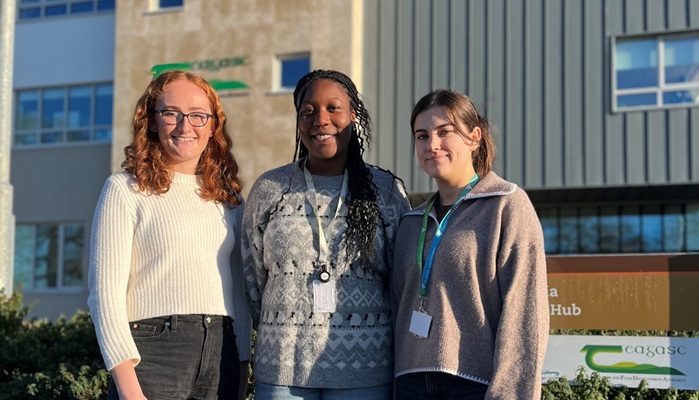
Each year, Teagasc hosts students seeking hands-on experience in food research. This year, three of those former interns made a choice to come back, Rose Edwin, Food Programme Communications Officer uncovers their reasons for returning.
Every year, the Teagasc Food Research Programme welcomes students from across Ireland and Europe. Some come for short Erasmus placements, others arrive for their final year undergraduate dissertations or as part of Master’s degrees, gaining valuable lab or industry experience during their visit. This year, three of those former interns made a choice to come back, Rose Edwin, Food Programme Communications Officer uncovers their reasons for returning.
Sharon Olanrewaju, Róise Flaherty and Megan O’Driscoll are now first-year PhD students at Teagasc Food Research Centre, Moorepark, Fermoy. Each started their journey here as undergraduate intern, and each chose to return for their doctoral research.
So, what brought them back?
For Sharon, a graduate of MTU in pharmaceutical biotechnology, it was all about the hands-on experience.
“I first came to Teagasc for a placement in third year, and I loved how practical it was,” she says. “I came back again in fourth year because I wanted more. The lab work was real. I was not just assisting, I was trusted to run experiments, analyse data and contribute to projects.”
Megan, who studied alongside Sharon, also came twice for her placements.
“I had always thought of a PhD as this huge, intimidating thing,” she laughs. “But during my placement, I saw how the scientists worked and how curious they were. It made me think, maybe I could do this too. I started wanting a challenge. I realised I wanted to solve something.”
Róise, graduate from University College Cork in Nutritional Science, came to Teagasc for a six-month placement.
“I had not worked with fermentation or bioprocessing before,” she recalls. “But here, I had the opportunity to work on something from start to finish. It was more than coursework; I was really doing science.”
She continued: “When I returned to college and we had a module on fermentation, it all clicked. I had already done it here, with real equipment, real questions, real data. That experience grounded everything I was learning.”
What stood out to all three was not just the facilities or equipment, it was the culture.
“People here take time to teach,” said Róise. “You can ask questions, and they want to answer.”
“You are not just a student here,” Megan adds. “You are part of the research.”
It was the sense of purpose that left a lasting impression. At Teagasc, they were shaping parts of real projects, they were being challenged, and their work mattered.
Now, as PhD students, Sharon, Megan, and Róise are building on that foundation. They returned because their placements showed them what research could be, and that they wanted to be part of it.
Internships can be more than short-term placements. For these three, they were the beginning of their research careers.
Important challenges
Today, each is tackling important challenges in food research:
Sharon is developing new treatments for mastitis in dairy cows using beneficial bacteria commonly found in food. Her goal is to improve cure rates while reducing antibiotic use, supporting healthier cows and more sustainable dairy farming.
Róise is working on CELEBS project, turning dairy waste into valuable products. She uses microbes like yeast and bacteria to transform leftover whey into useful ingredients like natural colours, oils, and amino acids, reducing waste while creating sustainable food ingredients.
Megan is using DNA technology to detect harmful bacteria in food. Through a VistaMilk project, she’s developing rapid methods to identify disease-causing bacteria like Listeria and Cronobacter, helping keep our food supply safe.
From internship to PhD, their journeys show how early experiences can spark lasting careers in science.
Photo caption: From left to right: PhD students Róise Flaherty, Sharon Olanrewaju and Megan O’Driscoll at Moorepark Food Research Centre, Fermoy.