
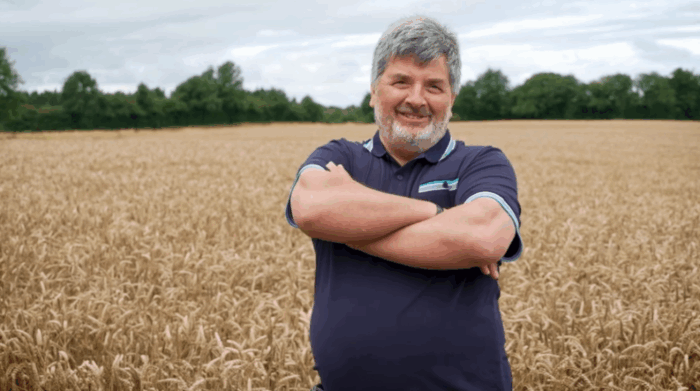
Due to the nature of their farming systems and larger field sizes, tillage farmers – in the main – tend to have a lower space for nature on their farms. Breaking the mould in this regard is Tom Tierney, a tillage farmer from Co. Kildare and winner of the Biodiversity Category of the Teagasc FBD Environmental Sustainability Awards 2025.
Tom Tierney’s approach, passion and understanding of biodiversity on his farm were key elements in this victory, Siobhán Kavanagh, Signpost Programme Communications and Engagement Specialist, and John Mahon, Signpost Programme Tillage Advisor, tell us more.
Tom Tierney’s farm in Prosperous, Co. Kildare consists of 108ha of tillage, 10ha of forestry and 2.14ha of grassland.
Efficient nutrient management is a core element of his tillage farming business. Chemical nitrogen input, for winter wheat and winter barley crops has declined by 20-30% over the last three years, standing at 160kg/ha and 137kg/ha, respectively.
This reduction has been aided by a steadfast focus on soil fertility and holding on to the nutrients available. To the former, 67% of the farm is optimum for pH, P and K, while straw incorporation (72ha) and the establishment of overwintered catch crops (29ha) is key to the latter. Another element that brings added nutrient benefits is the growth of nitrogen-fixing legume crops (beans 19ha).
Find out more about Tom Tierney’s farming enterprise in the below video:
Away from the nuts and bolts of farming, Tom has a passion for biodiversity. Including forestry, the space for nature on his farm is 24%. Some of the actions he’s taken to enhance biodiversity include:
EIPs
The implementation of learnings from participation in EIPs has led to notable improvements in hedgerows, field margins, and use of pesticides, alongside the enhancement of Low-Input Grassland (LIG) and the creation of pollinator nesting sites since 2019. The continuation of these practices beyond the EIPs, particularly the retention of LIG without financial incentives or support, is especially praiseworthy.
Hedgerow management
Hedgerows are well managed, with great examples of treeline hedges on the farm. Topped hedges are managed to exceed 2m height, allowing flowering and fruiting.
Continuous cover forestry
Tom has 10ha of trees, planted in 2000. The forestry will be managed under a continuous cropping forestry type arrangement, allowing the farm to diversify and create a firewood business. He will harvest a bit and will replant a bit. He imported his own forestry head and uses his own harvester. With the harvester head, he can harvest his own trees when he’s less busy with the crops.
The adoption of continuous cover forestry on the farm is not only benefitting biodiversity but is also maintaining commercial viability, demonstrating a progressive model for farming with nature.
The thing he is most proud of on the farm is the forestry, adding: “To wake up in the morning and hear the bird song; there’s now a dawn chorus where there previously wasn’t one.”
Working with nature – above and below the ground
There is clear evidence of working with nature, including the use of Integrated Pest Management (IPM) and an emphasis on encouraging natural predators, reducing reliance on chemical inputs and supporting ecological balance.
On this approach, Tom explained: “When I started into no-till, I stopped using insecticides. I don’t put insecticides on the crops because I want the beneficial insects predicating and doing the work where they need to.”
Tom has a very clear understanding of the importance of below ground biodiversity and its importance in maintaining good soil health. He is using compost to help improve the fertility and biological status of his soils. Organic compost (100t) is applied in spring, and rotational break crops include beans, oilseed rape and oats.
Future aims
Other sustainability measures on this farm include no-till establishment using a Duncan drill, 33% reduction in pesticide usage, GPS-controlled sprayer with section control and autosteer, and catch crops to protect bare soil.
The future plan is to go into farming with his daughter, Erin in a partnership arrangement and then she will take over from Tom. They plan to increase organic manure use, expand the forestry, and become involved in social farming.
More from Teagasc Daily: The stand-out practices on Don Somers’ tillage farm