
Winter barley growers missing an opportunity with rotations
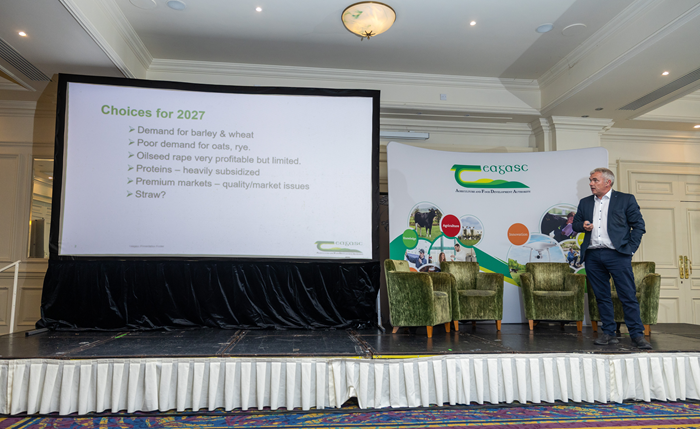
Set against a backdrop of low grain prices and demand, the value of effective crop selection and rotation was reenforced to growers at the Teagasc National Crops Forum, which took place on September 10.
Taking to the podium to discuss crop planning for 2027, Teagasc Crops Specialist, Shay Phelan reiterated the importance of rotations to allow growers to “make the best margin possible”.
“General rules still apply,” Shay Phelan explained, noting that first cereal crops after break crops pay the best, whereas second cereal crops are more expensive to grow and perform poorer.
“First cereals, be they wheat or barley, do tend to yield more than your second or continuous cereals.”
Research conducted at the Teagasc Crops Research Centre, Oak Park, was shared to verify this point, with Shay Phelan explaining that first crop winter wheats after a break provided a yield benefit of 11% or 1.1t/ha, whereas first crop winter barley crops benefitted from a 9% yield increase or an additional 0.7t/ha.
Worryingly from a winter barley crop potential perspective, Shay Phelan noted that 80% of winter barley is grown in the second subsequent cereal slot, whereas only 23% of winter wheat is in a second or subsequent slot.
“It is definitely not an ideal spot for winter barley. It should be a wake-up call for anyone growing winter barley that it needs to be treated a little bit better,” he added.
“Every grower expects winter barley to yield 9.5-10t/ha and, in general, we are not getting it. Five-year average data from the CSO shows yields closer to 8.8t/ha and we are also not putting it in that first cereal slot; it is being grown in second and subsequent cereal slots.”
Through his presentation, Shay Phelan also examined three potential crop rotations for growers of winter wheat, winter barley or malting barley, noting that rotation choice will be heavily influenced by land suitability, rotational considerations, weed pressures and market demands.
From these assumed rotations, Shay Phelan added: “The winter wheat rotation, when grown on high yielding sites, is the most profitable producing an average margin of €740/ha. Margins for the winter barley and malting barley rotations are similar, but the profitability of the latter depends on malting pass rate and premium. But when we examine our rotation in the whole, break crops are contributing more to our margin than most cereal crops. If we were standing here 10 or 15 years ago, that would not have been the case.”
For further details on the above, view Shay Phelan’s presentation to the Teagasc Crops Forum here.
Shay Phelan featured on this week’s episode of the Tillage Edge podcast, discussing how growers can adjust crop rotations to improve profitability and resilience.
Listen in below:
To view all presentations from the Teagasc Crops Forum, visit here.