
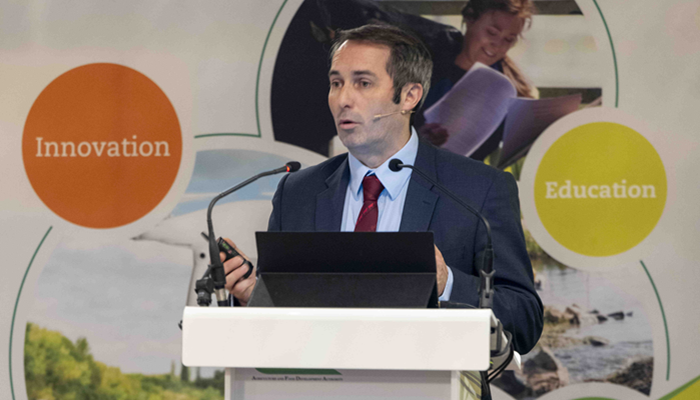
The critical link between winter nutrition, cow condition and the relationship with fertility next year was laid bare to delegates at the Teagasc National Beef Conference, hosted in Athenry, Co. Galway on November 18, 2025.
Discussing the numerous factors in play when priming suckler herds for a successful breeding season next year, Head of the Animal and Bioscience Research Department at Teagasc Grange, Professor David Kenny said: “Over the past decade, Irish suckler farmers have really struggled to improve the reproductive performance of their herds.
“Data from the Irish Cattle Breeding Federation (ICBF) for 2025 shows that the average suckler cow only calves every 13 months, limiting the potential for output and ultimately profit.”
Putting this limitation on performance in context, Professor Kenny noted that for herds with a 400-day calving interval, carrying 20 cows, it would mean that only 17 calves would be available to sell each year – essentially meaning that three cows have been passengers for the year.
Other areas that require attention are: the longevity of cows within suckler herds, with the average cow only lasting 4.5 lactations; the average six-week calving rate remaining at 60%; fewer than 20% of beef heifers calving for the first time at 24 months of age (average age of 31 months); and less than 17% of all calves born to beef cows being bred from an AI sire.
“This does not bode well for sustained genetic improvement of the national suckler beef herd, profitability of beef farms, or indeed a reduction in the environmental footprint of beef production,” Professor Kenny said.
However, a pathway does exist to improve these metrics, with Professor Kenny pointing to the importance of key performance indicators, including:
- 365-day calving-to-calving interval.
- <5 % cows culled annually as barren.
- >95% of cows calving to wean a calf.
- Heifers calving at 24 months of age.
- Compact calving with 80% of cows calved in 42 days.
- Replacement rate of 16 to 18% (5-6 calves/lifetime).
- Sustained genetic improvement of the cow herd for economically important traits relating to reproduction, calving ability, health and calf weaning weight; and
- Close alignment of calving date with onset of pasture availability in the spring.
Teagasc Beef Specialist, Catherine Egan spoke to Professor Kenny at the Teagasc National Beef Conference, watch the video below:
Immediate tasks to improve suckler herd fertility
After the rain late last week, many suckler herds have now returned indoors for the winter housing period, and Professor Kenny reminded those in attendance that the management of these cows over the coming months – in terms of nutrition, body condition score management and health – can have positive or negative implications on the performance witnessed next breeding season.
“The success of next year’s breeding season starts now,” Professor Kenny commented, “How we feed cows prior to calving – and this has been verified by numerous studies – has a greater impact on their reproductive performance than the diets offered post calving.”
Teagasc studies have show that it takes the typical suckler cow 50-55 days after an average calving to return cycling, whereas first calvers are typically 10-15 days longer. Failing to offer cows suitable diets in mid-to-late pregnancy may add further to this.
“Energy is the primary nutrient regulating reproduction in female beef cattle and inadequate dietary energy during mid-to-late pregnancy delays the resumption of subsequent heat activity even when dietary energy is adequate during lactation,” Professor Kenny commented.
As to the diets to feed to ensure that reproductive performance isn’t hampered, Professor Kenny shared a number of key points:
- If cows are in good body condition score (BCS) (3.25-3.5) at housing, moderate dry matter digestibility (DMD 65-68%) grass silage fed ad libitum during the ‘dry’ period, is sufficient to allow for some mobilisation of body reserves supporting a target BCS of 2.75 to 3.0, post-calving.
- It is important to remember that 80% of calf birth weight is attained during the last three months of pregnancy and minimising the risk of dystocia or calving difficulty is a key management objective.
- Where herd BCS is not uniform, group cows by BCS at housing and feed as appropriate to reach the target BCS at calving.
- If cows are in good BCS (>3.0) at housing and only better-quality silage (>70% DMD) is available, farmers should restrict access to silage or incorporate straw into the silage to dilute the ‘quality’ of the offered feed.
- Dietary protein content is generally not a limiting factor in suckler cow nutrition. Where forages low in protein are offered in the period immediately pre-calving, a suitable protein supplement (soyabean meal) may be provided to reduce udder flagging and to allow for the production of high-quality colostrum.
- A pre-calving mineral should be offered to cows at least six weeks before calving to reduce the risk of health and metabolic problems around calving.
- A comprehensive health plan is vital for prevention of diseases that may cause reproductive wastage in suckler cows. A farm-specific vaccination protocol should be discussed and implemented in consultation with your vet.
For further insights, Professor David Kenny’s full paper to the Teagasc National Beef Conference is available to read here. It includes detailed information on managing replacement heifers, strategies to shorten the interval between calving and breeding, and the role of synchronisation programmes in suckler beef systems.