
15 June 2024
Wireworm IPM in field vegetable crops: An update on practical monitoring and risk assessment
William Deasy, Teagasc Specialised Vegetable Advisor, looks at recent advances in ways to monitor and assess the risk of wireworm damage with Martyn Cox of Blackthorn Arable Ltd., UK, who in 2022 completed a comprehensive review for CUPGRA to help growers combat the problem of wireworms.
This work has improved risk assessment and understanding of wireworm, and the information is now increasingly used in the UK. Martyn has worked in agronomy for over 45 years, and set up as an independent agronomist around 23 years ago managing a range of conventional and organic crops, specialising in potatoes. In 2022, he delivered a presentation on wireworms at the National Potato Conference here in Ireland.
Wireworm damage to crops
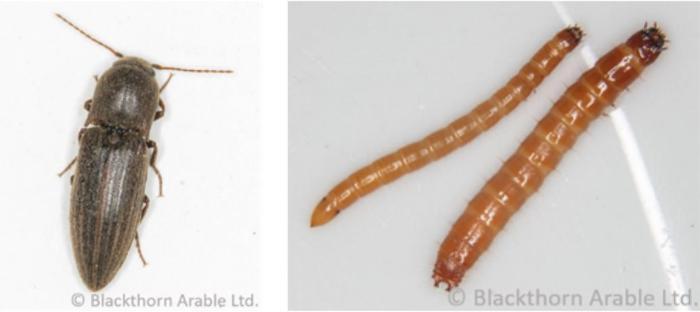
Adult Agriotes click beetle and wireworm larvae (Agriotes left).
Wireworms, the larvae of click beetle (Elateridae), are a soil-dwelling pest of cereals, grass and maize, as well as vegetable crops such as potatoes, carrots, Alliums, Brassicas, lettuce, and a variety of other crops. Wireworm damage to seedling stems and roots can cause wilting, delayed growth and death leading to patchy crops and yield loss; damage to root and tuber crops can significantly reduce marketability and suitability for storage.
“Damage caused by wireworms has increased in recent years for a number of reasons including: reduced availability of soil applied active ingredients; changes in cultivation practices, for example, reduced tillage after cereals and increased cover cropping (green cover) in the rotation, which have many advantages but also favours wireworms and limits chances to disrupt the pest; more grassy habitats in farmland favourable to wireworm survival; and a warming climate,” explains Martyn.
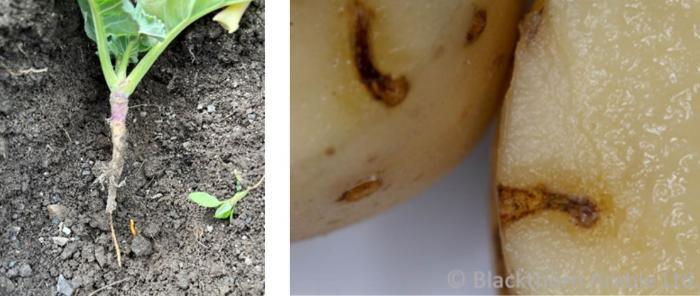
Wireworm damage to Brassicas and potatoes.
“Once a field is infested, wireworms are a challenging pest to control because of their long life cycle up to five years, overlapping generations, wide range of host crops, and ability to quickly move down the soil profile in response to changes in temperature and moisture,” adds Martyn.
High wireworm populations are traditionally associated with permanent or long-term grassland as this provides a favourable habitat for wireworms due to the continuous vegetation cover and abundance of food, stable moisture and temperature, and limited disturbance. When infested grassland is ploughed, the subsequent crops are especially vulnerable to attack. Organic crops like potatoes, for example, that frequently follow a fertility building grass ley are particularly vulnerable to wireworm damage.
There is now increasing understanding that wireworm can also be found where grass has not been in the rotation. “Grass in the rotation is an established risk, but field margins, other grassy habitats and weedy ground also have an important influence on wireworm numbers. Additionally, cereals are very attractive for egg laying, and green cover after cereals is food for new larvae. Where high risk crops such as two years of cereals are grown with autumn cover/weedy stubble and reduced cultivations ahead of a vulnerable crop like potatoes, then a damaging wireworm population can exist,” says Martyn.
For growers, the future of preventing wireworm damage relies on an integrated pest management (IPM) approach that is based on assessing the risk factors that favour infestation or crop damage and monitoring. “Careful crop rotation to avoid favourable crops for wireworms is a vital first step, and means planning well ahead and assessing the risky fields and times in the rotation and monitoring,” explains Martyn.
“The best time to control a wireworm is when it is young. Practices such as cultivating row crops during the egg hatch period, use of less susceptible poor host crops and cover crops, and intensive cultivation when adults/larvae are vulnerable indicate that the best strategy is to target the larvae in the first few months; timing tillage to reduce wireworm numbers in bare soil when larvae are small,” advises Martyn. “For vegetable growers, there may be chances to disrupt the life cycle at egg laying and egg hatch. The period of egg laying is May to June/July but this will vary depending on the species and location. Any cultivation, for example, preparing seedbeds for summer planted vegetables can be very useful here, but it must be emphasised that adult Agriotes can be found over a period spanning more than three months and the exact detail of egg laying and egg hatch is difficult to predict and most likely variable between species and emergence times,” says Martyn. “For conventional growers, crop protection can be achieved using pyrethroid insecticides such as tefluthrin seed treatment where approved, especially if the timing coincides with a period of high activity, but pyrethroids may not reduce the overall wireworm population and this can be factored into the wireworm risk model,” adds Martyn.
Wireworm identification and life cycle
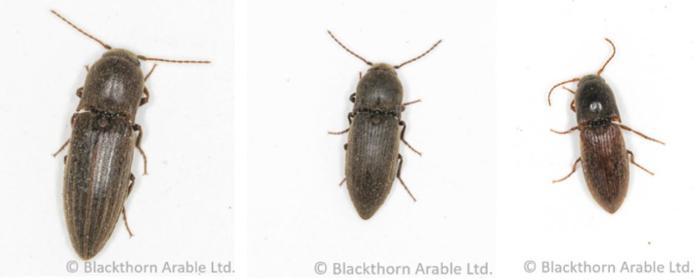
Only a few wireworm species are pests of crops. Several Agriotes species including Agriotes lineatus, Agriotes obscurus and Agriotes sputator are major contributors to wireworm damage, but species of other wireworms found in Ireland such as Athous, Ctenicera and Selatosomus are also crop pests. “More is known about the life cycle of Agriotes than other genera, some of which pupate in the spring and for these species activity is around a month later than for Agriotes,” explains Martyn.
Adult click beetles: Agriotes lineatus; Agriotes obscurus; and Agriotes sputator.
|
|
Understanding the wireworm life cycle |
|
Spring: Late March onwards |
Adults emerge from the soil and breed. |
|
May-July |
Eggs hatch, larvae 1.5 mm long. Larvae live around 3-5 years depending on species and temperature. |
|
July-August |
Year 4 larvae pupate, which lasts 2-3 weeks. |
|
Autumn |
Adult beetles remain below the soil surface until spring. |
Adult click beetles for the main Agriotes species emerge from the soil in spring, breed and survive until late summer. Female beetles lay their eggs from May to July, singly or in small clusters just below the soil surface. They prefer grassy, weedy ground or cereals for egg laying as in bare soil the eggs can desiccate and die. After about a month, the young larvae hatch. Initially they are transparent white and around 1.5 mm long, as they grow their colour darkens to the typical shiny brown of fully grown wireworms. They spend three to five years in the soil, depending on species and environmental conditions, before they are mature; feeding for two or three periods each year, from March to May and during September and October. Wireworms reach maturity in July and August, when they burrow deeper into the soil. Two to three weeks later, they become adults where they remain below the soil surface until spring.
Risk assessment: identifying wireworm risk factors
Assessing the risk of wireworm infestation or crop damage is an important preventative strategy and useful decision-support tool for wireworm IPM.
|
Key wireworm risk factors |
Effect |
|
Grass, cereals or similar in the rotation in the last 10 or more years |
↑ risk |
|
Areas of permanent grass or grassy margins nearby |
↑ risk |
|
Grass leys (two years) and cereals in the rotation |
↑ risk |
|
Cover crops, especially grasses |
↑ risk |
|
Utilising crops/cover crops less favourable to wireworms |
↓ risk |
|
Beside a field with known problem |
↑ risk |
|
Lack of knowledge of field history (e.g. rented land) |
↑ risk |
|
Weedy stubble, crop residue, organic matter content |
↑ risk |
|
Moisture retentive soil |
↑ risk |
|
Rivers or reservoirs (surface water bodies) nearby |
↑ risk |
|
Plant free situation after a cereal crop for one month |
↓ risk |
|
Intense tillage compared to reduced tillage (when larvae are active in upper profile) |
↓ risk |
|
Lack of inversion tillage early autumn (August/September) |
↑ risk |
|
Late lifted potatoes |
↑ risk |
|
Tolerant varieties/variety selection e.g. potatoes |
↓ risk |
|
Wireworm species identity (known crop pest) |
↑ risk |
|
IPM in a rotation including risk assessment and monitoring |
↓ risk |
Monitoring
Monitoring wireworm populations is a key component of an IPM approach, makes wireworm risk assessment much more reliable, and should be ongoing in fields at high risk of wireworm infestations, including those lacking proper rotation, with a history of wireworm infestation, or changing from permanent grass/long-term leys to annual cropping.
Bait and pheromone traps can be used to determine the presence or absence of wireworm larvae and adult click beetles, respectively. Bait trapping is increasingly being employed to detect wireworm in the soil. Bait traps use germinated untreated wheat and maize seed as sources of CO2 and volatiles to attract wireworms, and can detect lower populations of wireworms than soil core samples in Martyn’s experience with monitoring, but they must be used in the right conditions. “Wireworm in the soil is highly influenced by temperature and moisture. Once the soil is above 8°C and not saturated, bait trapping monitoring results become more reliable. Soil temperature data loggers are invaluable for successful monitoring of larval activity. Identification of what is found in traps is vital, as not all wireworms are crop pests,” Martyn advises.
“Adult trapping with pheromones can be used, and although there is no direct correlation between adult catches and the presence of larvae, it can give a better indication of when adult beetles are active and the presence of some species over others. It can also identify where invasion is taking place,” says Martyn.
“Once crops are planted, crop monitoring for damage is essential. For the majority of crops, except potatoes, the most serious damage is caused to young plants, usually in spring and early summer. Monitoring in potatoes has shown that wireworm feeding starts early, and can fluctuate, but the severity of damage increases later in the season, particularly September onwards. If serious damage is expected, consideration should be given to lifting earlier than usual,” adds Martyn.
Through his extensive work on wireworms, Martyn has produced bait trapping guidelines for wireworm larvae and adult pheromone trapping guidelines for Agriotes click beetles that are now increasingly used as tools for monitoring and optimising risk assessment in the UK. This article is focused on highlighting these recent advances in wireworm risk assessment and practical monitoring techniques that are supporting wireworm IPM decisions on crop rotations, cultivations, adapting planting and harvest dates, and control strategies.
Further information
Bait trapping guidelines for wireworms 2024 (Martyn Cox)
Pheromone trapping guidelines for Agriotes click beetles 2024 (Martyn Cox)
Wireworm – National Potato Conference 2022 (Martyn Cox)
Acknowledgements
Thank you to Martyn Cox Blackthorn Arable Ltd. for providing wireworm expertise and information on advances in wireworm monitoring and risk assessment.
Read the full document, including guidelines on bait trapping for wireworms and pheromone trapping fro agriotes click beetles here: Wireworm IPM in field vegetable crops (PDF)