
25 March 2025
With current fertiliser prices organic manures are more valuable than ever!
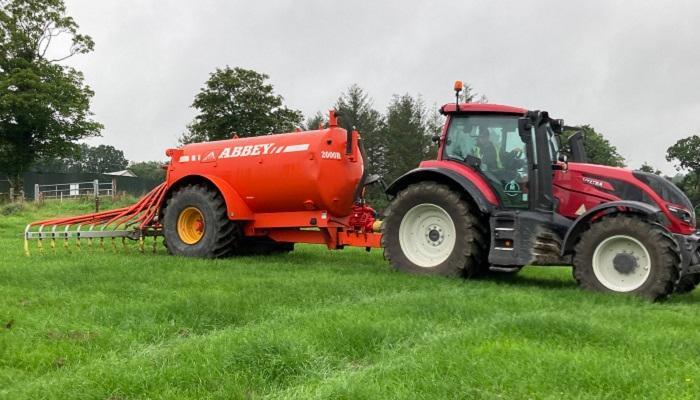
Now is the time to plan for grazing and silage while making the most of nutrients on-farm. Smart slurry use boosts soil fertility, saves costs, and protects the environment. Plan wisely for a productive season! Anne O’ Malley, Business & Technology Advisor, tells us more.
Soil temperatures are rising, daylight is increasing and grass growth will also increase as farmers plan ahead for grazing and silage requirements for the year ahead. This is a very busy but rewarding time on farms. Remember to stay safe with livestock, machinery and in particular, with slurry.
View the Grass10 Newsletter for weekly updates
Soil test results are valid for four years and soil labs have being very busy with large volumes of soil samples taken in the last three years. Farmers are seeing the positive results of liming with increases in soil phosphorus (P) indexes without the addition of extra bag fertiliser. Soil results show fields with low P & K fertility (Index 1 & 2), optimum fertility (Index 3) and high fertility (Index 4). Do not apply P to Index 4 or high fertility soils and re-sample to check the P Index before applying P again. This is a saving and instead divert applied nutrients if necessary to suitable productive low P & K fertility fields.
Complete a whole farm fertiliser plan to determine P and K requirements. In most cases cattle slurry is effective and a relatively low cost manure and can be used to supply all of the P and K requirements without the need to apply chemical P or K on low intensive farms. The key is good management of cattle slurry to protect our environment and maximise nutrient recovery and minimise losses.
The current value of a 2500 gallon tanker of slurry is about €70 euro. Cattle slurry can vary in nutrient content depending on its dry matter (DM) content. The average DM content of cattle slurry is about 6% and the range goes from 2% (very dilute) to 7% (thicker). Diluting cattle slurry with water is beneficial for ease of agitation and can help to improve N availability in the slurry, however it will also dilute the P and K content. The key message is that all nutrients from the farmyard count for grass, even soiled water with very low DM. Cattle slurry (6% DM) has a Slurry N-P-K equivalent of 50Kg bag of 9-5-32 units/1000gallons using Low Emission Slurry Spreading (LESS).
Nitrogen (N) is the key driver of grass growth under optimum conditions. N is a volatile nutrient and exists in many different forms, some available for uptake by plants, but, ammonia can be lost to the air, nitrate to drainage water and nitrous oxide is a potent greenhouse gas. Productive fields with good soil fertility with a pH of 6.3 and a P & K index at 3 are more efficient in utilisation and recovery of N with less losses to the environment.
A good crop of grass silage needs 100 units N per acre and grass silage takes up on average about two units N per day. Therefore, apply N at least 50 days before cutting to ensure full crop N utilisation. Cattle slurry can be used to supply up to 30% of the N requirements of a silage crop and the balance can be supplied by bag fertiliser. All farmers should aim to use protected urea as their straight N chemical fertiliser source.
Further resources for fertiliser spreader calibration
Nitrogen recovery in cattle slurry is optimum during cool, damp, overcast days where uptake by the growing crop is high and N loss through ammonia emissions is lowest. Ammonia losses increase during the summer months and the majority of losses occur within 24 hrs of application. LESS methods of trailing shoe/injection reduce N losses and allows more flexibility for spreading with less contamination of grass. Applying slurry in spring at 2500 gals per acres by LESS will supply about 20 units per acre of available N. A fertiliser plan is important so that if you apply cattle slurry to a field you reduce your bag fertiliser application rate accordingly to take account of nutrients applied in the slurry.