
Women in Agriculture: 80% of farm successors are male
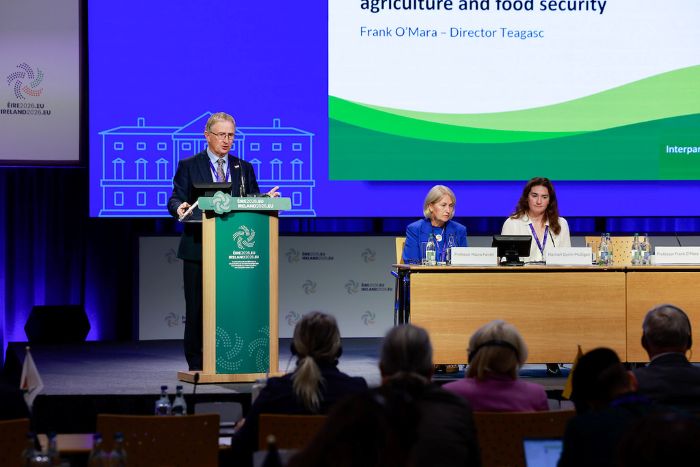
Over the past three decades, there has been little growth in the number of female farm holders in Ireland and, where a successor to a farm has been identified, 80% are male.
That was one of the many key messages delivered by Professor Frank O’Mara, Director of Teagasc, who drew on findings from the HER-SELF project, completed by Maynooth University, Teagasc and Munster Technological University.
Addressing the Interparliamentary Conference on Agriculture in Dublin Castle in late July, Professor O’Mara discussed some of the project’s important findings, explaining:
“Female farm holders represent just 13.4% of farm holders in Ireland, with little increase since 1991. The project also found that female farm ownership is highest in areas where farm sizes are smaller and where land values are lower.”
Another finding presented by Professor O’Mara from the HER-SELF Project was that farm incomes for female farmers are consistently lower than for male farmers and they receive lower direct farm payments.
Speaking on the implications for agriculture, Professor O’Mara commented that the very low percentage of female farm holders is a concern, pointing to results from the FLIARA Horizon Europe project which illustrated that women contribute significant innovation capacity to the sector.
“One thing that is clear from the research and the case studies that have been examined is that women contribute huge innovative capacity to the sector and we are losing out by having so few female farm holders,” Professor O’Mara explained.
Despite the limited growth in the number of female farm holders over the past 30 years, Professor O’Mara noted that there are signs of change:
Female participation rate in the Teagasc education programme has increased consistently over the last decade, up from 13 to 28% in the last eight years. Additionally, Professor O’Mara acknowledged the achievements of Kate Curran a dairy farmer from Co. Waterford, and Robyn Dowling who has established an equine business in Dublin – the two most recent winners of the Teagasc Student of the Year Competition.
As for Teagasc’s role, Professor O’Mara noted that the organisation is very anxious to support women farmers:
“We have a working group that is feeding into the Women in Agriculture Action Plan, and they have brought forward many initiatives in the last couple of years, one of which has been the establishment of women-only discussion groups.
“And since we began that initiative a few years ago, we now have 15 of those groups with a combined membership of 295.
“It is not as if we are saying that all females should be in women only discussion groups,” Professor O’Mara said, “but some women prefer to start their journey in a women-only group where they can ask questions in a less intimidating environment.”
Stemming from abovementioned dedicated working group, Teagasc has organised a conference ‘Growing Voices – Women in Farming’, taking place in Tullamore later this year.
For more information on ‘Growing Voices – Women in Farming’, visit here.
For further details, Professor O’Mara’s full presentation to the Interparliamentary Conference on Agriculture is available to view in the below video:
Featured image source source: PARLEU2026.ie