Land Citizenship: Rural Women Cultivating Good Food For All
‘Land Citizenship: Rural Women Cultivating Good Food for All’ is a research and policy focused event, and is one of two events organised by Teagasc for the UN FAO International Day of Rural Women (October 15th) and the UN International Year of the Woman Farmer 2026.
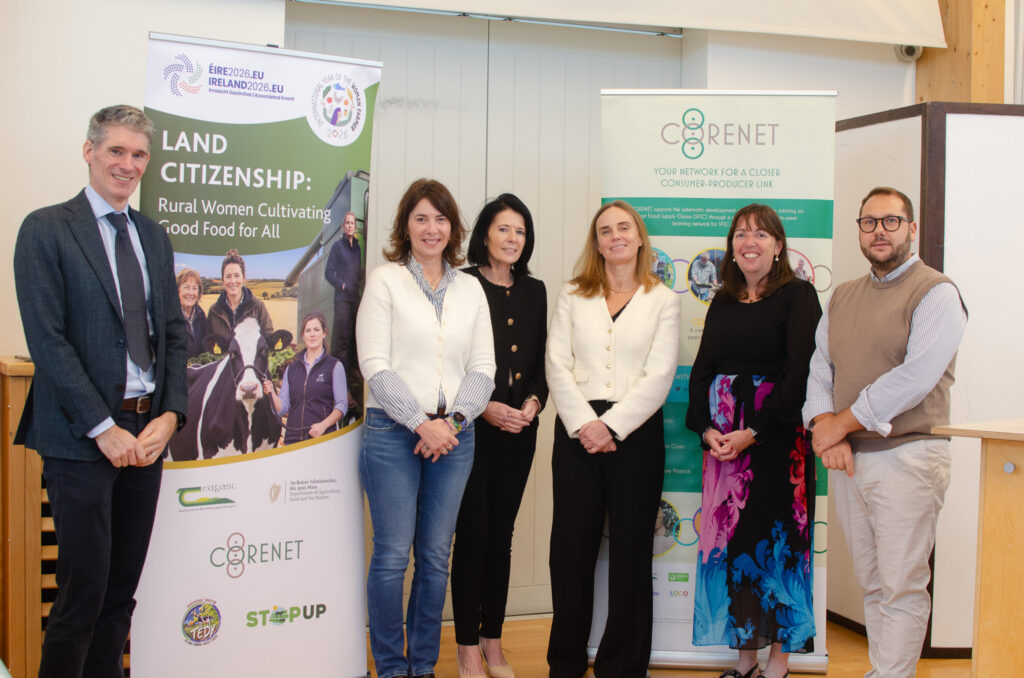
Pictured from (l to r) David Meredith, Teagasc; Raquel Ferriera, Teagasc & TEDY; Loreto Ferguson, Teagasc; Áine Macken-Walsh, Teagasc, COREnet & TEDY; AnneMarie Butler, Teagasc; Fedele Colantuono, COREnet Coordinator at the Land Citzenship: Rural Women Cultivating Good Food for all.
The ‘Land Citizenship: Rural Women Cultivating Good Food for All’ was jointly hosted by the Department of Agriculture, Food and the Marine, (DAFM) and Teagasc and was an official event for Ireland’s EU Council Presidency. The two-day event, organised as a Roadshow for the COREnet Horizon Europe project, had a strong international and policy innovation focus.
The first day of the event brought together farmers, advisors, researchers, policymakers and rural organisations from across Europe on field visits to a range of COREnet ‘Golden Cases’ (Airfield Farm. Burren Beef and Farm Experience, Masterchefs) and ‘Lighthouse Projects’ (Western Organic Producer Organisation, WOPO). These cases highlight the crucial role of advisory services, targeted policy support and collaborative networks in enabling inclusive, sustainable change. Several of the case studies featured at the event are initiatives supported by DAFM under Ireland’s CAP Strategic Plan 2023-2027, e.g. the Short Food Supply Chain scheme (SFSCs) and the Producer Organisation Early Support scheme.
Ms Elisa Goode, Department of Agriculture, Food and the Marine, said: ‘these examples showcase the leadership of women farmers in short food supply chains, and sustainable food systems, and demonstrate how farm development and diversification policies are being implemented on the ground to achieve multiple impacts that go beyond their headline aims, including a more gender inclusive agri-food sector’.
Dr Fedele Colaontuono, Project Manager of the COREnet Advisory Network, said: ‘in Ireland we see powerful examples of ‘Golden Cases’ and ‘Lighthouse Projects’ that rely on advisory supports. Such assistance is essential to empower female farmers in leading and shaping the emergence of Short Food Supply Chains; an element recognised as vital to future resilient food systems and an inspiration for other countries.
Advisory expertise of Teagasc Organic Specialists John Noonan, Elaine Leavy and Joe Kelleher were highlighted at the event, along with community-based and industry supports provided by Irish members of the COREnet Advisory Network, including Séamus Sheridan, food business consultant and Caitríona Scully, Mid-West BioDistrict.
The second day of the event was a research and policy symposium held in Galway, which addressed topics from DAFM’s Agroecology Partnership TEDY, COREnet’s sister Horizon Advisory Network EU4Advice and the STEP-UP Horizon Europe project focused on sustainable livestock production systems. Speaking at the event, Dr Áine Macken-Walsh, Teagasc Senior Sociologist, said: ‘Short Food Chains are one area where women have emerged as leaders of farm-based innovation, not only in Ireland but across the EU. Short Food Chains typically emerge within family farm settings, involving a mutually supportive arrangement of people, resources, relationships and responsibilities in a single farm setting. While in Ireland and across Europe, we see a gender imbalance in farm ownership, Short Food Chains have shown how collaborative arrangements involving women as co-leaders of enterprises can underpin significant achievement of EU and national policy objectives where sustainability, gender equality and attractiveness of agriculture are concerned’.
In her opening address, Professor Bina Agarwal, India, highlighted the potential of group, or collaborative farming, in transforming gender equality in agriculture, contextualising cases in Ireland in a worldwide context.
Keynote presentations from Ireland (Elisa Goode, DAFM; Mary Clancy, University of Galway) presented the historical and contemporary scene with respect to women’s involvement in Irish agriculture, identifying latent and emerging forms of opportunity.
Christian Jochum, Austria, presented the contrasting case of Austria, where, compared to EU averages, there are higher rates of female participation in agriculture, accompanied by a high proportion of organic agriculture.
Dr. Mousaab Alrhmoun of the Agroecology Partnership project TEDY said that Short Food Chains provide an example of profitable, sustainable and local business models that can practically foster the agroecological transition, in a way that is empowering of women, youth and other underrepresented groups in conventional agriculture.
A range of perspectives from policy and practice were heard at the event and were combined in a systemic mapping session. There were representatives from the Irish Natura & Hill Farmers Association (INHFA), the Women in Agriculture Stakeholder Group, Wild Atlantic Nature, Talamh Beo, and the Mid-West Bio-District.
The policy and practice focus complemented research representatives from the FLIARA Horizon Europe project, the University of Galway’s School of Political Science and Sociology and Social Science Research Centre, the University of Limerick’s Department of Management and Marketing, and France’s Université Lumiére de Lyon.
Providing creative expression to the constellation of experiences, perspectives and ideas at the event was a monologue from artist John Nee; and an embodied constellation approach led by creative practitioner Johanne Webb. These approaches, and their generative potential in innovation contexts, was harnessed by a dedicated workshop led by Dr Avion Phillips, Teagasc, for EU-FARMBOOK.
In his closing address, Paul Maher, Teagasc’s Head of International Affairs and Corporate Strategy said; ‘this event has drawn experience from different global contexts to highlight consistent evidence that women’s empowered roles in family farming leads to positive impacts for sustainability and innovation. Teagasc’s programmes in Ireland and further afield in the Global South recognise this evidence in strategies to improve rural and agricultural livelihoods across many dimensions.