
RU-MIT-LESS Research Project to Investigate Lifetime Potential of Methane-Reducing Feed Additives in Beef Cattle
Methane-reducing feed additives have the potential to contribute to Ireland’s agricultural greenhouse gas reduction targets, with studies showing emissions reductions of 8% to 30% under indoor conditions.
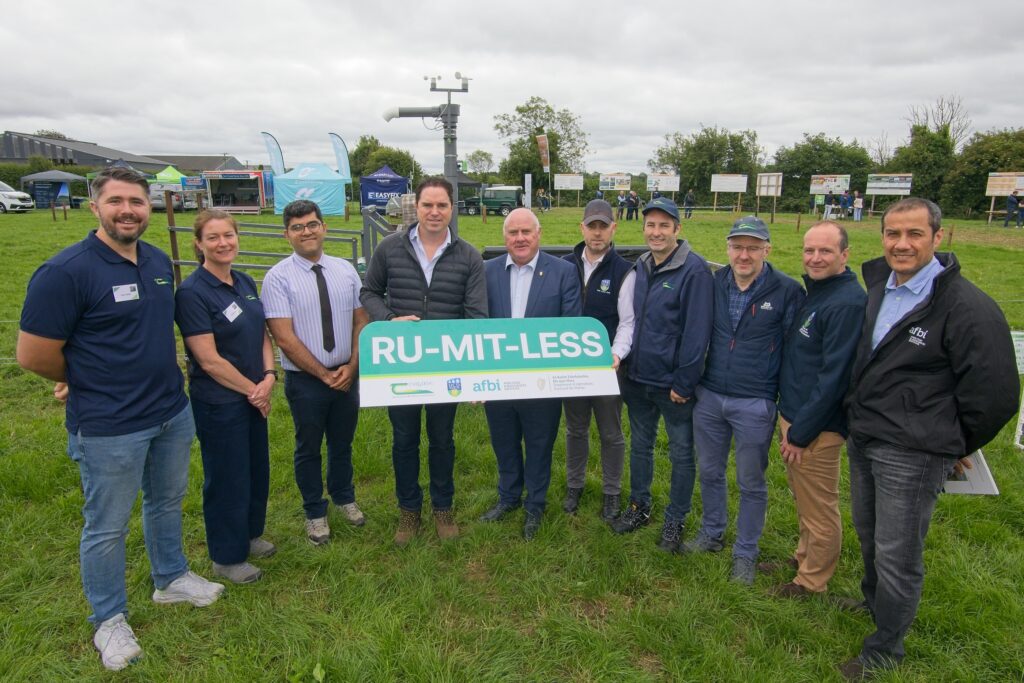
The RU-MIT-LESS research project was launched at the BEEF 2026 Open Day in Teagasc Grange. Pictured (Left to Right) were Dr Paul Smith (Teagasc and Project lead); Dr Orla Keane (Teagasc); Dr Mohmammad Mohammadrezaei(Teagasc); Martin Heydon TD, Minister for Agriculture, Food and the Marine; Noel Grealish TD, Minister of State at the Department of Agriculture, Food, and the Marine with responsibility for Research and Development; Professor Alan Kelly (UCD); Professor David Kenny (Teagasc); Dr Mark McGee (Teagasc); Dr Stafford Vigors (UCD) and Dr Omar Cristobal Carballo (AFBI).
However, their long-term effectiveness in grass-based systems remains uncertain. Sustained progress will depend on combining such technologies with improvements in overall farm system efficiency. These efficiencies include animal performance, genetics, nutrition, and management and can deliver lower emissions intensity alongside higher productivity.
Addressing this knowledge gap is the key focus of the new RU-MIT-LESS research project, led by Teagasc, in collaboration with University College Dublin (UCD) and the Agri-Food and Biosciences Institute (AFBI). The €1.5million euro project, funded by the Department of Agriculture, Food and the Marine (DAFM), will investigate the strategic use of a range of methane reducing feed additives throughout the beef production cycle, including early-life interventions as well as any additive benefits associated with combining different additives. The project will also evaluate how these technologies can be incorporated into practical and economically viable beef production systems, as well as investigating the societal barriers to the uptake and usage of feed additives within the Irish beef sector, and the effectiveness of new technologies for measure methane emissions.
The RU-MIT-LESS project was officially launched by Martin Heydon TD, Minister for Agriculture, Food and the Marine, and Noel Grealish TD, Minister of State at the Department of Agriculture, Food, and the Marine with responsibility for Research and Development. The Ministers launched the new RU-MIT-LESS research project at the Teagasc Beef Open Day in Grange, County Meath this week. Farmers attending the Open Day learned about the project’s objectives and its role in supporting climate-smart beef production.
Teagasc researcher Dr Paul Smith said: “While previous research has demonstrated the methane reduction potential of feed additives during indoor feeding periods, there is still much to learn about their long-term effects. RU-MIT-LESS will investigate a range of feed additives, both individually and in combination, across different stages of the beef production cycle, including early-life interventions. The project will evaluate their impact on methane emissions, animal performance and farm profitability, providing the evidence needed to support future adoption by Irish beef farmers. Furthermore, this project will focus on understanding the opinion of multiple actors throughout the beef sector, to the usage of feed additives for reducing methane emissions.”
Professor Alan Kelly, Associate Professor at the UCD School of Agriculture and Food Science, said: “University College Dublin (UCD) is delighted to collaborate on the DAFM-funded RU-MIT-LESS research project, with AFBI, and Teagasc. This research represents a major step towards delivering practical, science-based methane mitigation solutions for Irish livestock systems. A unique feature of the project is the integration of UCD and Teagasc expertise and farm system infrastructure, establishing a fully integrated dairy-to-beef research platform that links the UCD Lyons Dairy Herd and Dairy Calf Research and Education Facility with the Teagasc Grange Dairy-Beef Farm system. Through this model, the research will examine how early-life nutritional interventions, genetics, management practices, and later-life mitigation strategies can deliver cumulative, lifetime reductions in enteric methane emissions, while also promoting improved farm production efficiency. The findings will identify cost-effective solutions that enhance the sustainability, productivity, and resilience of Ireland’s pasture-based dairy and beef sectors.”
AFBI researcher Dr Omar Cristobal Carballo said: “Methane suppressing feed additives are promising methane mitigation technologies, with the potential to reduce Irish GHG emissions. Addressing reductions in methane emissions is urgent for climate mitigation, livestock sustainability, feed efficiency, and long-term agricultural viability. Wearable technologies provide a practical, scalable, and data-driven solution for monitoring and mitigating methane production. RU-MIT-LESS will assess a promising novel halter type wearable device and compare the CO2 and CH4 measurement results with those from metabolic chambers and greenfeed when animals are fed different methane suppressing supplements, at different stages of growth, and in indoors and grazing setting”.
A comprehensive approach to methane mitigation
Over the lifetime of the project, researchers will investigate the effectiveness of different methane-reducing feed additives across the full beef production cycle, including the potential benefits of introducing interventions early in life. Alongside measuring methane emissions and animal performance, the project will evaluate the economic and environmental impacts of these technologies at farm level.
The research will also explore farmer and consumer attitudes towards methane mitigation technologies and develop improved methods for measuring methane emissions, strengthening Ireland’s capability in emissions monitoring and low-carbon livestock research.
The outcomes from RU-MIT-LESS are expected to provide robust scientific evidence on the lifetime effectiveness of methane-reducing feed additives, helping to identify practical and economically sustainable solutions for Irish beef farmers. Ultimately, the project will aim to support Ireland’s climate ambitions while maintaining the productivity, sustainability and international reputation of the Irish beef sector.
For more information contact Dr Paul Smith (Principal Investigator): Paul.Smith@teagasc.ie