
Teagasc brings the food sector together to reduce food waste and drive circular food innovation
Teagasc welcomed primary producers, food manufacturers, policymakers and other stakeholders to the Teagasc Food Research Centre, Ashtown, to explore practical ways to prevent food waste and support circular food innovation. Organised as part of the Horizon Europe ROSETTA project, the mutual learning and demonstration mission event brought together key actors from across the food value chain to exchange knowledge, share experiences and explore practical solutions that prevent food waste and speed up the transition towards a circular food system.
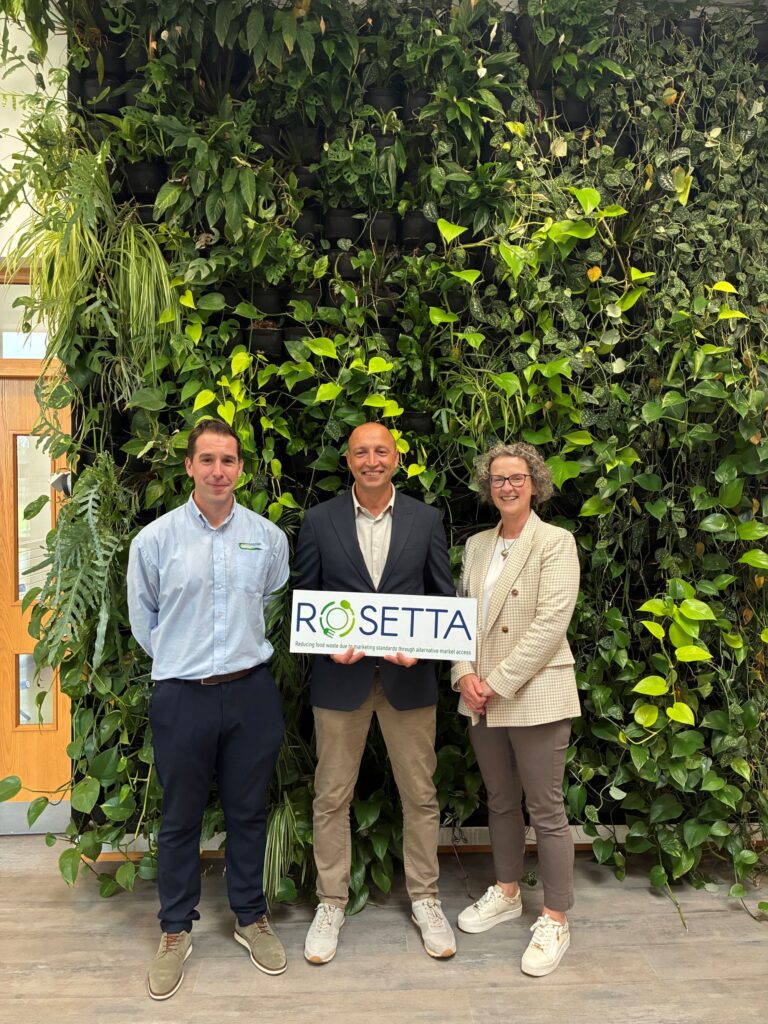
Pictured at a recent meeting on reducing food waste, held at the Teagasc Food Research Centre, Ashtown were Shay Hannon, Manager of the National Prepared Consumer Food Centre at Teagasc; Angelo Galatolo, technologist at Teagasc; and Professor Maeve Henchion, Principal Research Officer at Teagasc.
The event focused on the Irish ROSETTA pilot case, which aimed to add value to Irish fruit and vegetables that do not meet marketing standards. It provided participants with the opportunity to learn from this experience and discuss how innovative approaches to food waste prevention can be adapted and implemented in different organisations and regional contexts. Through collaborative discussion and peer-to-peer learning, participants explored opportunities to strengthen cooperation and accelerate the adoption of sustainable practices across the agri-food sector.
Participants were introduced to the ROSETTA project before learning about the Irish pilot case. A presentation then demonstrated how safe, but out-of-specification vegetables can be transformed into high-value food ingredients and innovative products.
Welcoming participants, Professor Maeve Henchion, Principal Research Officer at Teagasc, said: “Thinking a bit differently gives us real opportunities to prevent food waste. By looking at vegetables that may not meet aesthetic standards as a resource, and building circular thinking into new product development, we can deliver practical solutions. That is at the heart of the ROSETTA project at Teagasc.”
The mutual learning session then encouraged participants to exchange experiences, identify practical challenges and discuss opportunities for applying the lessons learned from the Irish pilot within their own organisations. By bringing key stakeholders together, the event reinforced the importance of collaboration in developing effective and scalable food waste prevention solutions.
Participants were also introduced to the Teagasc National Prepared Consumed Centre (NPCFC) Systematic Food Valorisation Framework. The framework, developed by Angelo Galatolo, technologist at Teagasc, underpins the scientific approach used in the Irish ROSETTA pilot.
Speaking during the demonstration mission, Angelo Galatolo, said: “What is particularly exciting is the wide range of products we have developed, from everyday bread and fermented carrot stalks, reflecting growing interest in fermentation and gut health, to premium chocolate bonbons. This shows how a humble, rejected carrot can be transformed into innovative, high-value food products. Engagement at the National Ploughing Championships and Airfield Estate demonstrated real consumer interest and excitement, with many people keen to see these products reach the market.”
The event concluded with a showcase and tasting of foods developed from out-of-spec vegetable ingredients, allowing participants to experience firsthand how such resources can be transformed into innovative, high-value food products.
Speaking during the event, Shay Hannon, Manager of the National Prepared Consumer Food Centre at Teagasc, said: “Preventing food waste is not without challenges, but this project has shown that vegetables which fall outside marketing specifications can still have real value. From bread to chocolate bonbons, we have demonstrated how these ingredients can be transformed into appealing food products that consumers value.”
In scaling the food waste prevention solution developed by Teagasc, participants recognised the project’s zero-waste approach, the development of more than 100 recipes using relatively simple technologies and the potential to apply the framework to other crops. Key challenges included limited facilities for large-scale drying and processing, regulatory and food safety barriers, and the need for stronger funding, collaboration, marketing and market development. Creating a link between the grower and potential processor was highlighted as a particular challenge. The workshop also explored consumer perceptions of “upcycled” foods and opportunities to create non-food as well as food products from surplus and by-products.
Notes to Editors
- ROSETTA is a 3-year EU funded project that aims to assess the impact of marketing standards on food waste and propose sustainable solutions for the utilisation of food that does not meet marketing standards but is still safe to be consumed. For more information about the ROSETTA project and its ongoing activities, visit the official website: https://rosetta-project.eu/
Further information on the National Prepared Consumer Foods Centre available here National Prepared Consumer Food Centre – Teagasc | Agriculture and Food Development Authority