
Teagasc Launches New Corporate Strategy “Innovating for Impact: Improving Competitiveness and Resilience in the Agrifood Sector”
Teagasc launched its new Statement of Strategy 2025-2028 “Innovating for Impact: Improving Competitiveness and Resilience in the Agrifood Sector” today, Monday, 8th December, at its Food Research Centre, Ashtown, Dublin 15.
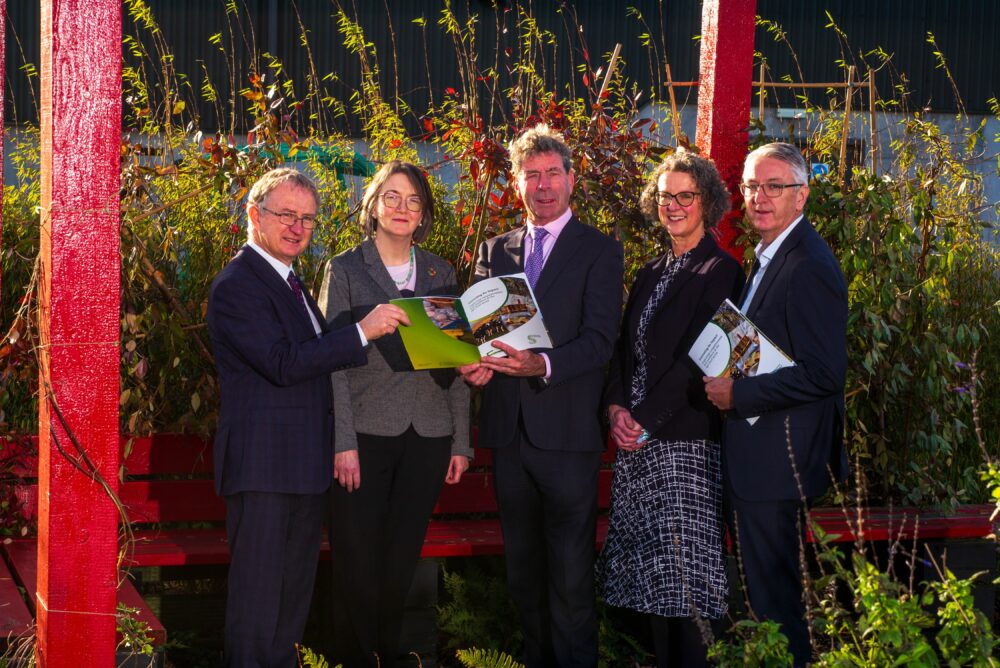
Teagasc launched its new corporate strategy “Innovating for Impact: Improving Competitiveness and Resilience in the Agrifood Sector”, today, December 8, at its Food Research Centre, Ashtown, Dublin 15. Pictured at the launch are from left to right: Professor Frank O’Mara, Teagasc Director; Sinéad McPhillips, Secretary General of the Department of Agriculture, Food and the Marine; Liam Herlihy, Chair of the Teagasc Authority; Professor Maeve Henchion of Teagasc, who led the development of the strategy; and Paul Maher, Head of International Relations and Corporate Strategy.
With a focus on competitiveness and resilience, the launch marks a reorientation of priorities for the organisation, setting out an ambitious roadmap to strengthen productivity, environmental sustainability, attractiveness and innovation in the agrifood sector in the years ahead. This is in line with the EU’s renewed focus on competitiveness and food security and the Irish Government’s Action Plan on Competitiveness and Productivity. Strengthening both environmental sustainability and the economic viability of Ireland’s family-based farming model remains essential.
Commenting on the importance of the agrifood sector – contributing €19.1bn to gross value added at factor cost and exporting to over 180 countries worldwide in 2024, Liam Herlihy, Chair of the Teagasc Authority said: “We will continue to work with holders of over 130,000 farms and over 200 companies from across the agrifood system to address complex challenges but also to seize new opportunities. With its integrated model of research, education, and advisory services, Teagasc is uniquely positioned to drive innovation, sustainability, and resilience for farmers, industry, and society.”
Mr. Herlihy described the new strategy as ambitious, emphasising that “‘Innovating for Impact’ will ensure that Teagasc continues to be relevant to its stakeholders. It is designed to position Teagasc to be responsive, flexible and adaptive in a rapidly changing environment.”
He highlighted the strong synergies between Teagasc and a broad range of partner agencies and other organisations with aligned remits and a shared commitment to supporting the growth and transformation of the agri-food sector. In particular, the close strategic alignment with the Department of Agriculture, Food and the Marine (DAFM), Enterprise Ireland, Bord Bia, and Bord Iascaigh Mhara (BIM) reflects a collective national ambition to foster innovation, drive sustainability, and enhance global competitiveness. Working with partners across the agri-food sector, Teagasc will introduce measures to attract highly skilled young people into farming, with a particular focus on increasing the participation of women and part-time farmers. As the sector faces growing risks from market disruptions, geopolitical tensions, and economic shocks, the strategy places greater emphasis on innovation to increase value-added production and expand market opportunities.
The strategy builds on several recent Teagasc initiatives including its advisory, education and climate strategies, as well as specific initiatives relating to water quality, strategic communications and international development. It includes more than 40 new initiatives that will shape the agrifood industry over the next three years. These initiatives will be reviewed during the lifetime of strategy to ensure that Teagasc is achieving real impact. As a result, additional initiatives may be introduced over time, while others may be phased out.
Professor Frank O’Mara, Teagasc Director, outlined the organisation’s sectoral priorities for the coming years, aimed at enabling the agrifood sector to be more productive, more environmentally sustainable, more attractive and more innovative. Farm-level productivity will be improved by optimising herd and crop health, advancing genetic gain, adopting more efficient management practices, and using technology to support data-driven decision-making.
Teagasc will continue to deliver on its Climate Action Strategy and the Better Farming for Water Campaign by guiding farmers to reduce emissions, adapt to climate change, and improve water quality. Over the course of the strategy, Teagasc will also develop a dedicated Biodiversity Strategy.
He emphasised the importance of continued investment in people, processes and infrastructure, alongside strengthened collaborations.
“Teagasc will build on existing partnerships to ensure we remain thought leaders, accelerating innovation and delivering real benefits for our clients, stakeholders, and the wider community,” Professor O’Mara said.
He reaffirmed Teagasc’s commitment to maximising its impact through three key pathways: technology development and adoption, capacity building and providing policy information and support and noted that progress along these pathways relies on a superb operations function.
Sinéad McPhillips, Secretary General of the Department of Agriculture, Food and the Marine (DAFM), delivered a keynote address at the launch. She commended the new strategy, welcoming its focus on competitiveness and resilience – priorities that align closely with the Department’s vision for the sector. Ms. McPhillips emphasised that addressing the opportunities and challenges facing the sector in the time ahead will require both innovation and practical solutions. Highlighting Teagasc’s unique role, she noted that few bodies internationally combine research, education and advisory services in one organisation.
“This integrated model is a real strength for Ireland. It ensures that farmers and agri-food businesses have access to the latest science, the skills to apply it, and the advice to make it work on the ground,” she said.
Reacting to the strategy as a member of a stakeholder discussion panel, Michael Doran, farmer and chair of the Irish Cattle Breeding Federation (ICBF) welcomed the new Teagasc Advisory Strategy and highlighted the role of improved genetics in tackling the challenges facing the sector. He stated: “The renewed focus on competitiveness will be really important at farm level after the increase in production costs over the last number of years, especially as we face more fluctuations in receipts and inputs costs”. He voiced strong support for the new generational renewal opportunity initiative and praised the new national training and learning platform, which will blend digital tools with hands-on, in-person training programmes.
“It’s vital that we keep a strong pipeline of talent coming through. Farmers need practical ways to upskill so that we can take on board the new technologies developed by Teagasc. That’s how we’ll drive innovation and build long-term resilience right across the sector,” Mr. Doran said.
Commenting from a food industry perspective, Paul Kelly, Director of Food Drink Ireland welcomed the establishment of a new Office for Agri-Food Innovation Support, emphasising its role in creating streamlined access to Teagasc’s research expertise, pilot-scale facilities and dedicated innovation support team.
“For research to deliver real value for industry, it must be translated into practice. What we need are the practical innovation pathways that this office can provide to help businesses adopt new solutions quickly and effectively,” Mr. Kelly said.
He highlighted the influence of climate change and regulatory pressures on investment decisions all along the agrifood supply chain, noting that the new office will be a valuable resource for industry as it navigates these challenges while remaining competitive and resilient.
Professor Maeve Henchion of Teagasc, who led the development of the strategy, highlighted the extensive stakeholder and staff engagement underpinning the strategy. She noted that along with almost 30 interviews with external stakeholders, more than 40 staff workshops were held, involving more than 60% of staff, fostering combined ownership and motivation to deliver.
Further information
- The English version of “Innovating for Impact: Improving the competitiveness and resilience of the agrifood sector” is available here
- The Irish version of “Nuálaíocht le haghaidh Tionchair: Feabhas a chur ar iomaíochas agus ar athléimneacht san earnáil agraibhia” is available here
- A short video providing an overview of the strategy is available here with further details on a selected number of strategic initiatives provided on a short video available here
- Further information on “Better Farming for Water- 8 Actions for Change” campaign is available here