
Teagasc signs EU Soil Mission Manifesto
Teagasc has signed the EU Soil Mission Manifesto, reaffirming its commitment to supporting farmers and land managers to safeguard soil health for the benefit of people, nature, food production, and climate.
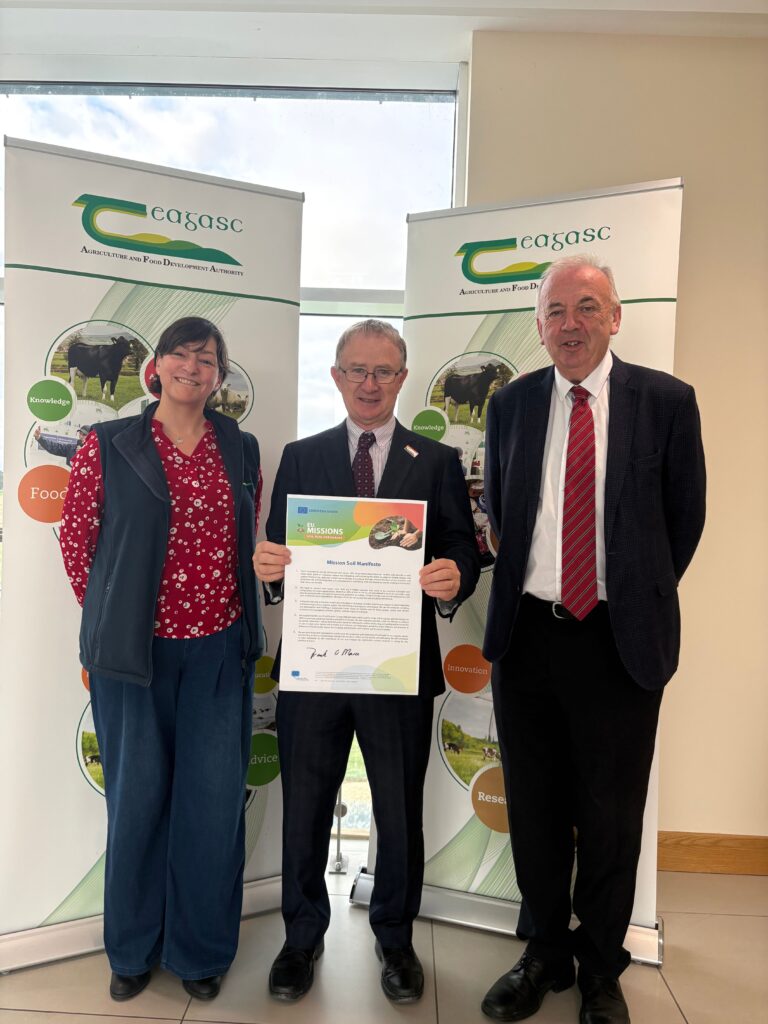
Pictured after Teagasc signed the EU Soil Mission Manifesto were Dr Veronica Nyhan, Teagasc Soil and Plant Nutrition Specialist, Professor Frank O’Mara, Director of Teagasc, Professor Pat Dillon, Director of the Research at Teagasc.
The signing comes during a period of particular focus on soil health in Ireland, with the Irish Soil Health Week taking place from Monday, 21 September to Friday, 25 September 2026, ahead of European Mission Soil Week in Dublin on 17 and 18 November 2026. European Mission Soil Week is organised by the European Commission and hosted by the Department of Agriculture, Food and the Marine and Teagasc under Ireland’s Presidency of the Council of the European Union. The manifesto recognises soil as an essential foundation for life, with approximately 95% of the world’s food produced directly or indirectly from soil. Healthy soils support clean water and air, carbon sequestration, biodiversity, productive agriculture, and the cultural landscapes on which communities and economies depend.
However, soils are under increasing pressure from unsustainable management practices, pollution, soil sealing, and climate change. The manifesto highlights that more than 60% of soils in the European Union are considered to be in an unhealthy condition.
By signing the manifesto, Teagasc supports the EU Mission ‘A Soil Deal for Europe’, which aims to establish 100 soil living labs and lighthouses by 2030. Through research and innovation, living labs and lighthouses, soil monitoring and soil literacy activities, the Mission addresses challenges including erosion, soil pollution, loss of soil organic carbon, declining soil biodiversity, and land degradation.
The manifesto encourages action at global, national, regional, and local levels. Teagasc will continue to contribute to raising awareness of soil health and supporting farmers, land managers, students, researchers, and communities in understanding, protecting, and restoring soils.
Professor Frank O’Mara, Director of Teagasc, said: “Soil is one of our most important natural resources and is fundamental to the future of sustainable agriculture. By signing the EU Soil Mission Manifesto, Teagasc is reaffirming its commitment to support soil health through research, education, knowledge exchange, and practical advice. We all have a role to play in caring for soils and ensuring that they remain healthy and productive for future generations.”
Dr Karen Daly, Head of the Soils, Environment and Land Use Department at Teagasc Johnstown Castle, added; “The objectives of this Manifesto align closely with our work to build resilient farming systems by protecting and improving soil health. Through Mission Soil projects such as MARVIC and SoilHarmony, Teagasc is working with partners across Europe to support the EU Soil Monitoring and Resilience Law, improve our understanding of soil carbon and soil health, and develop practical approaches that can support farmers and land managers. Looking ahead, Mission Soil will provide further opportunities to strengthen European collaboration, share knowledge, and translate research into practical solutions for healthy soils.”
Dr Veronica Nyhan, Teagasc Soil and Plant Nutrition Specialist, said: “For farmers and land managers, good research has to translate into practical decisions about how soils are managed. An important part of our role in Teagasc is taking the knowledge emerging from research and helping farmers apply it in ways that work within their own farming systems. Mission Soil can help strengthen that connection between research, demonstration, and practical action on farms.”
European Mission Soil Week will bring together policymakers, researchers, farmers, land managers, businesses, and other soil stakeholders in Dublin on 17–18 November to exchange knowledge, share solutions, and advance sustainable soil management across Europe.
Note to editors: