
Teagasc Water Quality Conference
A major conference on Water Quality, organised by Teagasc, is taking place today, Wednesday, 29 October in the Heritage Hotel, Killenard, County Laois. The aim of the conference is to understand the current policy, science and practice around agriculture and water quality, and to examine what can be learned from the catchment approach taken in New Zealand.
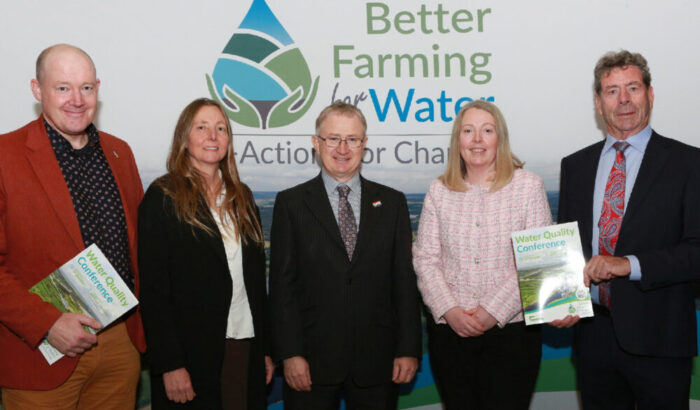
A major conference on Water Quality, organised by Teagasc, is taking place today, Wednesday, 29 October in the Heritage Hotel, Killenard, County Laois. Pictured at the conference are Professor Richard McDowell, Principal Scientist at the New Zealand Institute for Bioeconomy Science Limited; Dr Jenny Deakin, Programme Manager with the EPA; Professor Frank O’Mara, Teagasc Director; Marie Archbold, Senior Adviser, Water Advisory Unit, Department of Housing, Local Government and Heritage (DHLGH); and Liam Herlihy, Teagasc Chairman.
Opening the Conference, Professor Frank O’Mara, Teagasc Director said: “We all want plentiful food which is safe, nutritious, high quality, and affordable while returning a decent living to farmers. Abundant, clean water is a cornerstone of our society, our economy and the rural landscapes that sustain food production. Marrying these objectives is a key focus of our work in Teagasc.”
Professor O’Mara continued: “It is clear that water quality must improve. Farmers have already taken on board a lot of measures and implemented a lot of actions to improve water quality. Teagasc has a role to support them in taking further actions, in co-ordination with all other interested parties. In 2024, we launched the ‘Better Farming for Water: 8-Actions for Change’ campaign. The objective of the campaign is to support all farmers to reduce the loads of nitrogen, phosphate, sediment and pesticides entering our river network.”
The first session of the conference was on ‘Water quality policy and regulatory challenges for Agriculture in Ireland’ and included speakers from government departments and the EPA.
Dr Jenny Deakin, Programme Manager with the EPA pointed out that “Overall, water quality in Ireland is continuing to decline, despite improvements in some areas. All sectors have a role to play. Excess nitrogen and phosphorus losses from agriculture remain a key contributing factor. While there are many actions being undertaken across the sector to improve water quality, the scale and pace of implementation needs to be increased. The EPA has updated our tools and maps to help target the right measures in the place. The evidence shows that in the Priority Areas for Action, where actions are being targeted, there are greater levels of improvement in phosphorus concentrations than elsewhere. This highlights the progress that can be made when actions are targeted.”
Catchment science approach to water quality
‘Catchment science approach to improving water quality in an agricultural setting’ is the theme of the second session of the conference, with a presentation on the New Zealand experience and from the Agricultural Catchments Programme here in Ireland.
Professor Richard McDowell, Principal Scientist at the New Zealand Institute for Bioeconomy Science Limited, shared insights on the New Zealand approach to improve water quality in an agricultural catchment landscape. Speaking at the conference, Professor McDowell said; “Empirical evidence demonstrates that on-farm mitigation actions can improve surface- and groundwater quality when properly targeted, implemented, and maintained. The level of confidence in attributing observed improvements depends on data quality and analytical rigour. The five-step framework, comprising target setting, action selection, implementation, monitoring, and attribution, provides a scientifically defensible process for linking farm actions to measurable freshwater improvements.”
Dr Per-Erik Mellander from the Teagasc Agricultural Catchments Programme outlined some of the findings to the conference: “The Agricultural Catchments Programme (ACP) plays an important role for the national strategy to improve water quality. It delivers a comprehensive understanding of the processes and controlling factors that determine nutrients loss to water under the influence of changing drivers. There are critical source areas, critical mobilisation areas, critical delivery pathways, and critical delivery times for nutrients. Detailed insights need to be scaled up to larger areas and tested across scenarios to generate practical, evidence-based guidance for mitigation strategies.”
The final session of the conference entitled ‘Supporting farmers to improve water quality through research and advisory’ heard about knowledge transfer initiatives, the latest from the ASSAP programme and updates on research.
Noel Meehan said: “The ‘Better Farming for Water’ campaign represents a comprehensive, multi-year, multi-actor commitment to support farmers in achieving national water quality targets. By focusing on the 8-Actions for Change, grounded in improved nutrient, farmyard, and land management, the campaign provides practical solutions for reducing nutrient, sediment, and pesticide loss. Crucially, the campaign’s structured Priority Catchment Selection Process ensures that resources, especially Knowledge Transfer efforts, are targeted efficiently to “At Risk” waterbodies where agricultural intervention is most critical and where the specific pollutant issue can be identified through the FLAG map proxy. The expected impacts include enhancing farmer knowledge, reducing pollutant loss, and increasing the proportion of agricultural water bodies achieving high or good ecological status.”
Deirdre Glynn, ASSAP advisor in the Teagasc Kilkenny/Waterford advisory region said: “The ASSAP programme and the Farming for Water EIP represent a transformative approach to improving water quality in agricultural landscapes. By working collaboratively with farmers and stakeholders, these initiatives demonstrate that sustainable farming and environmental protection can coexist. Their success highlights the importance of cooperation, innovation, and shared commitment to address complex environmental challenges.”