
What does the future of breeding look like for the Irish dairy industry?
What does the future of breeding look like for the Irish dairy industry? That was the question that connected over 100 stakeholders this week for the Dairy Breeding Summit at Teagasc Moorepark, hosted by VistaMilk Research Ireland Centre.
The summit united global breeding organisations, researchers and Irish industry stakeholders to discuss one important question: how do we continue building a successful dairy breeding programme that is economically, environmentally and socially sustainable for the future?
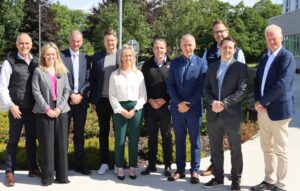
Pictured L to R: Andrew Cromie, Vice President General Manager Europe, ST Genetics; Sinead McParland, Teagasc; Sean Coughlan, CEO, Irish Cattle Breeding Federation; Lars Nielsen, Chief Breeding Officer, Viking Genetics; Margaret Kelleher, Genetics Operations Manager, Irish Cattle Breeding Federation; Stephen Butler, Teagasc; Donagh Berry, Director, VistaMilk; Hendrik Albada, Global Sire Acquisition Manager, Genus ABS; Mark Daly, Research Ireland; Håvard Melbo Tajet, Chief Technology and Innovation Officer, Geno.
The programme featured speakers from some of the world’s leading breeding and genetics organisations, including Håvard Melbo Tajet of Norwegian breeding organisation Geno, Andrew Cromie from global genetics company ST Genetics, Hendrik Albada of Genus ABS, and Lars Nielsen from Scandinavian breeding cooperative Viking Genetics. Irish perspectives also featured prominently through contributions from Seán Coughlan of the Irish Cattle Breeding Federation alongside Teagasc’s reproductive technology expert Dr. Stephen Butler.
Professor Donagh Berry, Director of VistaMilk, said the summit was designed to start a collaborative conversation about the future direction of dairy breeding and to create space for industry, researchers and international breeding organisations to share perspectives on the opportunities and challenges ahead for the sector.
“Having been involved in the development of many aspects of the Irish breeding programme over the past 25 years, I have seen first-hand the value of collaboration and knowledge exchange across the international breeding sector. One of the sector’s greatest strengths has been its willingness to rapidly adopt innovation once new technologies became practical and deliverable at farm level. We are now entering another major period of transformation, driven by advances in reproductive technologies, data analytics, genomics, and evolving societal expectations. By setting out a blueprint. I want to ensure the industry continues to thrive for the next 25 years,” he said.
Professor Berry continued; “By bringing together international breeding organisations and commercial experts, we can learn innovations already being implemented globally, identify emerging opportunities, and explore how Ireland can develop a future-ready breeding programme that delivers long-term environmental, economic and social sustainability.”
Dr Margaret Kelleher of the Irish Cattle Breeding Federation said the summit represented an important opportunity for the Irish industry to engage directly with global leaders in dairy breeding innovation.
“The technologies and breeding strategies discussed at this summit are already shaping dairy industries internationally. Bringing together these organisations and experts gave Ireland an opportunity to learn from real-world commercial experience and to consider how we can continue evolving our national breeding programme to meet future challenges and opportunities,” she said.
Dr Kelleher said; “The Irish dairy industry has made significant progress through genetic improvement over recent decades, and continued collaboration between industry, researchers and international partners will be essential to maintain that momentum into the future.”
The event concluded with a panel discussion and interactive forum focused on future opportunities and challenges for Irish dairy breeding.