ENcouraging FArmers towards sustainable farming SYstemS
 ENFASYS (2022-2026) examines how policy interventions and business strategies can support the transition towards more sustainable farming systems.
Which farmers are open to organics? What might help them make the transition?
Rather than viewing farmers’ decisions in isolation, ENFASYS examined the wider food system and the behavioural and structural ‘lock-ins’ that can prevent change. The project screened 160 interventions and undertook detailed case studies to identify potential levers for transition towards Sustainable Farming Systems.
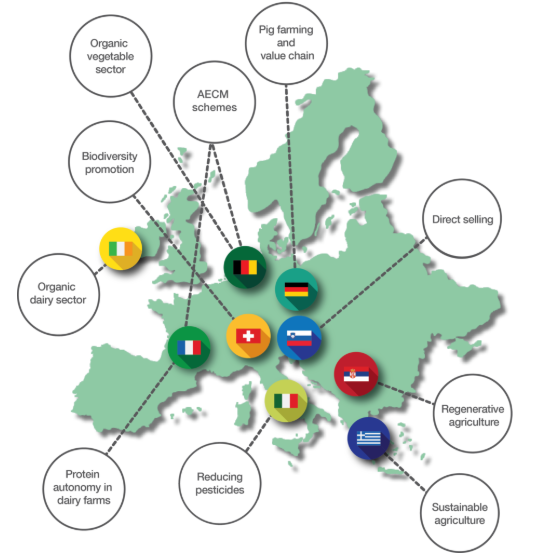
ENFASYS has set up and investigated 10 participatory processes across Europe to understand food system dynamics and decision-making, uncovering key lock-ins and potential levers to move towards Sustainable Farming Systems.
Collaboration
In Ireland, ENFASYS and GROFarmS collaborated to investigate a particularly important question:
What are the farm, farmer, economic and environmental characteristics that distinguish farmers who would consider converting to organic farming from those who would not?
A supplementary questionnaire was incorporated into the 2024 Teagasc National Farm Survey, gathering responses from approximately 700 farmers. The survey was informed by the Self-regulated Stage Model of Behavioural Change and examined farmers’ stage of organic adoption alongside farm characteristics, attitudes, perceived barriers and preferences for behavioural interventions.
Analysis focused on 623 farmers who had not yet progressed to active conversion. Of these, 98 farmers indicated that they would consider joining the Organic Farming Scheme but were unsure what was involved.
Initial analysis suggests that openness to conversion is associated with a combination of farm structure, farmer attitudes and perceived feasibility. Cattle-finishing and sheep farmers were more likely than dairy farmers to be open to organic conversion. Farmers who felt that organic farming was personally the right thing to do and who believed they had sufficient time, labour and financial resources were also more likely to consider conversion.
Among potential interventions, farmers more open to conversion placed greater value on:
- increased Organic Farming Scheme payments
- greater milling capacity and improved availability of competitively priced organic concentrate feed and
- improved access to local markets for organic produce.
The results underline an important message for organic policy and advisory services: conversion is not driven by one factor. Financial incentives matter, but farmers’ perceptions of risk, practical feasibility, markets and their own ability to operate an organic system also influence whether they move from awareness to action.
This research is helping to identify where policy and knowledge-transfer interventions can be targeted most effectively to farmers who may be open to conversion.
More Information
Project Partners
ILVO – Belgium
Humboldt University – Germany
University of Bologna – Italy
CIHEAM Montpellier – France
Teagasc – Ireland
Funding