OneWelPig
 Using a ‘One Welfare’ framework to develop alternative high welfare pig production systems
The OneWelPig project is focused on creating a more sustainable way to raise pigs. This work is guided by the ‘One Welfare’ idea, which is simple: the health and happiness of animals, people, and the environment are completely linked.
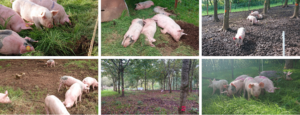
We are comparing different pig farming methods, especially those where pigs are kept outdoors, to see how well they meet modern expectations for welfare across all three areas. Detailed information has been gathered from these farms, everything from pig behaviour and health to farmer income and the quality of the soil and local biodiversity. This data will help us objectively measure the environmental and social impact of these systems.
A major focus is testing agroforestry, raising pigs among trees, for the first time in Ireland and using computer models to understand how switching to this system affects farm output. Our ultimate goal is to determine the practical challenges of raising pigs this way on a large scale, and then create a successful blueprint for the Irish pig industry to move toward systems that give pigs regular access to the outdoors. This shift will develop a viable alternative to intensive farming, creating a more resilient food supply chain, helping the local environment, and allowing farmers to earn a better living by offering premium, high-welfare pork.
Objectives
Our vision is the development of pig production systems that provide an environment that satisfies the animals’ physical and behavioural needs, whilst also considering farm workers and the environment.
We plan to achieve this through several key goals:
- Blueprint for outdoor pig production
- Cross sectional One Welfare characterisation of outdoor pig production
- Modifying the Pig Biocheck Tool for outdoor pig production
- Social barriers to alternative pig production practices and social impact of current systems
- Longitudinal One Welfare assessment of agroforestry and alternative systems for pig production
- Modelling land use change of alternative pig production systems
- Addressing practical constraints to improving welfare standards in conventional indoor pig production
- Social and environmental life cycle assessment of alternative pig production
OneWelPig will also help farmers identify viable means of income diversification, with potential to capitalise on premium prices for high welfare pig-meat and thus help to capitalise on the potential good animal welfare has to build resilience into food production chains. Ultimately, our research will provide the knowledge for individual producers to improve pig welfare, and potentially a portion of the industry to transition to higher welfare systems.
Actions
- Promoting real world change: Implementation of the Knowledge Transfer Plan
- Cross sectional ‘One Welfare’ characterisation of outdoor pig production systems in Ireland
- Modification of the Pig Biocheck Tool for systems offering outdoor access
- Social barriers to alternative pig production practices/systems and social impact of current systems
- Longitudinal One Welfare assessment of agroforestry for pig production
- A longitudinal One Welfare assessment of alternative systems of pig production in Ireland
- Modelling Land-use change through alternative pig production systems in the Irish Agricultural Sector
- Addressing practical constraints to improving welfare standards in conventional indoor pig production in Ireland
- Social and environmental life cycle assessment of alternative pig production systems in the island of Ireland
Outputs
Newsletters
- OneWelPig November 2025 Newsletter
- OneWelPig June 2025 Newsletter
- OneWelPig March 2025 Newsletter
- OneWelPig December 2024 Newsletter
- OneWelPig October 2024 Newsletter
Publications
Towards One Welfare Roadmap for Higher Welfare Irish Pig Farming 2026-2046
- Menant, Ophelie, Laura Boyle, Siobhan Mullan, Fidelma Butler, and Keelin O’Driscoll. “Pigs and pasture: Drivers and characteristics of outdoor systems on the island of Ireland.” PloS one 21, no. 2 (2026): e0341440.
- Buijs, S., McFarland. C., Olave, R. & Muns, R. Health and performance of fattening pigs reared in grassland and agroforestry systems in a temperate maritime climate. Animal (2025).
- Carroll, G., Wangui, J. & Kyriazakis, I. Lack of Social and Physical Opportunity are key barriers to adopting alternative pig farming systems Environmental Development (2025).
- Wangui, J.C., Carroll, G.A. & Kyriazakis, I. Rethinking social life cycle assessment for agricultural systems: insights using the pig value chain in the Republic of Ireland as a case study. Int J Life Cycle Assess (2025).
- Senanayake, N.S., Boyle, L., O’Driscoll, K. et al. Effects of season, age and parasite management practices on gastro – intestinal parasites in pigs kept outdoors in Ireland. Ir Vet J 78, 12 (2025).
Consumer Information
The OneWelPig project is focused on creating a better, more sustainable way to raise pigs. This work is guided by the ‘One Welfare’ idea, which is simple: the health and happiness of animals, people, and the environment are linked. Watch the video below to find out more about outdoor pigs on the island of Ireland.
The OneWelPig Map highlights the number of outdoor pig farms producing high-welfare pig meat on the island of Ireland.
LinkedIn & Facebook: #OneWelPig
Project Partners
- Prof Ilias Kyriazakis, Queen’s University Belfast
- Dr. Grace Carroll, Queen’s University Belfast
- Prof Siobhan Mullan, University College Dublin
- Prof Alison Hanlon, University College Dublin
- Dr Brian Leonard, University College Dublin
- Dr. Lucie Adenaeuer, University of Bonn
- Dr. Rodrigo Olave, Agri-Food and Biosciences Institute
- Dr. Stephanie Buijs, Agri-Food and Biosciences Institute
- Dr Fidelma Butler, University College Cork
- James Wangui, Queen’s University Belfast
- Melissa Cupido, Teagasc
- Ophelie Menant, Teagasc
- Mika Shin, University College Dublin
- Nipuna Senanayake, Teagasc
- Oscar Amponsah, Teagasc
- Heather Maggs, University College Dublin
- Nicola Mitchell, Agri-Food and Biosciences Institute
- Richard Mott, Agri-Food and Biosciences Institute
Funding
This project is funded for 4 years by the Irish Department of Agriculture, Food and the Marine’s Competitive Research Funding Programme (2021R600).