SAFER
Strengthening Agricultural landscape multiFunctionality through expansion of agroecological farming in EuRope
SAFER is a European Agroecology Partnership project investigating how agroecological practices can be expanded while balancing agricultural production, farmer livelihoods, biodiversity and wider societal benefits.
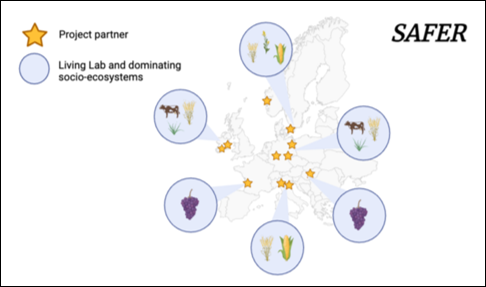
A central principle of SAFER is that there is no single agroecological practice suitable for every farming system or region. Solutions therefore need to be adapted to local environmental and socioeconomic conditions and developed with farmers and other stakeholders rather than transferred as universal prescriptions. SAFER brings together six European Living Labs in which researchers and stakeholders co-design locally relevant agroecological practices and assess their consequences at field, farm and landscape scales.

Source: Sylvie Richart Cervera
Actions
The Irish Living Lab
The Irish team, involving University College Dublin and Teagasc, is studying tillage landscapes in the Kildare region. The research examines how different levels of agroecological implementation influence biodiversity, ecosystem services, agricultural production and farm performance.
A particular focus is on whether reduced cultivation and other agroecological practices can enhance biodiversity and ecosystem services that support agricultural production. Ecological measurements include:
- soil health, including earthworm abundance and water infiltration
- natural pest control, including spiders and ground beetles and
- pollinator diversity and abundance.
Sampling across landscapes with different levels of agroecological implementation allows the research team to move beyond individual fields and investigate what happens as agroecological practices become more widely adopted.
Connecting environmental and economic performance
A distinctive feature of SAFER is the integration of ecological, economic and social analysis to understand the implications of agroecological transition for both the environment and farm viability. As part of the Irish research, organic and conventional tillage farms will be studied alongside each other to examine agroecological management, (including standard and reduced cultivation approaches) affects environmental and economic performance. Where possible, side-by-side fields or neighbouring farms will allow differences to be examined under broadly comparable local conditions.
The organic component will be developed in collaboration with the Organic Tillage & Vegetables EIP, drawing on existing organic farms and field-scale initiatives to strengthen the practical relevance of the research. Combining ecological measurements with farm-level economic data allows SAFER to examine the costs, benefits and trade-offs associated with different levels of agroecological transition. This study will be complemented with farmer experiences, attitudes, barriers to implementation and the practical factors influencing the adoption of agroecological practices. Together, this research will help answer a central question for SAFER: can practices that enhance biodiversity and ecosystem services also maintain productive and economically viable farming systems?
The inclusion of organic systems provides an important additional perspective, allowing the project to examine what can be learnt from farms that have already made a more extensive transition towards agroecological production and how environmental and economic performance compares with conventional systems at different levels of agroecological implementation.
More Information
Learn more about SAFER on the Agroecology Partnership website
Project Partners
INRAE, France
University of Verona, Italy
University College Dublin, Ireland
Brandenburg University of Technology, Germany
HUN-REN Centre for Ecological Research, Hungary
University of Bergen, Norway
ISOE, Germany
University of Padova, Italy
Teagasc, Ireland
ZALF, Germany
Lund University, Sweden
Funding