
27 January 2025
More than cost to consider when selecting a pre-calving mineral
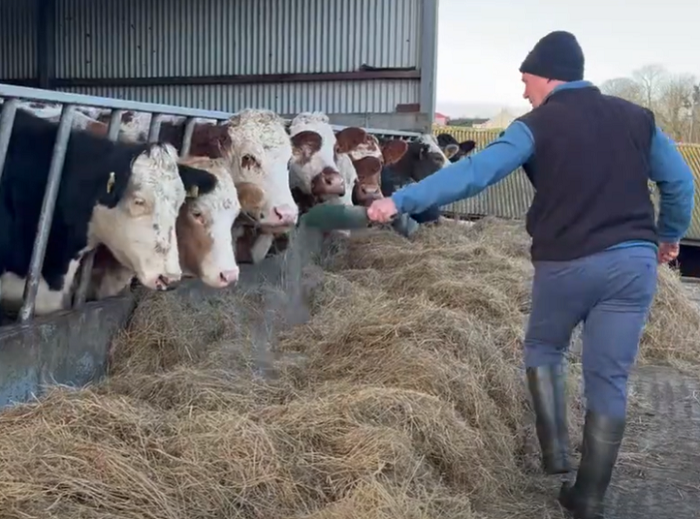
Ensuring suckler cows are adequately supplied with pre-calving minerals is an essential practice in ensuring the birth of vigorous and healthy calves.
Sharing key advice on pre-calving mineral feeding strategies as part of the Future Beef webinar titled: ‘A Farmer’s Guide to Pre-Calving’ on January 21, Future Beef Advisor, Aisling Molloy expanded upon the key considerations farmers have to bear in mind when supplementing.
Firstly, she noted, that silage dusting is the preferred method of ensuring cows receive an adequate supply of pre-calving minerals. This stems from the quantity of macro minerals – Magnesium, Calcium, Phosphorus and Sodium – required, totalling more than 40g per day and the inability of boluses to deliver such a volume. Where silage dusting is the route taken, she advised farmers to ensure that all cows have access to silage at the one time. In circumstances where feed space is limiting, dusting should be carried out twice daily to ensure all cows can consume the required minerals through silage.
Care is also required when selecting a pre-calving mineral, Aisling Molloy explained, and the product should align with the recommended allocations of macro and micro minerals, and vitamins as outlined in table 1 below.
Discussions with your Teagasc advisor or mineral supplier may be required in order to identify the most suitable pre-calving mineral for your herd’s needs.
Table 1: Selecting a pre-calving mineral – what you want to see on the label
| Macro minerals | % |
|---|---|
| Magnesium | 17-20 |
| Calcium | <2 |
| Phosphorus | 4.5 |
| Sodium | 15 |
| Micro minerals | mg per kg |
| Copper | 2,000-4,000 |
| Cobalt | 50-100 |
| Iodine | 200-600 |
| Manganese | 3,350-4,150 |
| Selenium | 40-60 |
| Zinc | 3,350-6,000 |
| Vitamins | iu |
| Vitamin A | >600,000 |
| Vitamin D3 | >120,000 |
| Vitamin E | >5,000 |
Farmers were also encouraged to feed pre-calving minerals as recommended by the manufacturer, this generally entails a feeding rate of 100-120g/day offered over the six week period pre calving.
“At a 120g/head/day feeding rate, a 25kg bag of minerals should last one week per 30 cows,” she added.
Farmers often debate the cost of feeding a pre-calving mineral, but Aisling Molloy stressed that ensuring the product meets the herd’s needs is more important than the cost.
“Check the mineral specification to make sure you are feeding what the cow actually needs.”
To reinforce this point, she provided an example which looked at the cost of feeding a cow a pre-calving mineral costing either €38 or €30 per 25kg. Over the six week required feeding period, the cost difference per cow is merely €1.61, which she explained is “really nothing in the grand scheme of things”.